

The third week of February was packed for hotels in New Delhi, with almost all standard rooms sold out. While the wedding season and the T20 Cricket World Cup boosted occupancy, the AI Impact Summit 2026, held from February 19-20, led to a sharp rise in high-profile foreign guests. As a result, luxury and presidential suites, typically priced around Rs 2 lakh per night, touched rates as high as Rs 30 lakh.
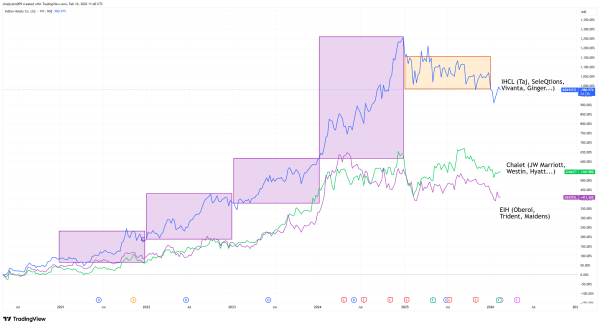
Despite this strong demand environment, India’s top hotel chains reported robust Q3 FY26 earnings even as their stock prices struggled. Shares of Tata-owned Indian Hotels Company (IHCL), Oberoi Group’s EIH, and Raheja Group’s Chalet Hotels delivered flat or negative returns in 2025, following a four-year rally that had lifted prices by 240-475%.

(Note: ITC Hotels is not included in the chart as it demerged from its parent and started trading separately in January 2025.)
 Source: Trading View
The wedding-season revenue surge, conference-led demand, strong earnings, and bullish analyst commentary failed to lift hotel stock prices. What, then, is keeping investors cautious: seasonal weakness, high valuations, market pessimism, or concerns about long-term downside? And is there room for hotel stocks to grow in 2026?
The changing ROCE of the hotel industry
Before we look at 2026, it is essential to understand what drove the sharp re-rating of hotel stocks post-pandemic. Like healthcare and real estate, the hotel industry is mature and capital-intensive, with long gestation periods before profitability. Until the last decade, expansion meant building properties from scratch — an asset-heavy approach that burdened balance sheets with debt and kept returns on capital employed (ROCE) in single digits. Moreover, luxury hotels were largely concentrated in big cities or key leisure destinations.
This trend is now changing with the growing adoption of managed assets and franchisee models.
Managed assets model
Large hotel chains like IHCL and ITC Hotels are expanding their footprint in Tier 2 and 3 cities, boutique and heritage properties, wellness resorts, etc., by managing hotels owned by third parties. This has enabled hotel companies to expand without having to put their money to build the asset, allowing them to launch multiple brands catering to different audiences and bring varied experiences under their umbrella.
Story continues below this ad
For instance, ITC Hotels manages Castle Kanota under its luxury and heritage hospitality brand, Storii Collection. ITC has multiple hotel brands under its umbrella: Mementos, Fortune, Welcome Hotel, and Storii. IHCL too has multiple brands across luxury (Taj), upper scale and upscale (SeleQtions, Vivanta, Gateway), and midscale (Ginger).
IHCL’s Business Model Transformation From 2017-2024
Source: Trading View
Franchisee model
Real estate companies such as Chalet Hotels and asset management platforms like SAMHI follow a franchisee model to build a portfolio of hotel brands like Marriott, Hyatt, Sheraton, and Holiday Inn. These brands help drive a quick turnaround. Both models improve ROCE, but balance sheets appear different.
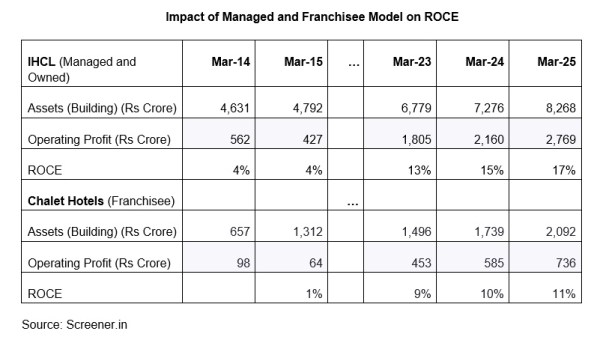
For instance, 68% of IHCL’s portfolio has shifted to managed or leased properties. In the last 10 years, its fixed assets grew 78%, operating profit increased fivefold, lifting ROCE from 4% to 17%. Chalet, in contrast, saw its building capex triple, while operating profit grew 7.5x.
Story continues below this ad
 Source: Screener.in
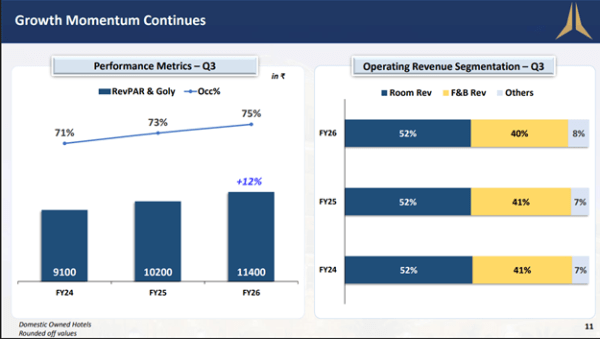
Some full-service hotels are diversifying their revenue stream beyond room occupancy. Underutilised lobby areas, rooftops, and ground-floor spaces are being converted into restaurants and cafés. Banquets and culinary events have made the Food & Beverage (F&B) segment a significant revenue driver. In Q3 FY26, F&B contributed about 40% of ITC Hotels’ revenue, 35% for IHCL, and 30% for Chalet. ITC now owns several signature cuisine brands like Bukhara and Avartana.
ITC Hotel’s Revenue Breakup
 Source: ITC Hotel’s Q3 FY26 Press Release
The hotel industry is attracting institutional capital
Improving ROCE is attracting investment from high-net-worth individuals, family offices, real estate developers, and listed companies. According to JLL, hotel transactions across operational, non-operational, and under-construction assets surged 17% to Rs 3,587 crore in 2025.
As hotel groups shift focus to asset-light models, they are now acquiring brands. Among the most noteworthy deals were IHCL’s acquisition of 51% stake in:
Story continues below this ad
As hotel groups shift focus to asset-light models, they are now acquiring brands. IHCL acquired a 51% stake in:
- ANK Hotels and Pride Hospitality (which manages the Clarks Hotels & Resorts brand),
- Sparsh Infratech (which manages luxury wellness brand ‘Atmantan’) and
- Boutique luxury hotel brand Brij Hospitality.
Real estate capital is also entering hospitality. Oberoi Realty’s joint venture company, I-Ven Realty, has signed an agreement with Switzerland’s Aman Group for a hotel and luxury residential project in Mumbai’s Worli.
Meanwhile, listed companies are also doing some greenfield expansion, such as IHCL’s 450-key Taj Bandstand hotel in Mumbai.
Macroeconomic factors impact short-term growth
Behind the changing landscape are MICE (Meetings, Incentives, Conferences, and Exhibitions), destination weddings, religious tourism, wellness, medical, sports and music events, experience-led short getaways, and more.
Story continues below this ad
Rising per-capita income and India’s hosting of international events such as the G20 Summit and the ICC Men’s Cricket World Cup are driving hotel demand. Demand diversification is creating new revenue streams throughout the year, thereby reducing seasonal fluctuations.
However, 2025 proved challenging.
Horwath HTL’s India Hotel Market Review 2025, published February 2026, highlighted several factors.
- The Maha Kumbh diverted leisure tourism to Prayagraj
- Operation Sindoor led to the disruption of group events in Punjab and Rajasthan
- West Asia crises affected Middle Eastern travel to Kerala
- IndiGo’s flight disruption due to the implementation of Flight Duty Time Limitation (FDTL) norms and harsh weather cancelled thousands of flights in December 2025
Despite this, the long-term growth remains intact as new airports, roads, and infrastructure improve connectivity. The growing Global Capacity Centres (GCCs) and data centre expansion are attracting foreign delegates to India. Hotels are expanding their capacity to tap this demand growth.
Infrastructure upgrades and increasing urban connectivity have made Motilal Oswal bullish on select hotel stocks, including IHCL and Chalet, which have pricing strength and high exposure in the Mumbai Metropolitan Region (MMR) and Navi Mumbai.
Strategies to stay above the industry average
Story continues below this ad
Hotel companies are deploying different revenue models to tap the growing demand.
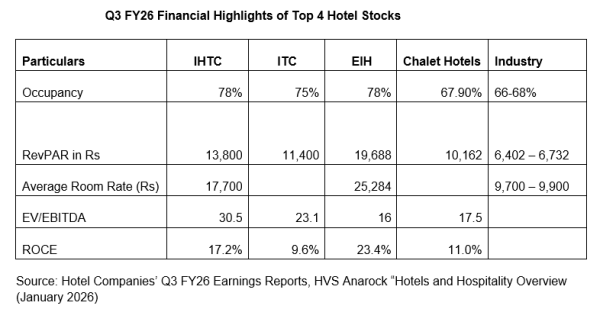
ITC Hotels and IHCL are exploring all segments, from luxury to upper and medium scale in Tier 1, 2, and 3 cities to leisure, experiences, heritage, and branded residences, and F&B. Hence, their revenue per available room (RevPAR) and ROCE are lower than EIH, which is focused on luxury and upper upscale segments. EIH is expanding conservatively, with revenue growth of 9% year-over-year to Rs 910 crore and an EBITDA margin of 45%.
Q3 FY26 Financial Highlights of Top 4 Hotel Stocks
 Source: Hotel Companies’ Q3 FY26 Earnings Reports, HVS Anarock “Hotels and Hospitality Overview (January 2026)
Chalet is focused on business travel, with 50% of demand from the MMR (Mumbai Metropolitan Region). This skews its performance to MICE. Motilal Oswal noted that such properties benefit from repeat bookings and longer stays, bringing earnings stability.
Investing in the market leader
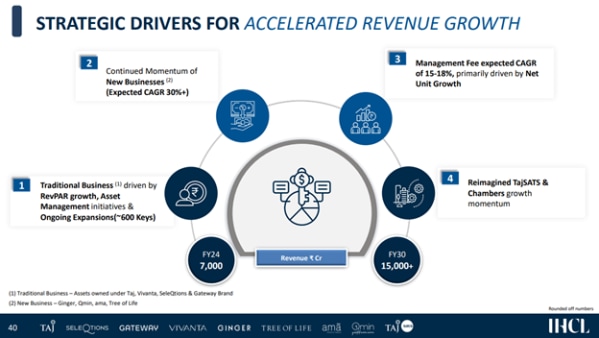
IHCL has completed the first phase of its transformation to an asset-light model and realised 17% ROCE, Rs 8,300 crore revenue, and a net cash position in FY25. It aims to double its revenue to more than Rs 15,000 crore by 2030 and grow its ROCE by over 20% while remaining net cash positive.
Story continues below this ad
To achieve this, it will use accelerated growth from new businesses like medium-range hotels, bungalows, boutique leisure, and more. Most of the new business will be managed or leased assets, increasing its revenue from management fees. Meanwhile, it will leverage traditional business growth levers of investing in renovated and new properties to boost RevPAR. It will also look to grow through acquisitions.
IHCL’s Revenue Growth Drivers
 Source: IHCL Capital Market Day Presentation, November 2024
Analysts bullish on top two hotel stocks
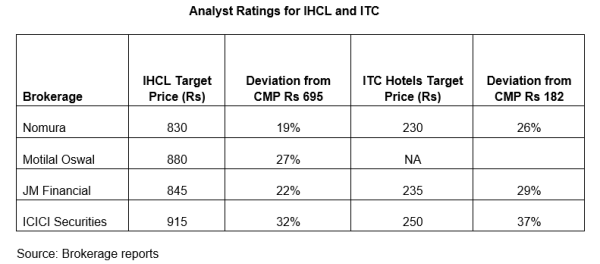
Nomura has a Buy rating on IHCL, with a price target of Rs 830, a 19% upside from the current market price of Rs 695. It believes the company is well-positioned to achieve or exceed its 2030 targets. It expects the latest acquisition of Brij Hospitality could generate a cash surplus of Rs 1,000 crore annually, after paying dividends and lease, which it can use for further acquisitions.
 Source: Brokerage reports
Nomura also initiated coverage on ITC Hotels in January 2026 and has a Buy Rating, while JM Financial changed its rating from Sell to Buy in February 2026. Both are bullish on high single-digit average daily rates and improving returns from newly opened ITC Ratnadipa and Sapphire Residences in Sri Lanka.
Story continues below this ad
The flat growth in 2025 appears driven by short-term external factors. However, rising demand for hotel rooms and constraints in new supply will continue to drive pricing strength in the medium term. There could be some hiccups in future growth prospects if average daily rate growth weakens. It would be interesting to see how the next phase of managed keys growth drives ROCE between 2025 and 2030.
Note: We have relied on data from http://www.Screener.in throughout this article. Only in cases where the data was not available, have we used an alternate, but widely used and accepted source of information.
Puja Tayal is a financial writer with over 17 years of experience in the field of fundamental research.
Disclosure: The writer and his dependents do not hold the stocks discussed in this article.
The website managers, its employee(s), and contributors/writers/authors of articles have or may have an outstanding buy or sell position or holding in the securities, options on securities or other related investments of issuers and/or companies discussed therein. The content of the articles and the interpretation of data are solely the personal views of the contributors/ writers/authors. Investors must make their own investment decisions based on their specific objectives, resources and only after consulting such independent advisors as may be necessary.
