

6 min readNew DelhiUpdated: Feb 27, 2026 10:39 PM IST
Calling out the dangers of dissolving marriages on the basis of suspicion and sentiment, the Andhra Pradesh High Court has set aside a 2010 divorce decree, with a warning that acting on accusations rooted in “possessiveness, jealousy and inferiority complexes” without independent proof could shake the very foundation of the Indian family system and lead to “unpredictable consequences”.
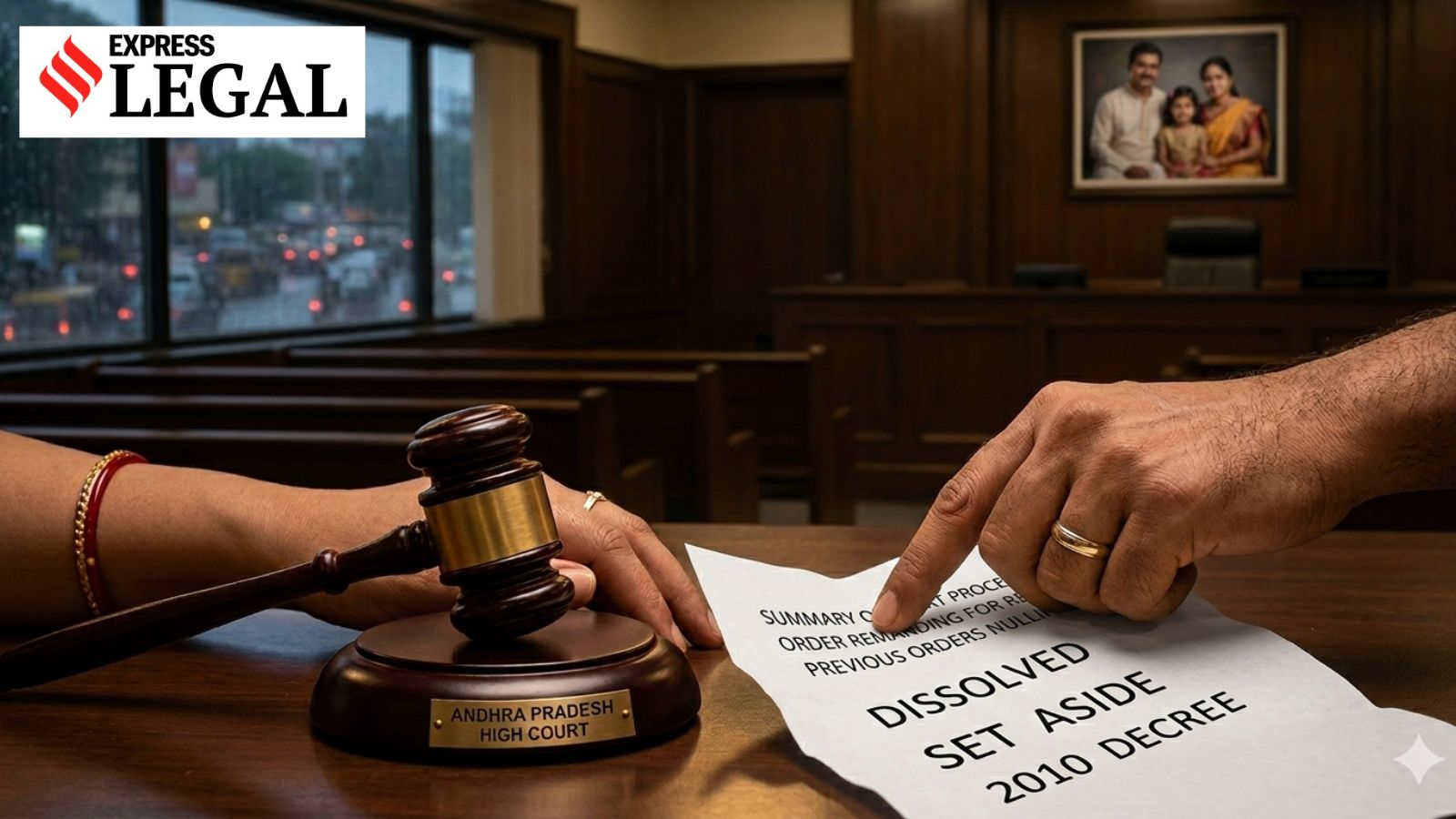
 Proper, cogent, clinching and legally acceptable evidence must be there to appreciate and accept the allegations like adultery, said the Andhra Pradesh High Court. (Image enhanced using AI)
A bench of Justices Battu Devanand and A Hari Haranadha Sarma was hearing an appeal filed by the wife and overturning the divorce granted by a Visakhapatnam family court in April 2010 and said that acting on such claims without independent evidence risks shaking the “fabric of Indian society”.

“The possessiveness, jealousy, inferiority complexes, and many other emotional issues in the conjugal life, often contribute to making wild allegations against each other,” the court said on February 24.
The bench pointed out when such matters come for scrutiny before the courts, mere interested oral assertions are not sufficient, there must be supporting independent evidence, with the required corroboration.
“Otherwise, the foundation of the Indian family system will get shacked (sic), and the esteem of Indian family and fabric of Indian society may get completely collapsed leading to many unpredictable consequences,” it added.
Strong word against casual divorce orders
- The family court judge did not appreciate the merits in proper perspective, and made a casual observation that the estranged husband and wife are living separately from each other and there is irretrievable breakdown of marriage, hence divorce can be granted.
- This is not a legally sustainable conclusion, and such a loose and unfounded observation ought not to have been made.
- Every separate living of the spouses for reasons of ordinary wear and tear in matrimonial life and personal emotional issues will not automatically constitute the animus for either cruelty or desertion, sufficient to invoke the jurisdiction to grant relief of dissolution of marriage.
- The allegation of adultery is a very serious one, even if it is in a matrimonial dispute.
- The standard of proof required shall be something beyond mere probability.
- The touchstone shall be near beyond reasonable doubt, since it operates as a stigma against a person and amounts to character assassination.
- Proper, cogent, clinching and legally acceptable evidence must be there to appreciate and accept the allegations like adultery.
Divorce decree set aside
- After analysing the evidence and legal principles, the bench concluded that the husband had failed to prove cruelty, adultery or desertion.
- The family court, it held, had not properly appreciated the evidence.
- Accordingly, the decree dated April 15, 2010, dissolving the marriage was set aside, and the wife’s appeal was allowed.
- There was no order as to costs.
AP High Court Slams Family Court for “Casual” Divorce Order — Here’s What Went Wrong
Timeline: A 35-Year Marriage, One Bad Order
1990
Marriage solemnised — Gompa Chellayyamma weds Gompa Lakshmana Rao under Hindu rites; couple has one daughter
2007
Husband files petition — Alleges cruelty and adultery; cites an unplanned pregnancy as trigger for suspicion
2010
Family court grants divorce — Cites “irretrievable breakdown” without proper evidence — later condemned as a “loose and unfounded” observation
2013
Wife appeals to HC — Challenges decree; husband dies during pendency; daughter brought on record in 2025
2025
HC sets aside decree — 2010 divorce order overturned after full re-examination of evidence
High Court’s Rebuke of the Family Court
“The family court judge did not appreciate the merits in proper perspective, and made a casual observation… This is not a legally sustainable conclusion, and such a loose and unfounded observation ought not to have been made.”
What Family Courts Cannot Do
1
Grant divorce solely because spouses are living separately — separation alone does not equal desertion or cruelty
2
Assume “irretrievable breakdown” without independent corroborating evidence on record
3
Accept vague witness statements or unsubstantiated oral claims as legally admissible proof
Marriage in 1990, divorce in 2010
- The case traces its origins to March 9, 1990, when one Gompa Chellayyamma married Gompa Lakshmana Rao according to Hindu rites.
- The couple had a daughter.
- Years later, in 2007, the husband approached the family court seeking dissolution of marriage under the Hindu Marriage Act.
- He alleged cruelty and adultery.
- One of the central planks of his case was that though the couple had planned to avoid a second child, his wife was found to be five months pregnant.
- Although both opted for a miscarriage, he claimed that the incident triggered doubts about her fidelity.
- He further alleged that she neglected him during illness, frequently visited her parental home, and developed an illicit relationship with another man.
- The wife denied the allegations, calling them false and motivated.
- On April 15, 2010, the family court allowed the husband’s petition and granted divorce.
- The wife challenged the decision before the high court in 2013.
Husband dies during appeal
- The legal battle took an unusual turn when the husband died during the pendency of the appeal.
- Their daughter was brought on record in November 2025 as his legal representative.
- This raised a crucial legal question: does an appeal against a divorce decree survive after the death of one spouse?
- The high court answered in the affirmative.
- Citing settled principles, the bench explained that a decree of divorce is not just a personal order between two individuals, it determines legal status.
- It affects inheritance, maintenance rights and carries social stigma.
- A woman’s status as a “divorcee” is legally and socially distinct from that of a “widow,” the court noted.
- Because these consequences survive the death of a spouse, the right to challenge the decree also survives.
Court examines evidence afresh
- Even though the daughter, now representing her late father’s estate, stated she had no objection if the appeal was allowed, the high court chose not to dispose of the case on concession alone.
- Instead, it undertook a detailed examination of the evidence.
- The bench found that the decision to terminate the pregnancy was admittedly taken jointly by both spouses.
- The husband could not specify any concrete instance of adultery.
- There was no independent or corroborative evidence to support the allegation of illicit intimacy.
- Witnesses produced by the husband offered vague statements without legally acceptable proof.
- The court noted that during cross-examination, the husband admitted he had not even mentioned the alleged illicit relationship in earlier maintenance proceedings.
- He also failed to provide details such as dates, times or persons to whom he had disclosed his suspicions.
- The judges were categorical that allegations of adultery cannot rest on conjecture.

© IE Online Media Services Pvt Ltd
