

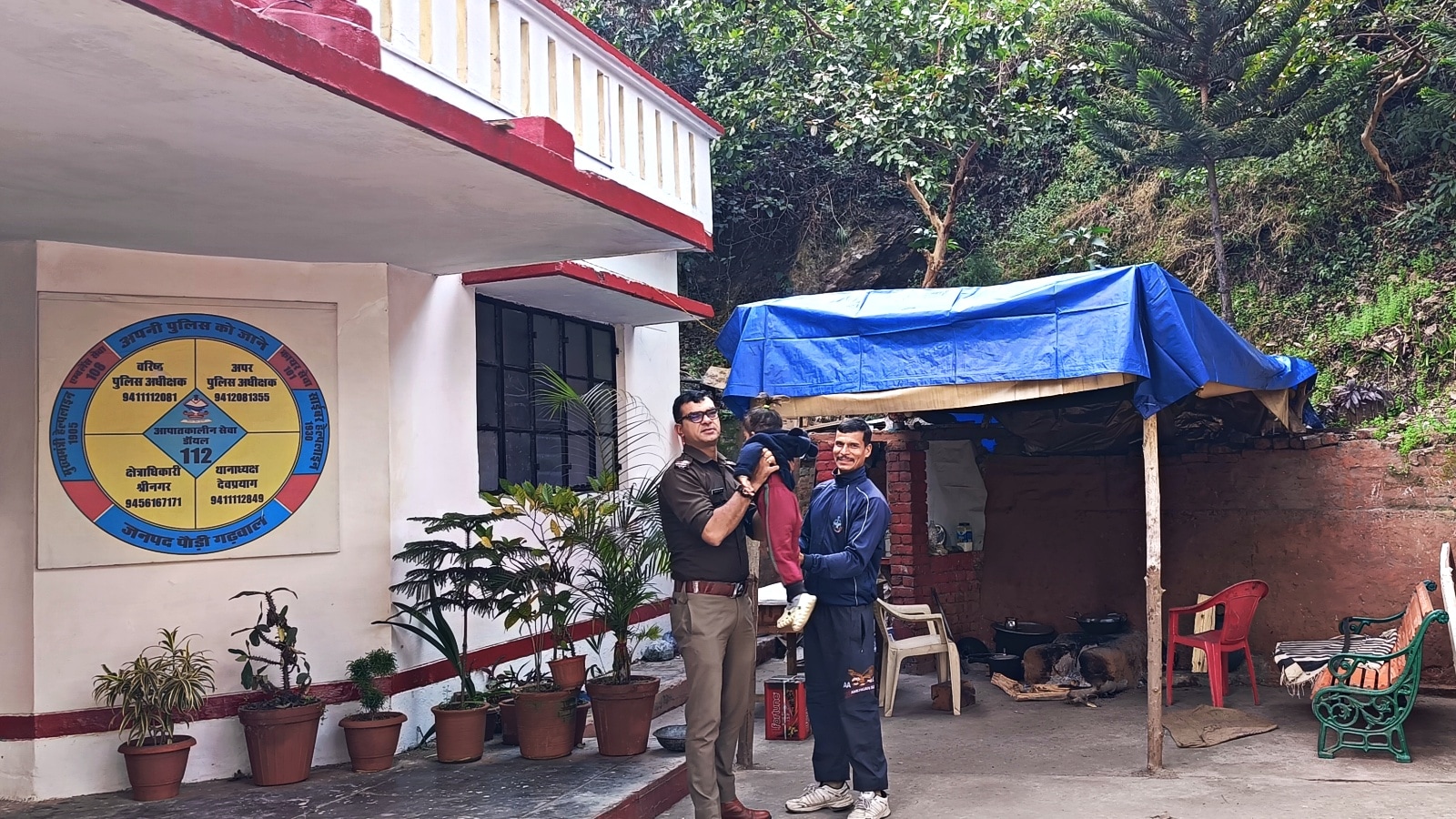
The police control room (PCR) call came at 8.30 am. A man from Haryana had survived a murder-suicide pact in an isolated part of town, but not his wife and daughter.
For the personnel of Devprayag police station in Uttarakhand’s Pauri Garhwal district, the mountain of paperwork, however, was far more challenging than solving the case.
This was nine years ago — on October 20, 2017, to be precise.
At this police station, time and crime continue to move at a glacial pace.Despite having jurisdiction over 80 hamlets and 70 revenue police villages, theDevprayagpolice registered just four cases in 2025, with old residents attributing this to the dwindling population, driven by the collapse of the local economy and a lack of employment opportunities.
Located in the corner of a hill, a few hundred metres from the confluence of the Bhagirathi and the Alaknanda, a painted blue-red signboard prevents the tall boundary wall from nearly hiding the police station.
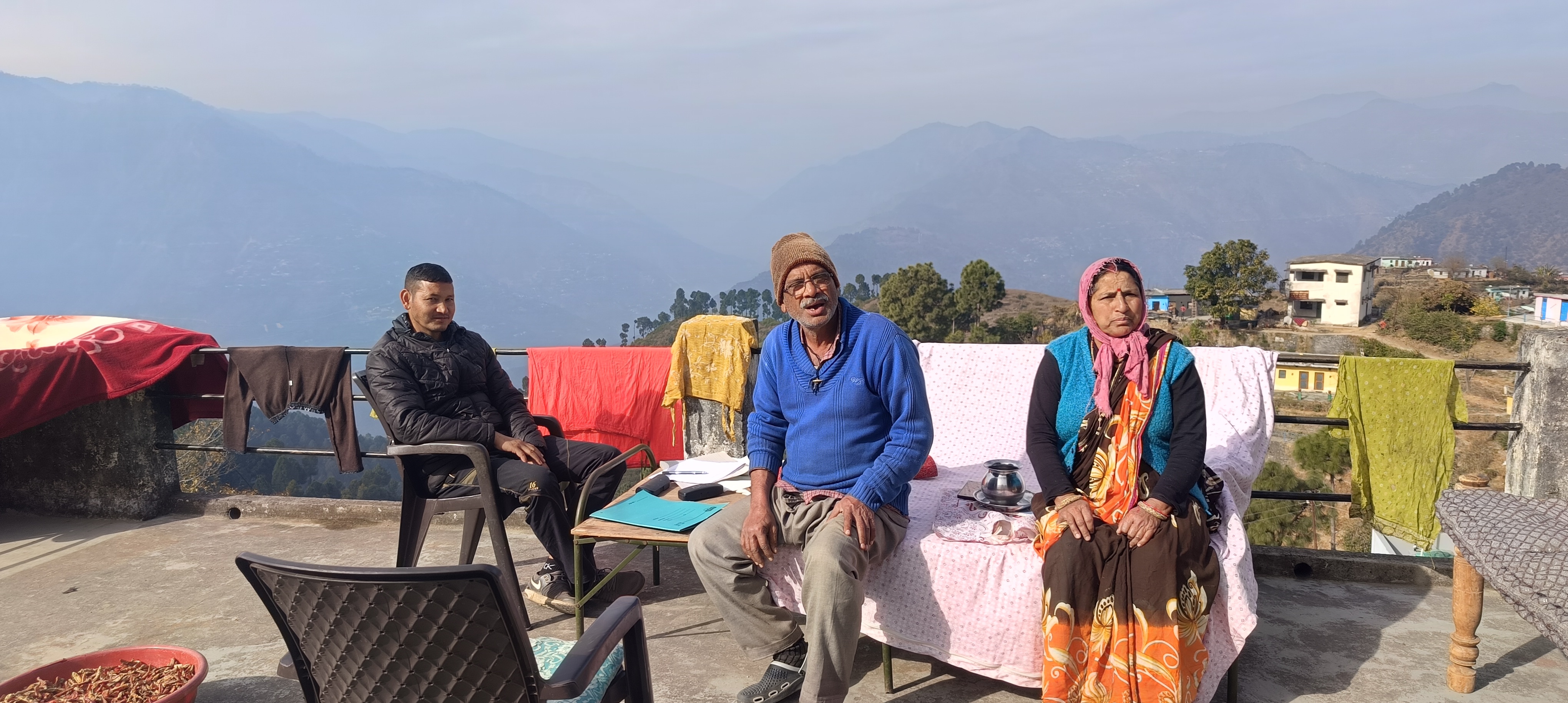 Badrish Kumar, the pradhan of Chaprauli, located 10 km away from Devprayag police station, flanked by his wife Kalpeshwari and Surender Singh, the resident of a nearby village. (Photo: Aiswarya Raj)
Sub-inspector (SI) Amarjeet Singh Rawat, the Station House Officer (SHO), arrives at Devprayag station at 9.45 am on the dot each day. A tall officer with chunky framed glasses, the frown on his face disappears as soon as Constable Ankita Chauhan’s three-year-old son toddles up to him.
Born and raised in the neighbouring Tehri district, the burly Rawat was posted at Raipur police station in Dehradun district’s Garhwal region, 108 km away, till 2022. He also did a stint at Pauri Garhwal’s Thalisain police station, over 100 km from his current posting.
Story continues below this ad
“The Raipur station registered around 450 cases in 2025, many related to heinous crimes. Devprayag is different; it’s quiet and slow,” says Rawat.
He is not off the mark.
Outside the Devprayag police station, the quiet chill of a January day is broken occasionally by the crackle of the fire lit in the front yard, by the deep sighs from the Alsatian basking in its heat and by the three policemen slurping lemon tea next to the blaze. Even the smell of fresh paint refuses to dissipate months after the two-storied building was given a pale yellow coat.
Inching closer to the bonfire, Rawat gazes at the police station across the river, which falls under the state’s Tehri Garhwal district, connected by a bridge. Tehri’s Devprayag police station is where the pilgrims go to report crimes. A small population of priests and their assistants at Badrinath, nearly 200 km away, live with their families on that side of the river when the shrine closes for winter.
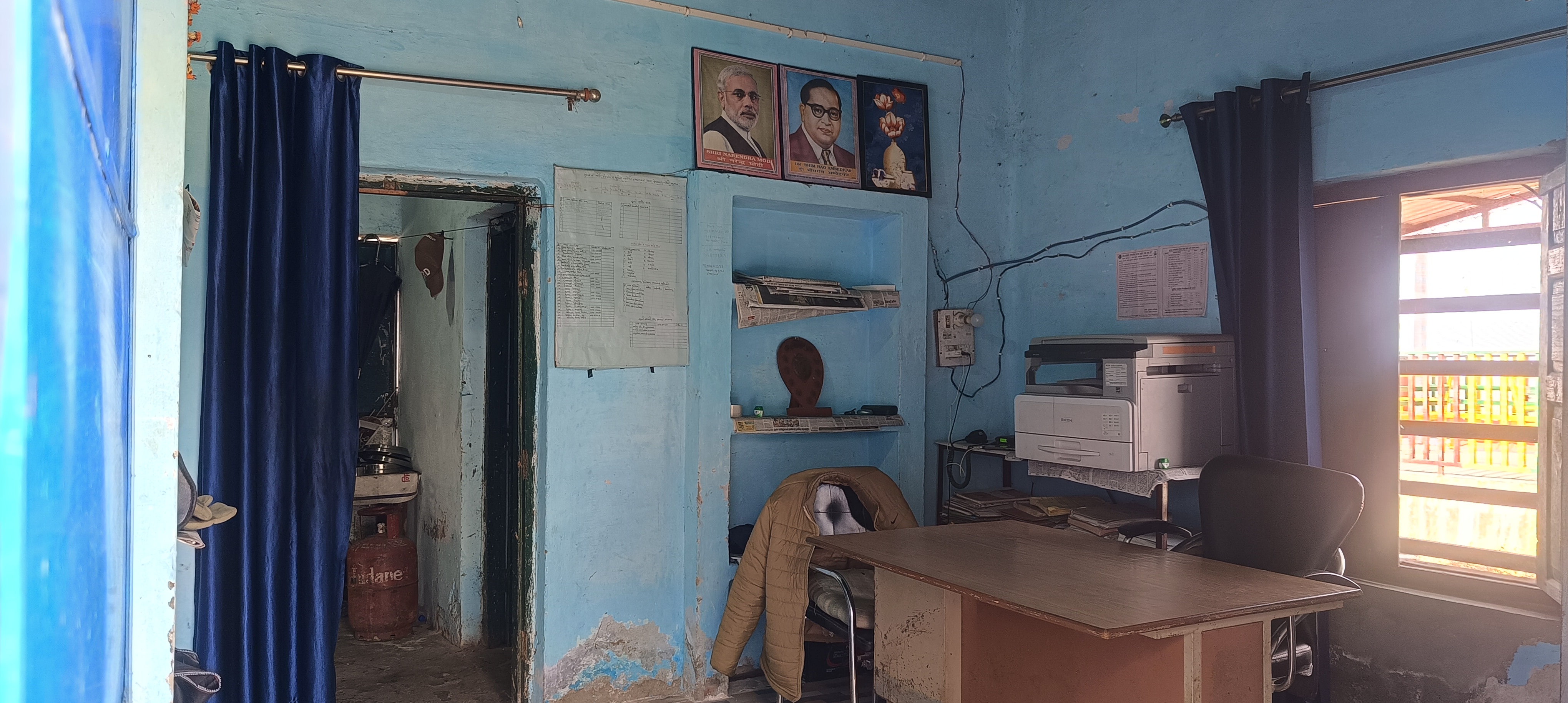 The chowki at Sabdarkhal village, nearly 20 km from Devprayag police station, falls under the station’s limits. (Photo: Aiswarya Raj)
Located on opposite river banks, the two stations share the same name, owing to the eponymous temple town. But that’s where the similarities end. In 2025, Tehri Garhwal’s Devprayag station registered around 40 cases.
Story continues below this ad
“This side of the river has small villages. Most disputes are not reported to the police. Instead, they are resolved at panchayats and gram sabha meetings. Crime in the hills is low because there is hardly anyone left here now,” Rawat explains.
According to the 2011 Census, Pauri Garhwal district recorded a population of 6.86 lakh. Between the 2011 Census and 2017, the Migration Commission found that 734 villages in the state had been completely vacated by inhabitants, while the population had fallen by 50 per cent in another 565.
Of the hamlets under the jurisdiction of Devprayag police station, 70 villages are still manned by revenue officials, said Rawat. The system of revenue policing is being phased out following the May 2025 Uttarakhand High Court orders. The SHO estimates that the station has around 4,500 residents under the civil police limits.
According to the National Crime Records Bureau (NCRB), Uttarakhand recorded just 17,094 cases in 2023. In contrast, its neighbour Uttar Pradesh reported 66,381 cases in a single category (crimes against women).
Story continues below this ad
The NCRB data states that no cases were registered by two police stations in Uttarakhand’s Pithoragarh district (the seasonal Gunji and Pangla) in 2025, while Bageshwar district’s Kausani and Champawat district’s Tamli police stations registered just three each all year. The next was Pauri Garhwal’s Devprayag police station, which reported just four cases.
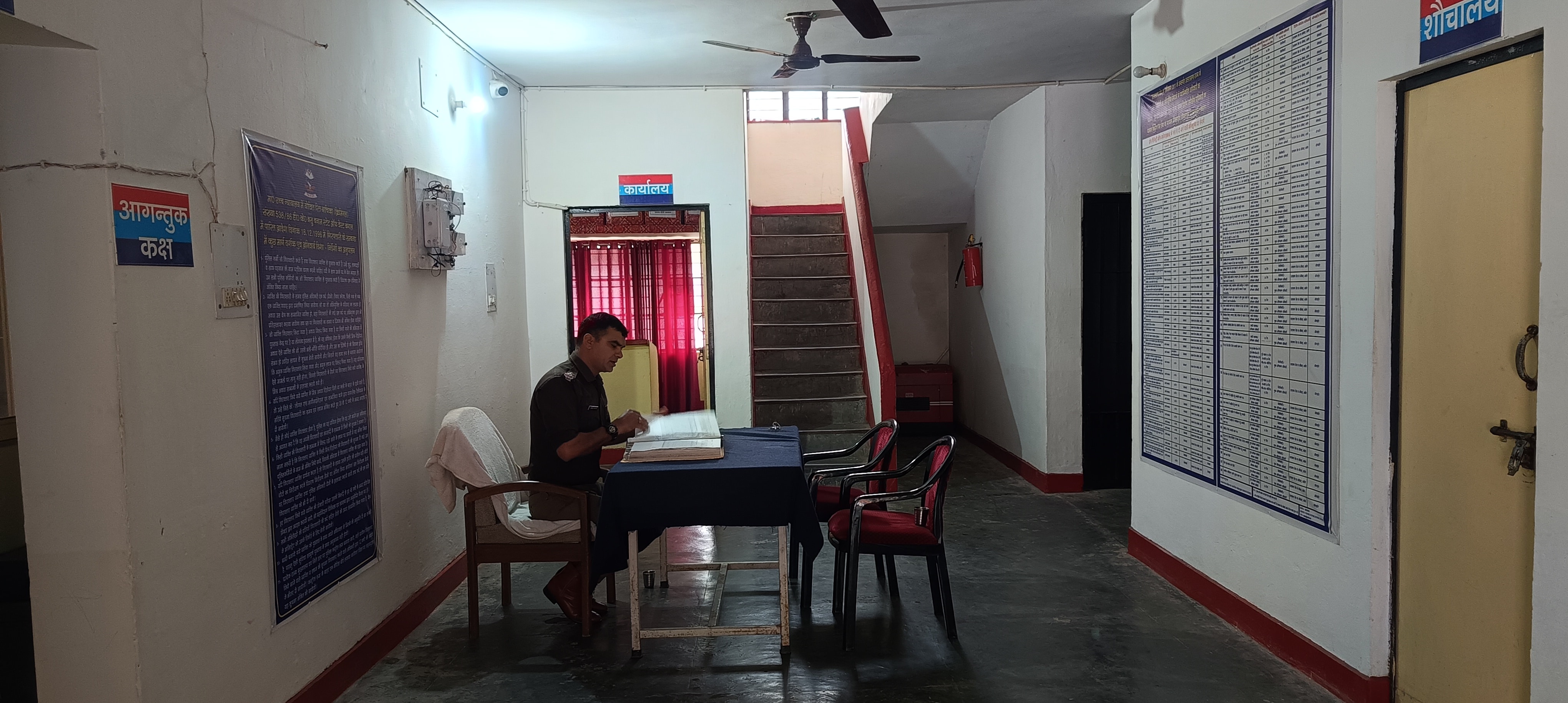 Amarjeet Rawat, SHO, at Devprayag police station in Uttarakhand’s Pauri Garhwal district. (Photo: Aiswarya Raj)
Since it was established in 1987, the Devprayag police station has, more or less, recorded very few cases annually. Initially, it catered to pilgrims who stopped at Devprayag while en route to Badrinath on foot. Later, a highway was built, bringing both traffic and pilgrims to the town. But not crime. And that has not yet changed.
The black grill door of the holding cell at the Devprayag police station in Pauri Garhwal district has a padlock. It has not housed an accused over the last six months, except on two occasions. In both instances, non-bailable warrants were issued in old cases against the accused, who were required to be produced in Pauri Garhwal courts.
Even the four cases reported at the station in 2025 concerned minor infractions, Rawat says. “The first case was registered when a man illegally transported 240 bottles of whiskey from Punjab. Then, a hotel owner was heckled by a group of people… Another case was a missing person complaint because a man fell into the river in his vehicle. Recently, a man accused his drunk brother of hitting him with a stick. He insisted we file an FIR. We conducted a medico-legal test and registered the case,” he says.
Story continues below this ad
He added that a 24/7 check-post on the link road from Devprayag to Pauri keeps track of illegal liquor dispatches in the area, which make up for the majority of crime in the area.
In one of the cases under the revenue police limits that he had to solve, Rawat was left with the mystery of a missing man.
“The man handed over his wallet and phone to a local for safekeeping before going to the liquor shop across the river. He had a drink and then jumped into the river. A few days later, we got a call from Rishikesh about a body retrieved 40 km downstream. We sent a picture to his son in Delhi, but he could not identify his father. A relative finally identified him and we closed the case. We suspected early on that it was a case of suicide,” he says.
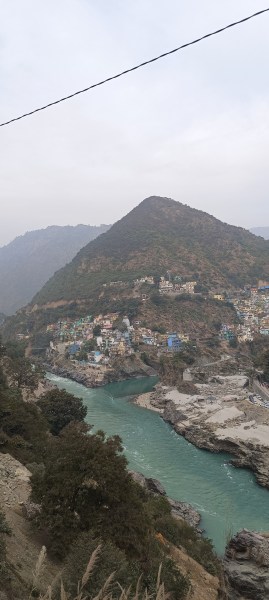 The Devprayag police station is located a few hundred metres from the confluence of the Bhagirathi and the Alaknanda.
To deal with such cases and, at times, death itself, he said the police station also maintains a detailed register with information on the residents, their photographs, emergency contacts, neighbours, etc.
Story continues below this ad
“Interestingly,” Rawat says, “the police station has never “seen” certain types of crimes, including “cybercrimes”.
He says, “Two residents approached us recently to report so-called cybercrimes. Of these, one man had sent money to the wrong person from his phone. Mainstream cybercrime is yet to reach these villages.”
So what do the officers — two sub-inspectors, an assistant SI, 10 head constables and four constables — do all day?
Besides frequent outreach programmes to tackle drug abuse in the 40 educational institutions under their jurisdiction, and spreading awareness on cyber crimes and crimes against women, they spend a lot of time on an Uttarakhand Police initiative for the elderly.
Story continues below this ad
“We visit the elderly in villages under our jurisdiction, since the once close-knit hill communities have been hollowed out by migration,” he says.
One such village where these officials visit the elderly is Chaprauli, located 10 km away from the police station. At Chaprauli, most residents start retiring for the day around 3 pm. With more and more wild animals straying into human settlements, they lock their livestock inside their sheds in the afternoon itself.
The roads are deserted, except for an occasional bus en route to Pauri. As a pick-up truck goes past his house, the driver shouts a greeting as he takes a turn, “Pradhan ji.”
Pradhan Badrish Kumar, wearing a bright blue sweater to fend off the crisp air, waves back in acknowledgement.
Story continues below this ad
Sitting on a charpoy on the terrace, Kumar, his elderly wife Kalpeshwari Devi and acquaintance Surender Singh, 26, are basking in the afternoon sun. The couple are among those who receive occasional visits from the local police. The grizzled Kumar attributed the lack of crime in the area to its declining population.
“Almost all young adults and children live outside the state. Those left behind work to feed their families. No one here has more than Rs 1,000 in their pocket at a time. The economy is largely afloat thanks to the money the children send us from outside,” he says.
The “collapse” of agriculture in the region had compounded the problem of migration, he said.
Kumar says, “Only 3% of arable land is cultivated now. Since crops were being raided by wild animals, we started growing turmeric instead of wheat and millets. We consume whatever we grow; nothing is for sale. That too resulted in a drop in income. Why would someone want to stay back here?” he says.
Kumar claimed many youth from the village would earlier join the armed forces. “But that took a hit after the Agnipath scheme was launched. Most youth are employed in the informal sector now. Some who stayed back are employed by MGNREGA (now VB-G RAM G) or doing construction work. There is no local economy left now,” says Kumar, looking at the pine-covered horizon.
Seated next to Kumar on the sunny terrace, Surender Singh, who lives in a village close to Chaprauli, is among those who had applied to the armed forces.
“I passed the written test, but not the physical exam. I am looking for jobs in the plains now. Only 22 people are left in my village. My friend (also 26) and I are the only young adults currently,” he says.
Despite the lack of people and crime in the hills, in villages under Devprayag police station, the sight of the khaki uniform still evokes fear. Such was the case at Sabdarkhal village, nearly 20 km away, where a chowki falls under the limits of Devprayag police station.
Barely a kilometre downhill from the chowki, Sabdarkhal resident Sunil Kumar, wearing his son’s old school sweater, was eating lunch on a mat in front of his one-room house. Their one-room house is located at the farthest end of the isolated residential cluster in the village, denoting their social standing.
A narrow path snakes through the Dalit settlement, made up of small houses with sarees for curtains and stacks of flat stones for roofs, going up till Kumar’s house, about 100 metres away from the concrete double-storey houses of the “upper caste” residents.
As soon as his wife Beena Devi spots the two policemen and whispers something in his ear, Kumar jumps up, the lunch forgotten, as if scalded. The couple exhaled in relief only after the head constable and the constable walked past. However, they refused to speak till the policemen were well out of earshot.
“We don’t speak to them unless spoken to. I am scared of them. I don’t want to get into any of their business,” says Devi.
She confessed to having spoken to the police once — when she needed help carrying her son’s hostel belongings to their house downhill. “I asked for help and they sent someone over,” she says.
Resuming his lunch, Kumar chimes in, “There is nothing to report here. Everything is okay.”
Head constable Budhi Ballabh Singh Negi, whose presence had caused Kumar to temporarily abandon his meal, agreed that “everything was indeed alright” in the area.
He added that most matters got resolved themselves or at the chowki. “A man called us one night. He claimed his brother had staked a claim on his land. We told him we would come over in the morning. When we called for directions in the morning, he told us they had made up,” Negi says.
Then there was the man who had accused his neighbour’s cow of destroying his crop while grazing in his field. “Under what Sections could we have registered his complaint?” Negi says.
Back at the Sabdarkhal chowki, three volunteers from the Prantiya Rakshak Dal were awaiting the arrival of officer incharge Sandeep Chauhan. Even the crackling squawks from the wireless, lodged somewhere inside the one-room chowki with its peeling blue paint, are ignored.
Moments after his arrival, the trio are summoned by Chauhan. While the first volunteer carries his shoes and the second his bags, the third is directed to fetch hot water for the chowki incharge to wash his hands.
Drying his hands, Chauhan remarks, “Policing is difficult. It gets very cold here. We also get frequent VIP duties since the three former Chief Ministers visit Garhwal frequently. Having no crime to solve does not mean it is an easy job,” he says.
Back at the Devprayag police station, the building is empty by 4 pm. While its three personnel are at the check-post, Rawat sits next to the fire alone.
“It is the most mundane town. Nothing happens here,” he says. “Nobody comes, nobody goes”.
