

Take a look at the essential events, concepts, terms, quotes, or phenomena every day and brush up your knowledge. Here’s your UPSC Current Affairs knowledge nugget for today on Liquefied Petroleum Gas (LPG).

In this context, it becomes essential to understand LPG from a broader perspective, especially as it has been in the news repeatedly.
Story continues below this ad
Key Takeaways:
1. LPG is a relatively clean, portable, and efficient energy source. It is colourless and odourless and a strong “stenching” agent is added so that even a very small leak can be easily detected.
2. At a normal temperature, LPG is a gas. When subjected to modest pressure or cooling, it transforms into a liquid. As a liquid, it is easy to transport and store. Once it has been cooled or pressurised, LPG is usually stored in containers made of either steel or aluminium.
Story continues below this ad
3. LPG is an energy-rich fuel source with a higher calorific value per unit than other commonly used fuels, including diesel, coal, natural gas, petrol, and biomass-derived alcohols. This means that an LPG flame burns hotter, an advantage that can translate into higher efficiency. Its unique properties make it a versatile energy source that can be used in numerous applications.
How is LPG Produced?
1. LPG is produced as a byproduct of refining crude oil or processing liquified natural gas. It mainly consists of propane and butane, hydrocarbons that are naturally present in crude oil and natural gas.
2. According to the World Liquid Gas Association, globally, about 60% of LPG comes from gas processing and around 40% from refining, although the exact shares vary across regions and over time. LPG is thus a naturally occurring co-product of hydrocarbon extraction and refining.
Story continues below this ad
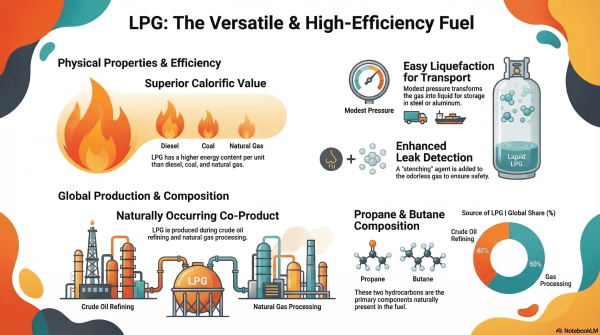 (Image: Google NotebookLM generated)
What are the applications and benefits of LPG?
1. There are numerous applications of LPG. It is used in commercial business, in industry, transportation, farming, power generation, cooking, heating, etc. LPG is used in homes as a gas to cook with. LPG is also commonly used in the agricultural sector and as a lower-emission automotive transportation fuel.
2. LPG also contributes to the improvement of the well-being of whole communities. For developing rural communities LPG can provide a first modern alternative to traditional cooking fuels (e.g., firewood, charcoal, dung), contributing to a better quality of life.
3. According to the World Liquid Gas Association, “exposure to a mixture of particles and toxic chemicals, generated when wood or other biomass material is used for indoor cooking, is responsible for widespread sickness and greatly reduced life expectancy for many people living in poorer communities. With its intrinsically clean-burning characteristics, LPG offers a practical avenue towards cleaning up the air we breathe.”
Story continues below this ad
4. LPG also helps reduce black carbon and particulate matter emissions compared with more polluting solid fuels, thereby improving both indoor and outdoor air quality and lowering associated health risks.
India’s LPG Import dependence
1. According to data published by the Petroleum Planning and Analysis Cell (PPAC), which falls under the Union Ministry of Petroleum and Natural Gas, India has been a net importer of crude oil and LPG since 1999, the earliest year for which data is available.
2. While the country has gradually been able to produce and export its own petroleum products, LPG in particular has remained a laggard and is now the country’s most imported petroleum product.
Story continues below this ad
3. India depends on imports to meet around 60% of its LPG requirement, and 90% of its LPG imports come from West Asia through the Strait of Hormuz.
4. Though India has managed to reduce its import dependence for other fuel products, the growing demand for cooking gas has largely been met with increasing LPG imports.
5. Behind the growing imports is the rising demand for LPG — on the back of accelerated urbanisation, growth of middle-class households, and Central and state governments’ schemes for free or subsidised LPG cylinders, especially for rural households.
Story continues below this ad
6. While LPG consumption between 1998-99 and 2023-24 has grown more than fivefold, production grew by just over threefold in the same period. Since 2020, though LPG consumption growth has slowed, India has struggled to expand its production capacity to meet the demand.
7. Despite expanding the capacity of its crude oil refining, a process of which LPG is a byproduct, India appears to have hit a ceiling as far as domestic LPG production goes, resulting in a growing and persistent reliance on imports.
8. This is exemplified by the share of LPG in the total production of petroleum products from domestic refineries — in 1998-99, LPG accounted for 5.2% of total refinery output by quantity, but by 2024-25, despite growing production capacity, LPG accounted for just 4.2% of refinery output.
Story continues below this ad
BEYOND THE NUGGET: What is the Essential Commodities Act?
1. With fuel shipments via the Strait of Hormuz halted for the foreseeable future due to the war in West Asia, the government on 9th March invoked the Essential Commodities Act to divert natural gas to “priority sectors” that are dependent on the fuel.
2. The Essential Commodities Act (ECA) was enacted in 1955 to “provide, in the interests of the general public, for the control of the production, supply and distribution of, and trade and commerce, in certain commodities”. If the supply of essential commodities or products were disrupted due to hoarding or black marketing, this would affect the normal, everyday life of people.
3. Essential commodities as defined by the Act include cattle fodder, coal and its derivatives, automobile components and accessories, cotton and wool textiles, drugs as defined in Section 3 of the Drugs and Cosmetics Act, 1940; foodstuffs, iron and steel as well as products made of these, raw cotton, raw jute; and any other product listed by the Centre via a notified order.
Story continues below this ad
4. Under the original act, the government could fix the minimum support price of any packaged product held as an “essential” commodity.
5. In June 2020, the Centre amended the Act to delist certain commodities as essential, allowing the government to regulate their supply and prices only “under extraordinary circumstances” such as war, famine, extraordinary price rise and a natural calamity of grave nature. The commodities thus delisted include food items, including cereals, pulses, potatoes, onions, edible oilseeds and oils. In such cases, limits can be placed on the number of stocks of such items held by individuals.
Post Read Question
Consider the following statements regarding Liquefied Petroleum Gas (LPG):
1. LPG is naturally colourless and odourless.
Story continues below this ad
2. A stenching agent is added to LPG so that leaks can be easily detected.
3. India depends on imports to meet around 60% of its LPG requirement
Which of the statements given above is/are correct?
(a) 1 and 2 only
(b) 2 and 3 only
(c) 1 only
(d) 1, 2 and 3
(Sources: For India, the costs of the Iran war beyond LPG, Explained, in 3 charts: How India became so dependent on LPG imports)
Subscribe to our UPSC newsletter. Stay updated with the latest UPSC articles by joining our Telegram channel – Indian Express UPSC Hub, and follow us on Instagram and X.
🚨 Click Here to read the UPSC Essentials magazine for March 2026. Share your views and suggestions in the comment box or at manas.srivastava@indianexpress.com🚨
