

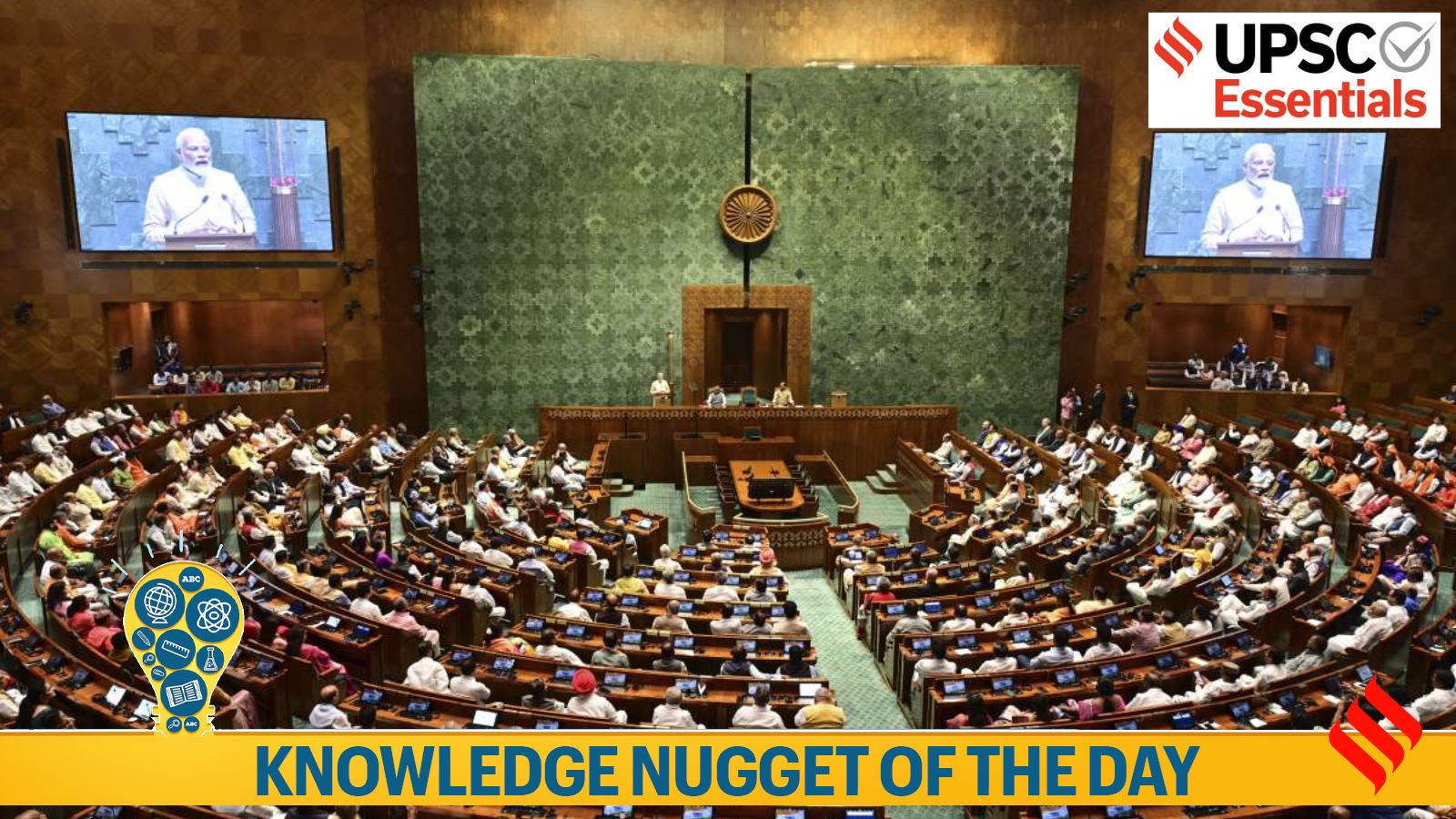
Take a look at the essential concepts, terms, quotes, or phenomena every day and brush up your knowledge. Here’s your UPSC knowledge nugget on the Rajya Sabha elections for today.
(Relevance: Parliament is one of the favourite topics of the UPSC. Questions have repeatedly been asked about the Rajya Sabha composition, powers, and elections. Therefore, it is important to brush up on your basics, as this is in the news. )
The Election Commission of India on Wednesday (18th February) issued the notification for elections to 37 Rajya Sabha seats, with polling and counting of votes scheduled for March 16. The term of 37 Rajya Sabha members is set to expire in April.
Among those MPs whose terms are ending, seven are from Maharashtra, six from Tamil Nadu, five each from West Bengal and Bihar, four from Odisha, three from Assam, two each from Chhattisgarh, Haryana and Telangana, and one from Himachal Pradesh.
Key takeaways:
1. Rajya Sabha, or the Council of States, has 245 seats. It is a permanent House and cannot be dissolved. To ensure continuity, one-third of its members retire after every second year, under Article 83(1) of the Constitution, and “biennial elections” are held to fill these vacancies. The term of a member is six years.
2. Out of the 245 members, 12 are nominated by the President, and 233 are representatives of the states and Union Territories of Delhi and Puducherry. Vacancies arising due to resignation, death or disqualification are filled through bypolls. Those elected serve out the remainder of their predecessor’s term.
3. Under Article 80(3), the 12 nominated members should have special knowledge or practical experience in matters like literature, science, art etc. A nominated member may join a party within six months of taking a seat.
Story continues below this ad
4. Anyone contesting for the election of the Rajya Sabha should be a citizen of India and not less than 30 years of age. It should possess such other qualifications as may be prescribed by law made by Parliament.
5. Electors in a parliamentary constituency anywhere in India can contest the election. Earlier, the domicile of the particular state was only allowed to contest the Rajya Sabha election. In 2003, an amendment was made to the Representation of the People Act, 1951, which was also upheld by the Supreme Court in the Kuldip Nayar v. Union of India case, that removed this bar.
6. Rajya Sabha MPs are elected by Members of Legislative Assembly (MLAs) through an indirect election. Article 80(4) provides that members shall be elected by the elected members of state Assemblies through a system of proportional representation by means of a single transferable vote.
7. The Fourth Schedule to the Constitution provides for allocation of Rajya Sabha seats to the states and Union Territories, on the basis of the population of each state. For instance, there are 31 Rajya Sabha seats in Uttar Pradesh and 1 in Goa. Elections are held where there are more candidates than vacancies; otherwise, candidates are elected unopposed.
Story continues below this ad
8. The number of votes a candidate requires depends on the number of vacancies and the strength of the House. If there is only one vacancy, the required quota under the Election Commission’s Conduct of Election Rules, 1961, is calculated by taking the number of votes polled, divided it by 2, and adding 1. For example, if 100 votes are polled in an Assembly, the Rajya Sabha candidate would need:
100/2 + 1 = 51 votes
9. If there is more than one vacancy, the equation is based on an assigned value of 100 for every first-preference vote. The values of the votes credited to all candidates are totalled. The total is divided by 1 more than the number of vacancies, and 1 is added to this quotient.
For example, if 100 members of an Assembly vote for 3 Rajya Sabha vacancies, the required quota by any candidate would be
(100 × 100)/(3 + 1) + 1 = 2501
If for any seat, candidates fail to get the specified number, the second-preference votes will be taken into account, but with a lower value.
Story continues below this ad
10. Notably, a Minister who is a member of Lok Sabha has the right to speak in and take part in the proceedings of Rajya Sabha but has no right to vote in Rajya Sabha and vice-versa.
History of the Rajya Sabha
1. The ‘Council of States’, also known as Rajya Sabha, which received this nomenclature for the first time on 23 August 1954. The origin of the Council of States can be traced to the Montague-Chelmsford Report of 1918.
2. The Government of India Act, 1919 provided for the creation of a ‘Council of State’ as a second chamber of the then legislature with a restricted franchise which actually came into existence in 1921.
3. After the extensive debate in the Constituent Assembly regarding the utility of a Second Chamber in Independent India, it was decided to constitute a bicameral legislature for the country.
Story continues below this ad
4. During the Constitution Assembly discussion, Shri Gopalaswami Ayyangar while replying to the discussion on the Report of the Union Constitution Committee observed:
“Therefore, what we really achieve by the existence of this Second Chamber is only an instrument by which we delay action which might be hastily conceived, and we also give an opportunity, perhaps to seasoned people who may not be in the thickest of political fray, but who might be willing to participate in the debate with an amount of learning and importance which we do not ordinarily associate with the House of the People. That is all that is proposed in regard to this Second Chamber.”
5. After the First General Election of 1951, MPs for LS and MLAs for states were elected, the stage was set for the election of the MPs of the Rajya Sabha. The ECI held these elections in March 1952, and the Rajya Sabha was constituted on April 3, 1952. They met for the first time on 13 May 1952.
6. Dr. S. Radhakrishnan was the first Chairman of the Rajya Sabha. He was elected unopposed for two consecutive terms. (1952 to 1957 and 1957 to 1962). The first Deputy Chairman was Shri S. V. Krishnamoorthy Rao. He also remained in office till 1962.
Story continues below this ad
BEYOND THE NUGGET: Power of the Rajya Sabha
1. In terms of the constitutional power of Parliament, the Rajya Sabha has equal power with the Lok Sabha. A Constitution Amendment Bill can be introduced in either House of Parliament and has to be passed by each House. There is no provision for a joint sitting of both Houses to resolve a deadlock on a Constitution Amendment Bill.
2. Rajya Sabha enjoys some special powers. If it passes a resolution by a majority of not less than two-thirds of members present and voting, saying that it is “necessary or expedient in the national interest” that Parliament should make a law on a matter enumerated in the State List, Parliament becomes empowered to make a law on the subject. Such a resolution remains in force for a maximum of one year but this period can be extended by one year at a time by passing a similar resolution.
3. A similar route can be adopted for recommending the creation of one or more All India Services common to the Union and the states. Parliament becomes empowered to create such services.
4. Rajya Sabha has a role to play if the President, as empowered by the Constitution, issues proclamations in the event of national emergency, in the event of failure of constitutional machinery in a State, or in the case of financial emergency”. Every such proclamation has to be approved by both Houses of Parliament within a stipulated period.
Story continues below this ad
5. Under certain circumstances, however, Rajya Sabha enjoys special powers. If a proclamation is issued at a time when Lok Sabha has been dissolved or the dissolution of Lok Sabha takes place within the period allowed for its approval, then the proclamation remains effective, if the resolution approving it is passed by Rajya Sabha within the period specified under Articles 352, 356 and 360 of the Constitution.
Post Read Questions
(1) Rajya Sabha has equal powers with Lok Sabha in: (UPSC CSE 2020)
(a) the matter of creating new All India Services
(b) amending the Constitution
(c) the removal of the government
(d) making cut motion
(2) Consider the following statements: (UPSC CSE 2012)
1. Union Territories are not represented in the Rajya Sabha.
2. It is within the purview of the Chief Election Commissioner to adjudicate the election dispute.
3. According to the Constitution of India, the Parliament consists of the Lok Sabha and the Rajya Sabha only.
Which of the statements given above is/are correct?
(a) 1 only
(b) 2 and 3 only
(c) 1 and 3 only
(d) None
Story continues below this ad
| Answer key |
| 1. (b) 2. (d) |
(Sources: Explained: How are Rajya Sabha MPs elected? Why are the polls important?, History Headline: 60 years ago, when a Rajya Sabha election was declared void, Rajyasabha faqs, digital sansad
Subscribe to our UPSC newsletter. Stay updated with the latest UPSC articles by joining our Telegram channel – IndianExpress UPSC Hub, and follow us on Instagram and X.
🚨 Click Here to read the UPSC Essentials magazine for February 2026. Share your views and suggestions in the comment box or at manas.srivastava@indianexpress.com🚨
