

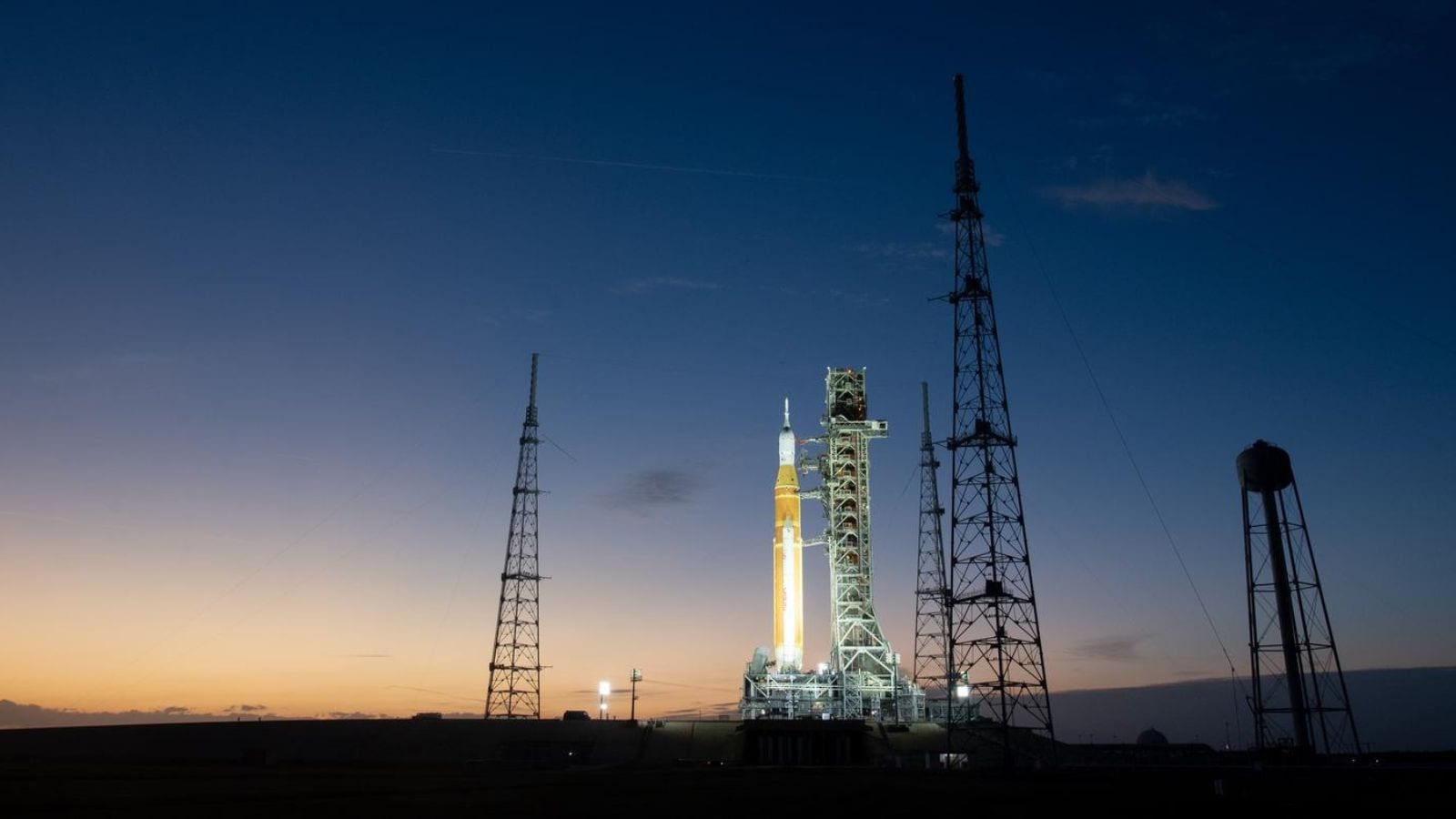
NASA’s Artemis mission continues to run into challenges. Engineers on Thursday faced a new hiccup during a test of the massive rocket that will carry four astronauts around the Moon for the first time in over 50 years. During the technical evaluation, the NASA team faced an “issue” with the ground support equipment while operators attempted to partially load the Space Launch System’s liquid hydrogen tank. The test was aimed at evaluating the recently installed seals in the propellant filling area. The seals were replaced after hydrogen leaks derailed an earlier dress rehearsal.

While NASA confirmed achievement of several critical objectives and collected important data at the same points where previous leaks occurred, the reduced hydrogen flow caused by faulty ground equipment added another complication to an already troubled testing timeline.
Over the weekend, teams will clean out the affected lines to maintain proper conditions and examine the ground support hardware. A clogged filter is suspected as the culprit behind the flow restriction, and technicians plan to swap it out before determining when to schedule the mission’s second full wet dress rehearsal later this month.
ALSO READ | NASA’s Artemis II moon mission slips to March
Crewed moon missions
So far only the US has achieved successful manned missions to the moon. Between 1969 and 1972, twelve astronauts explored the lunar surface across six successful Apollo missions. Apollo 11 achieved the first crewed Moon landing in July 1969.
Artemis-3 is likely to launch in 2027-28 and the Artemis-4 and 5 could launch in 2028-29 and 2030, respectively.
Story continues below this ad
China has also announced a manned mission to the moon under its Chang’e Project. The China Manned Space Agency has set a preliminary target of landing two astronauts on the moon by 2030.
India is planning to send its first astronauts to the Moon by 2040 under Space Vision 2047.
What will NASA’s Artemis-2 mission do?
The Orion spacecraft Artemis II mission is set to take astronauts farther from Earth and nearer to the Moon than any crew has travelled in more than 50 years. They will become the first people in over half a century to fly past the Moon. From this rare vantage point, the team will collaborate with researchers on the ground to support scientific studies that will help future human spaceflights.
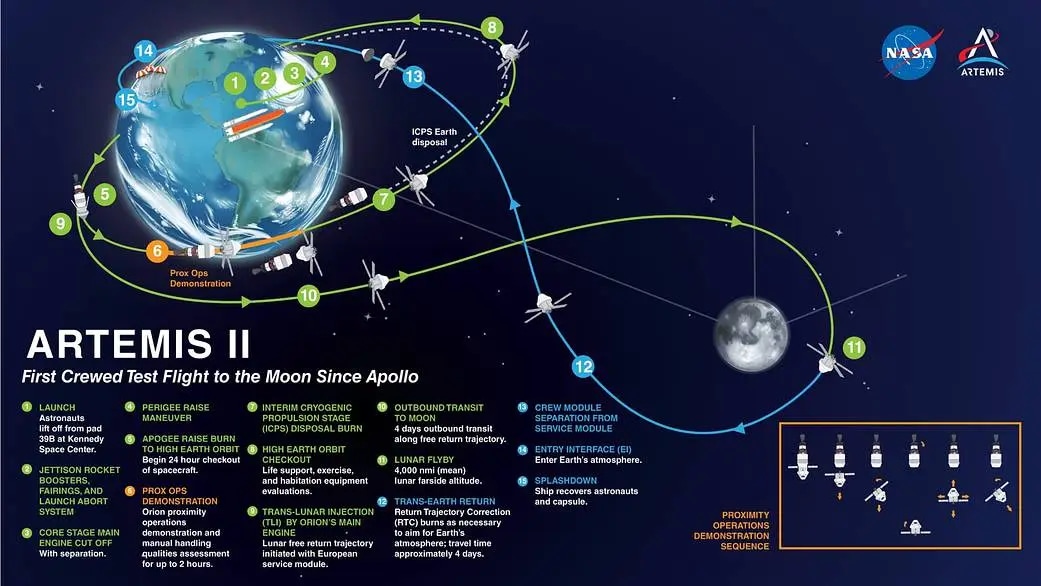 The planned trajectory and route plan of the Artemis II mission (Image: NASA).
As per NASA, during the round trip, the Orion spacecraft will pass over the Moon’s far side — the hemisphere permanently turned away from Earth. For roughly three hours, the crew will observe and capture images of geological formations, including impact craters and ancient lava plains. Drawing on intensive geology training completed both in classrooms and in Earth locations that resemble lunar terrain, they will document subtle differences in shapes, textures, and colors — details that help scientists understand the Moon’s geological past. Mastery of these observational skills will be essential for future missions aimed at exploring the lunar South Pole.
Story continues below this ad
When will Artemis-2 Moon Mission launch?
NASA has said March remains the agency’s earliest possible launch opportunity for the historic Artemis II mission, which will send astronauts Reid Wiseman, Victor Glover, Christina Koch, and Jeremy Hansen farther from Earth than any human has ventured since the Apollo era ended in 1972.
The space agency has identified just five potential launch dates between March 6 and March 11. If those windows close, the mission would slip to April, adding more delays to a program already years behind its original schedule.
Data analysis from Wednesday’s partial fueling test will determine whether engineers have finally resolved the persistent hydrogen leak issues that have plagued the Space Launch System since its first test flight in 2022. The agency spent three years implementing fixes after those initial problems, yet leaks resurfaced during testing earlier this month.
