

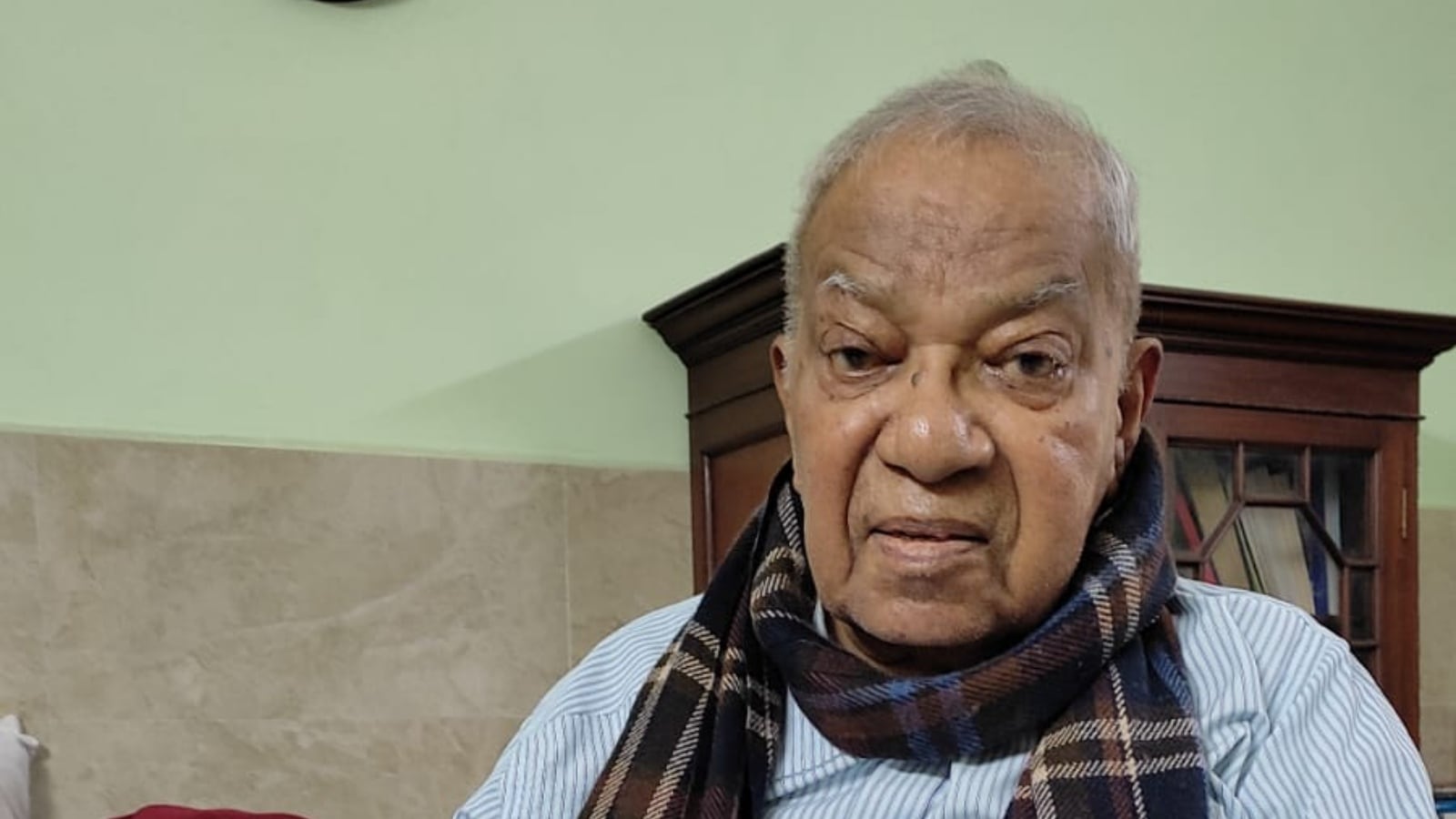
On most mornings, Father Thomas V Kunnunkal would set out on foot from the Jesuit residence at St. Xavier’s School in Delhi, moving slowly but deliberately. “Water and walk”, he said, was the key to a long life. He lived on only a few medicines, believed in simplicity, and accepted age without complaint.
Father Kunnunkal, a Jesuit priest, a Padma Shri awardee and one of the most influential figures in India’s post-Independence education system, died in Delhi on Wednesday evening. He was 99. Best known for reshaping the Central Board of Secondary Education into a national benchmark, Father Kunnunkal served as the CBSE chairman from 1980 to 1987.

“He was always peaceful,” recalled Joseph Victor Edwin, a teacher of theology at Vidyajyoti Institute of Religious Studies in Delhi who had known Father Kunnunkal for more than 25 years. “Quiet. Accepting. Even at 99, there was no anxiety in him.”
Father Kunnunkal died at Jivodaya Hospital.
“He was among the first to give CBSE a clear vision,” said Latika Gupta, an assistant professor of education at Delhi University. “He understood that the board had to stand for something academically.”
Under his leadership, CBSE gained credibility, coherence and confidence, persuading several schools, particularly convent and missionary, that had long favoured ICSE, to migrate to the board. “Because of the trust people had in him,” Gupta said, “principals and governing bodies were convinced.”
Yet Father Kunnunkal rarely spoke about his achievements. He declined when urged by students to write an autobiography. Asked to allow a book to be written, he insisted it should focus not on him but those who worked alongside him.
“He believed deeply in networking and synergy,” Edwin said. “He would say: ‘In mathematics, one plus one is two. But in human relations, one plus one can be two, three, four or even zero. It depends entirely on the quality of relationships’.”
Story continues below this ad
Born in Alappuzha, Kerala in 1926, Father Kunnunkal joined the Society of Jesus in the 1940s and later became part of the Delhi Jesuit Province. He studied in the US, earning master’s degrees in English, Educational Administration and Educational Measurement.
Before entering national policy-making, he served two terms as the principal of St. Xavier’s School, Delhi.
In 1974, he was awarded the Padma Shri for his contribution to education.
He helped conceptualise and establish the National Open School under the National Policy on Education, 1986.
Story continues below this ad
Recalling his years as a student under Father Kunnunkal, former Delhi University Vice-Chancellor Dinesh Singh said he shaped him “as a mentor and as a visionary institution builder”. “In 1970, he banned corporal punishment, something almost unheard of then, and appointed a full-time student counsellor who was accessible to students throughout the day,” he said.
Singh said Father Kunnunkal went on to build St Xavier’s “from scratch”, reform the CBSE when it was “in bad shape”, and help establish the open school system. He added that while serving as the DU Vice-Chancellor, he worked with Father Kunnunkal again when the latter chaired Jesus and Mary College, where he “made major improvements”.
Singh said, “He chose a life of austerity and service despite coming from a privileged background…he would work alongside students in villages near Meerut. Principals like him are exceedingly rare.”
“As a Jesuit, he was inspired by a call to commit to the poor,” Edwin said. “He asked himself: as an educationist, how do I serve those who drop out, especially in towns and cities? That question led to open schooling.”
Story continues below this ad
The poor, colleagues said, were never an abstraction for him. He spoke often of education not merely as charity, but as scale systems that could reach those excluded from conventional classrooms. “Not just feeding the poor,” Edwin said, “but educating them.”
Beyond education, Father Kunnunkal was a lifelong advocate of interfaith dialogue. He served as director of the Jesuit-run Indian Social Institute in New Delhi and as president of the Islamic Studies Association, where Edwin worked closely with him. His influence, Edwin said, shaped an entire generation of dialogue practitioners.
“He taught me the power of now,” Edwin said. “Let go of the past. Live fully in the present.” Another lesson, he said, was to resist the human instinct to find fault.
Gupta tried to meet him thrice between October and December last year. Each time, she was told he was too unwell. “But even in his nineties,” she said, “people still went to him for advice.”
Story continues below this ad
“He had no fear,” Edwin said. “No pain. No restlessness. He was always positive.”
