

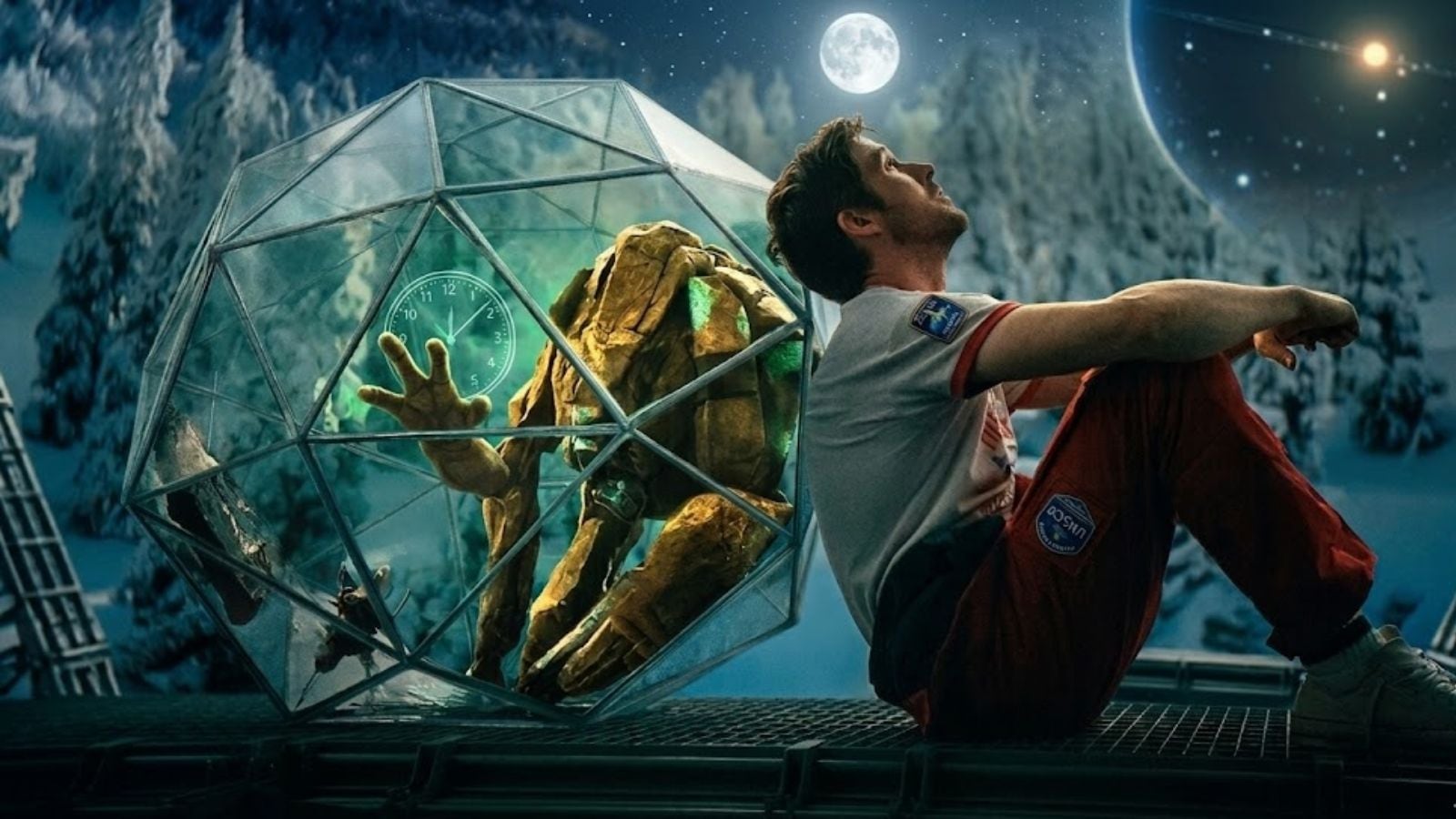
There are films we watch, and then there are films we carry with us. Project Hail Mary belongs firmly to the latter. It hasn’t just found an audience; it has found a rare kind of emotional unanimity. Across continents, across languages, people are responding to it not as spectacle, but as solace. Much of that response is rooted in the film’s startling sincerity. In a cinematic landscape that often leans on irony or distance, Project Hail Mary dares to be disarmingly earnest.
And at the centre of it is a relationship that, on paper, shouldn’t work — between Ryan Gosling’s Ryland Grace, a man riddled with hesitation and self-doubt, and Rocky, an extraterrestrial being who doesn’t even possess a face in the way we understand it.

An alien we learn to feel, not understand
And yet, Rocky may well be one of the most lovable aliens ever put on screen.
Rocky has no expressive eyes or familiar human features to anchor our empathy. He communicates through vibrations—sounds that initially feel alien in the truest sense: incomprehensible, almost intimidating. But slowly, almost imperceptibly, those sounds begin to carry meaning. Not just linguistic meaning, but emotional weight. Curiosity. Concern. Playfulness. Trust. It is in that gradual unfolding that the film finds its heartbeat.
Grace, when we meet him, is not the archetypal hero. He is not brimming with confidence or conviction. If anything, he is defined by his reluctance, a man defined by hesitation, constantly second-guessing his place in the world. Space, in that sense, becomes both a literal and metaphorical expanse: vast, isolating, and unforgiving.
And then Rocky arrives.
Not fixing, but believing
What follows is not a transformation driven by grand gestures or dramatic turning points. It is something quieter, more intimate. Two beings, separated by biology, language, and entire evolutionary histories, begin to understand each other. They begin to rely on each other. And in that reliance, something shifts within Grace.
Rocky does not set out to “fix” him. There is no conscious intervention, no deliberate mentorship. But there is an unspoken assumption that defines their dynamic, an almost childlike, instinctive belief that things can be fixed. Problems can be solved. Obstacles can be worked through. It is, in essence, the alien wearing an invisible “I can fix it” cap, not as a declaration, but as a way of being. And that belief is contagious.
Story continues below this ad
Grace, who once hesitated, begins to act. Where there was doubt, there is now effort. Where there was fear, there is now curiosity. The transformation is not about becoming someone else; it is about finally allowing himself to become who he could have been all along. This is where Project Hail Mary connects to a lineage of stories that have quietly endured across decades.
Rocky saw us as we are
In E.T. the Extra-Terrestrial, Elliott’s loneliness finds an answer not in resolution, but in recognition. E.T. doesn’t change Elliott’s circumstances; he changes how Elliott sees himself within them. In Koi… Mil Gaya, Rohit’s journey is more overt, but at its core lies the same idea – that being truly seen, truly accepted, can unlock parts of ourselves we didn’t know how to access. PK offers an inversion. Here, the alien, played by Aamir Khan, becomes the lens through which humanity is examined. He doesn’t just help one individual grow; he unsettles an entire ecosystem of beliefs, gently nudging people towards honesty, towards questioning, towards becoming better versions of themselves.
Project Hail Mary absorbs all of these impulses and distils them into something profoundly affecting. It strips the idea down to its emotional core: what happens when someone — or something, encounters us without preconception?
Because that, ultimately, is the deeper reason this trope continues to resonate. It is not just about the absence of judgment, though that is certainly part of it. It is also about the presence of assurance. Human beings, for all their complexities, carry a quiet, persistent need, to be reassured of their worth. To be told, in ways both explicit and implicit, that they are enough. That their flaws do not define them. That their hesitations are not disqualifications.
Story continues below this ad
To be seen, without being measured
We seek this assurance constantly, sometimes subtly, sometimes desperately. And yet, we rarely receive it in its purest form. Our interactions are layered with expectations, comparisons, and conditions. Love, acceptance, even validation, they often come with qualifiers.
An alien, in these stories, exists outside that framework. It does not know our hierarchies. It does not recognise our insecurities as flaws. It does not carry the cultural baggage that teaches us how to measure each other. It encounters us as we are, not as we are supposed to be. In doing so, it offers something that feels almost radical: unconditional understanding.
That is why the “I can fix it” impulse feels so powerful in these narratives. It is not about fixing us in a corrective sense. It is about holding space for us until we begin to believe that we are not broken to begin with. Rocky embodies this beautifully. Without ever articulating it in human terms, he treats Grace as capable, as worthy of partnership, as someone whose presence matters. There is no condescension, no doubt. Just an unwavering, almost matter-of-fact trust. And in that trust, Grace finds himself.
Perhaps that is what audiences are responding to so viscerally. Not just the novelty of first contact, or the thrill of a story set against the vastness of space, but the intimacy of being understood without explanation.
Story continues below this ad
It also explains the unusual, almost word-of-mouth fervour the film has inspired in India.
The push for IMAX screenings, the willingness to show up at ungodly hours, the collective insistence that this is a film worth experiencing properly – it all points to something beyond casual appreciation. It speaks to a kind of ownership, a sense that this story belongs to everyone who has ever felt uncertain, overlooked, or quietly inadequate. Because Project Hail Mary is not really about space. It is about what happens when, in the most unlikely of places, we find connection. When, against all odds, we are met not with judgement, but with understanding. Not with expectation, but with belief.
And in that encounter, we are reminded that becoming better versions of ourselves does not always require grand epiphanies. Sometimes, it just requires someone, somewhere, to look at us – even without eyes – and see us as we always hoped to be seen.
