

Puducherry Assembly Elections 2026: Elections to the Legislative Assemblies of Kerala and Assam, and the union territory (UT) of Puducherry, commenced on Thursday (April 9).
Despite its UT status, Puducherry has a legislative assembly and a chief minister. Only two other UTs in India currently have legislatures: Delhi, and Jammu & Kashmir. We explain how this came to be, and what it means for governance.
Union territories are governed under Part VIII of the Constitution, comprising Articles 239 to 242. This section entrusts the administration of UTs to the Indian President, via appointed administrators. Thus, most UTs, including Chandigarh, Daman & Diu and Dadra & Nagar Haveli, and the island territories of the Andaman & Nicobar and Lakshadweep, have no elected legislature, and are governed by administrators.
However, the passage of the Government of Union Territories Act 1963 constituted Puducherry as a UT, and provided it with a legislature.
The Treaty of Cession, which established the de jure, or formal legal transfer, of the territories of Puducherry, Yanam, Mahe and Karaikal from France to India was signed on May 28, 1956. In practice, India enjoyed de facto or administrative control of Puducherry since November 1, 1954. However, this treaty was not legally ratified until August 1962.
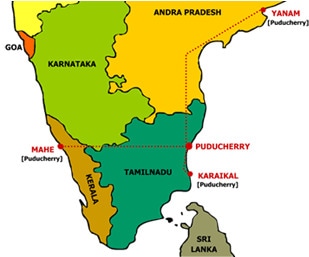 Map of Puducherry, including Mahe, Yanam and Karaikal
The administrative distinction of providing Puducherry with a legislature reflected India’s commitment to the Treaty while continuing the French practice of maintaining Puducherry’s representative assembly. This special status is enshrined in Article 239A, which provides for local legislatures and a council of ministers in Puducherry.
The President also has the power to nominate members to the Puducherry Assembly, a provision that has had political implications in the past.
Story continues below this ad
Only two other UTs presently enjoy similar representative status: Delhi since 1992, and Jammu and Kashmir since 2019.
Delhi as the National Capital Territory
Delhi was elevated to the status of National Capital Territory (NCT) under the Constitution (69th Amendment) Act, 1991, which came into force in 1992. The Act introduced Article 239AA, which provides for a legislative assembly, with the power to make laws on subjects in the State and Concurrent lists, barring public order, police and land.
But the division of powers between the Lieutenant-Governor (L-G), who is the centrally appointed administrator, and the elected government has been a contested issue over the years.
In 2015, a Union Home Ministry notification said that the L-G of Delhi shall exercise control over “services”. In 2018, a five-judge Supreme Court bench held that the L-G is generally bound by the aid and advice of the elected government.
Story continues below this ad
In 2021, Parliament passed an amendment to effectively nullify this ruling. Following a challenge to this amendment by the then AAP government, another five-judge Supreme Court bench ruled in May 2023 that the Delhi government has legislative and executive powers over “services”.
Shortly after, however, the Union government promulgated an ordinance that similarly nullified this ruling as well, swinging the balance of power back to the L-G. In August, Parliament passed an Act to take the place of the ordinance.
In contrast, Puducherry’s legislature enjoys a relatively broad scope of powers, with no such subject restrictions. However, it is subject to parliamentary scrutiny: Article 246(4) empowers Parliament to legislate on any subject for any Union Territory, regardless of whether it falls under the State or Concurrent List. Thus, if a conflict arises between a law passed by the Puducherry Legislative Assembly and the Parliament, the parliamentary law will prevail.
The distribution of powers between the elected government and the Lieutenant-Governor (LG) is explicitly laid out in Article 239AA, while Puducherry operates under Article 239A and the 1963 Union Territories Act, which does not clearly delineate the LG’s discretionary powers.
Story continues below this ad
This matter was clarified by the Supreme Court in K. Lakshminarayanan v. Union of India (2019), which held that the Puducherry LG is bound by the aid and advice of the Council of Ministers, and cannot operate as an independent authority in routine administration. The LG may intervene only under exceptional circumstances when a matter is referred to the President due to a genuine difference of opinion.
Article 240 of the Constitution empowers the President to make regulations for certain UTs, including Puducherry. In practice, this provision is exercised when the legislature is not functional, for instance, when the assembly is dissolved or suspended. However, if the NCT administration cannot be carried on according to constitutional provisions, Article 239AB would be invoked, allowing the President to suspend Article 239AA and impose President’s rule.
The NCT’s powers remain subject to oversight by the President and the LG, who exercises discretion in certain matters. In Puducherry, while there is no comparable constitutional provision, the SC ruling now clarifies that the LG’s role is largely bound to the elected government’s advice, with limited scope for independent action.
Jammu and Kashmir since 2019
In 2019, Article 370 of the Constitution, which granted the erstwhile state of Jammu and Kashmir special status, was abrogated. In its place came the 2019 Jammu and Kashmir Reorganisation Act, which bifurcated the former state into two UTs: Jammu & Kashmir, with a legislature, and Ladakh, without a legislature.
Story continues below this ad
In practice, the J&K UT enjoys significantly less legislative autonomy compared to Puducherry. Section 32 of the Act allows the J&K assembly to legislate on subjects in the State list, barring public order and police, which remain under the LG’s control.
The LG also enjoys discretionary authority over subjects beyond the assembly’s legislative purview, including control over the bureaucracy and the All India Services. Moreover, Section 36 of the Act mandates that the LG recommend in advance any bill involving financial obligations before it can be introduced in the assembly. In practice, this gives the LG exceptional control over day-to-day financial business, far beyond what applies in Delhi or Puducherry.
