

Rivaldo Elephant Death: Rivaldo, the unusually gentle wild elephant who roamed the Vazhaithottam and Mavanallah forests of the Mudumalai Tiger Reserve and became a symbol of the fraught debate between captivity and freedom in Tamil Nadu’s Nilgiris, died on Friday morning. It was around 45.
Rewilded in June 2021 after three months in captivity and long known for its calm proximity to humans along the Sigur river corridor, Rivaldo largely remained within its familiar landscape near Bokkapuram and Vazhaithottam, returning there even after months of disappearance.
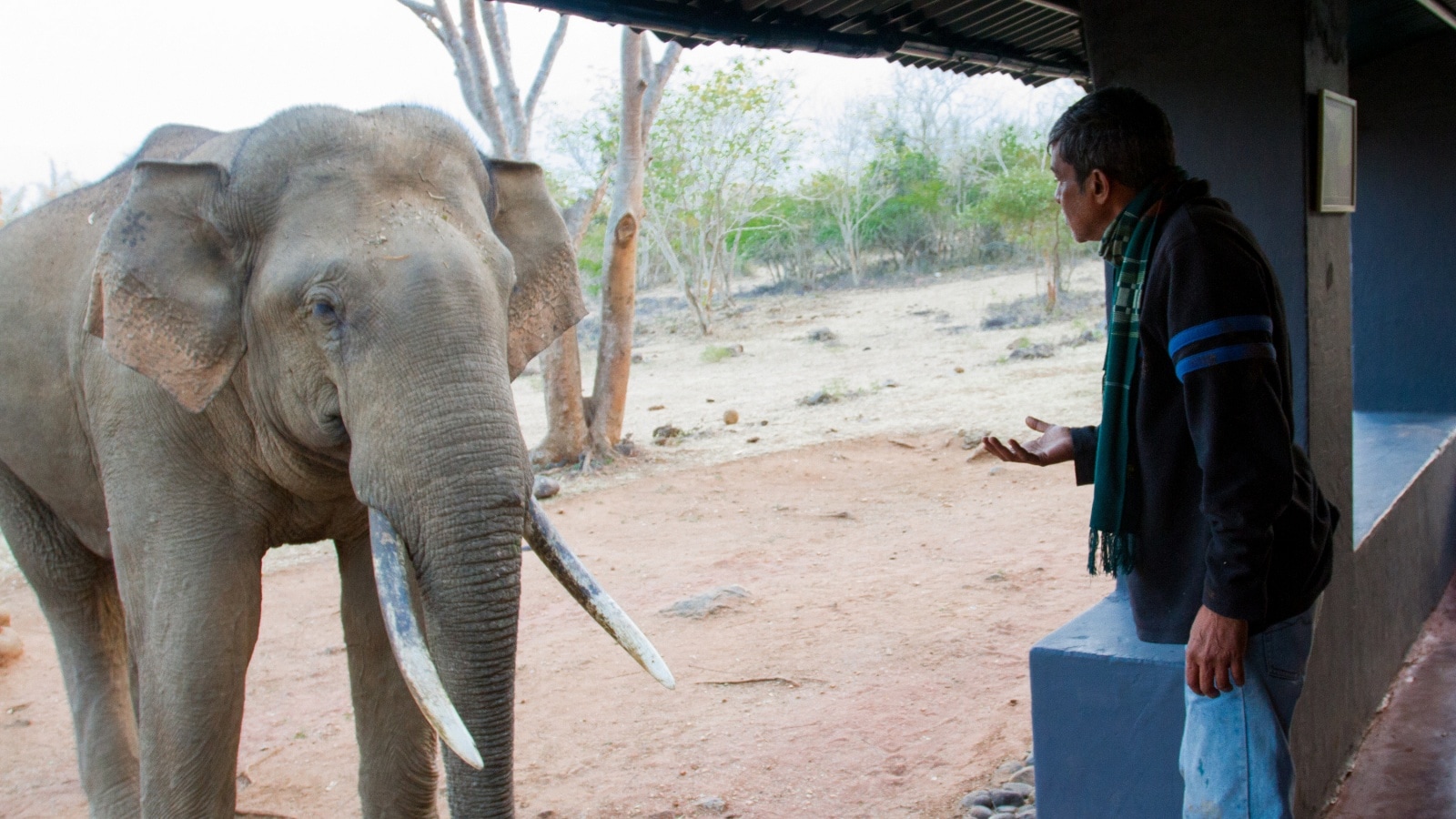
One man knew the tusker better than most. In a photo capturing their camaraderie, the man held out a hand, not in command but in conversation, beneath a tiled roof at Cheetal Walk – his residence in the Nilgiris. The man was late Mark Davidar, a conservationist.
Rivaldo was not Brazilian, nor a football star. But like the midfielder it was named after, the elephant inspired fierce loyalty. For nearly three decades, Rivaldo moved through the forests along the Sigur river and the Mudumalai Tiger Reserve, sometimes close enough to homes that people forgot it was wild, sometimes vanishing into the teak and bamboo for months at a time. Its death on Friday, according to local forest guards who spoke to The Indian Express, was after a final, frail return to the landscape that had shaped its life.
“He was released in 2021; he got a bit frightened of people after that captivity episode. He went back to the wild,” said Priya Davidar, an ecologist, former professor at Pondicherry University, and Mark’s sister.
“He was really a gentle, intelligent elephant. People used to throw things at him, but he still retained his gentleness. In 2020, a group lobbied for his captivity, and there was a successful counter campaign,” she recalled on Friday afternoon.
Rivaldo’s story is inseparable from the Davidars – a family synonymous with conservation in the Nilgiris. Mark, who died in 2013 at 56, had lived for a quarter century in Masinagudi, running the Sigur Nature Trust to protect elephant corridors. His home, Cheetal Walk, became something of a pilgrimage site. Wild elephants, drawn by salt, water and occasionally food left behind, wandered in and out of its clearing. Mark named the young male tuskers after his favourite Brazilian footballers: Roberto Carlos, Ronaldo, Kaka, Cafu, and Rivaldo. “Many more Brazilians are still roaming around here,” Priya said.
Story continues below this ad
Rivaldo lost a sizable portion of its trunk in 2013, likely to poachers. Mark ensured it was treated. Later, in 2015, when it was wounded again by a wild tusker, forest department teams intervened once more. The elephant became known for its unusual ease around humans and would linger near Cheetal Walk, waiting.
But proximity is a fragile thing in the wild. By 2020, Rivaldo’s habit of entering residential areas – including a gated community built on a disputed elephant corridor – had made it controversial. Some fed the animal, others feared it. Petitions were filed seeking its capture, citing health concerns. The Madras High Court rejected one such plea in 2021, remarking that while the “laws of nature may be cruel,” animals are “best left in the wild.”
Rovaldo had already been taken into custody once that year, led into a kraal near Vazhaithottam for medical treatment after difficulty eating because of an old trunk injury. It spent nearly 90 days in captivity before being released in August 2021 – the first case in India of an elephant kept for three months and then rewilded.
A senior government official later said it was Menaka Gandhi who intervened with Chief Minister M K Stalin soon after he took office in 2021, helping secure Rivaldo’s freedom.
Story continues below this ad
Once freed, it wore a radio collar and roamed 30 to 40 kilometres a day. Camera traps in December 2025 captured it near Bokkapuram after it had been missing for 48 days, prompting rumours that it had died. Officials said the animal likely wandered into Kerala and Karnataka before returning. “Wild elephants often move across landscapes before settling back,” a senior forest official from Mudumalai said.
Yet something had shifted. After captivity, Priya said Rivaldo was different.
Last September, it was injured in a clash with another tusker and vanished for three months. When it returned in December, thinner and weaker, those who had known Rivaldo sensed the end. The wound had gone untreated. Approaching the animal was no longer possible.
Rivaldo was younger than many tuskers who can live into their mid-50s. To those who watched it grow from a young bull in the mid-2000s, its journey seemed unfinished.
Story continues below this ad
Rivaldo’s life spanned a particular era in the Nilgiris – the tightening of corridors, the rise of gated communities, the legal battles over whether a wild animal who had tasted human food could ever return fully to the forest. It became a symbol – for some, of misplaced sentimentality; for others, of coexistence at its most fragile.
It was neither a saint nor a menace. It was a wild elephant that once stood close enough to a forest house to be named. Long after Mark Davidar’s death, villagers had told this reporter that Rivaldo still paused near Cheetal Walk, as if expecting the familiar figure on the veranda. The man was gone, but the elephant returned, again and again, to the clearing by the Sigur river.
In the end, Priya believes Rivaldo returned to the Vazhaithottam area in Masinagudi for the same reason. “Maybe he came back here to die as it is his own place. Poor guy, he could have happily lived another 10 more years,” she said.
