

Supreme Court’s ongoing Sabarimala hearings has brought forth the faultlines in the saffron camp on an issue close to its supporters’ hearts: freeing temples from state control.
Submissions by the BJP-led Centre to the nine-judge bench presided by Chief Justice of India Surya Kant reflect the Narendra Modi government’s reluctance to cede complete control of temples to the faithful — something the party has often accused Opposition-ruled states of.
Among those protesting the Centre’s stand are a host of Hindu outfits, including the ‘RSS-inspired’ Kerala Kshetra Samrakshana Samithi.
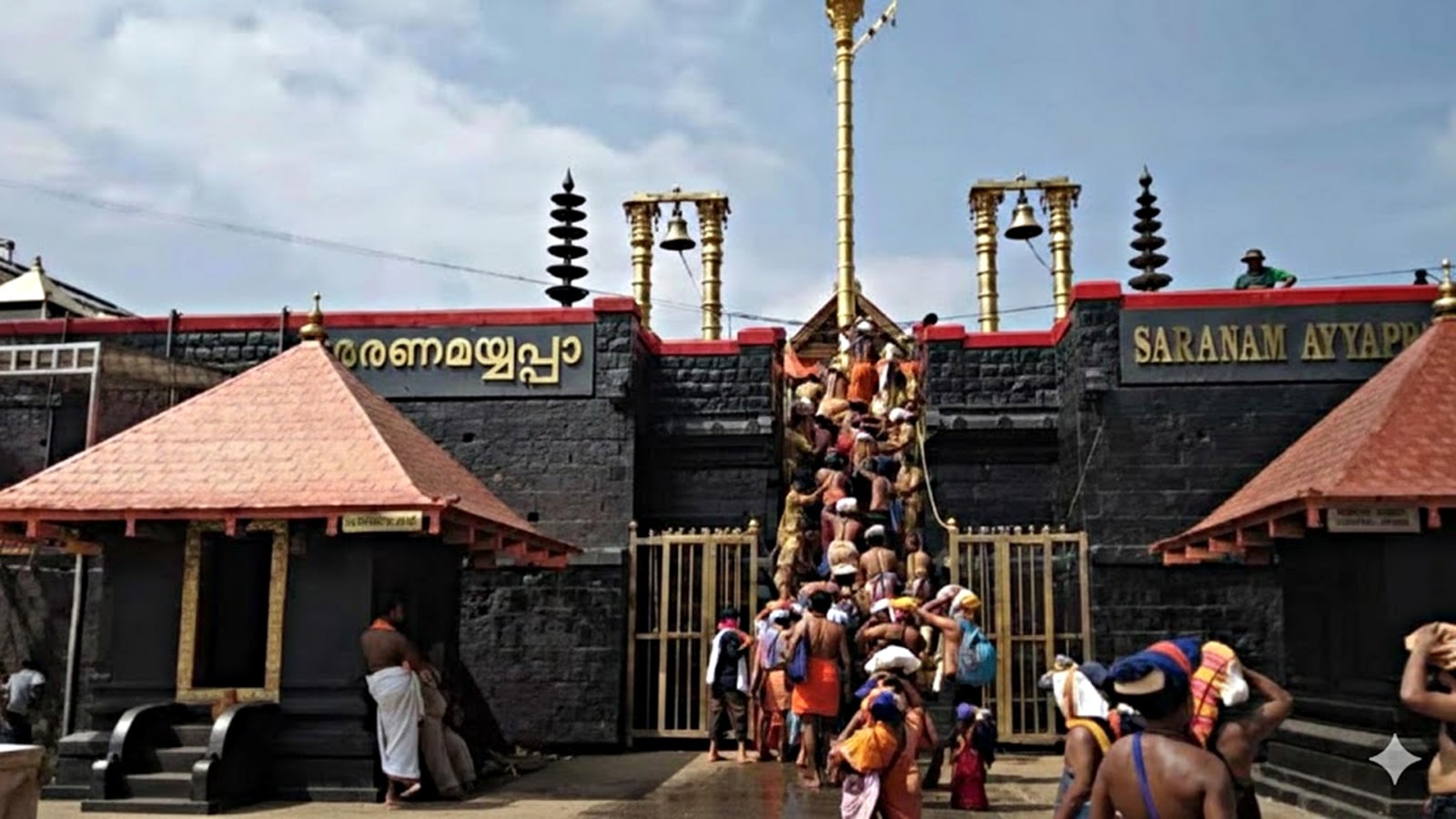
The bench, also comprising Justices B V Nagarathna, M M Sundresh, Ahsanuddin Amanullah, Aravind Kumar, Augustine George Masih, Prasanna B Varale, R Mahadevan and Joymalya Bagchi, is examining seven constitutional questions arising out of petitions seeking review of the 2018 Supreme Court judgment that struck down restrictions on entry of women into the Kerala hill shrine.
One of the key questions before the bench is “the interplay between the rights of persons under Article 25 of the Constitution and the rights of religious denominations under Article 26”. The reference is testing the limits of the constitutional framework to deal with the relationship among religion, religious denominations and the state.
While Article 26 (b) gives religious denominations, and any section thereof, right to manage their own affairs in matters of religion, Article 25 clause (2) sub-clause (a) empowers the state to make laws for regulating or restricting any economic, financial, political or other secular activity, which may be associated with religious practice.Sub clause(b) allows the state to make laws for social welfare and reform or the throwing open of Hindu religious institutions of a public character to all classes and sections of the faith.
Hindu outfits say that state governments have used Article 25 to establish perpetual control over temples, grab their wealth, appoint priests and sometimes even dictate — as in Tamil Nadu — what prayers should be recited in the sanctum sanctorum, or prevent saffron flags in temple festivalsas in Kerala.
Story continues below this ad
On the issue of appointment of temple priests (archakas), Solicitor General Tushar Mehta, appearing for the Centre, was categoric that it is not a secular function. “Even in a public temple, appointment of a pujari who requires certain expertise, qualifications and knowledge of Agamas (scriptures that explain the manner of consecration and worship in temples, their construction, etc.) can never be left to the government,” he said. “It (appointment) cannot be done under an act or by the state… Tomorrow, by this very logic…Shankaracharya can be removed by the state, some archbishop can be removed by the state. These kinds of things will have to emanate from the religion itself, from the society itself, from the denomination itself. It cannot be state-controlled. That is the real secularism… If we do not want religion to interfere with the state, the state also will not interfere with the religion.”
Mehta, though, was guarded on the interplay between Article 25 and 26 rights.
“Both rights are fundamental rights. Article 26 (b) is a right, which is not an island, but between the two, being the denominational right, would have a precedence, provided that if there is some provision of law which requires it to be curtailed, or to be regulated or restricted, then it would be Article 25 (2). And my concern also I have shared, if we say 26(b) is unhindered, then there can be an argument that even people from say Schedule Castes… can also be prevented…” he said. “I’m aware, some states are taking away control of some religious institutions… But if this right is conferred upon the denomination, one denomination amongst the Hindus or Muslims will prevent another denomination of the same religion… But we may not create a situation where there is disharmony internally amongst the religions. So, it would be the rare circumstance where you will interpret 26 (b) subject to 25 (2), but it (Article 26(2b)) would never be an isolated island,” Mehta added.
Senior Advocate C S Vaidyanathan, representing the Nair Service Society and Mathru Samithi of Kerala Kshethra Samrakshana Samithi, besides the Ayyappa Seva Samajam, and Swami Dayanand Saraswati’s Hindu Dharma Acharya Sabha, however, chose to differ on the rights of the denomination under Article 26 (b).
Story continues below this ad
He said the right under Article 26 should prevail over Article 25(2)(b) right, adding the only restraints can be on the grounds of public order, health and morality.
He contended that Article 25(2)(b) is “self limiting” and operates only in the context of Article 25, to enable the right of freedom of conscience that the provision guarantees, and does not extend to Article 26 to curb the religious rights of the denomination.
“Article 26 is to be dealt with separately; 26 is not subjected to other provisions of the part, nor is 25(2)(b) enabling the right under 26 to be controlled. 25(2)(b) is only enabling a law to be made which can regulate the right under Article 25, the individual right…There is no prohibition in regard to making any law for social reform. Like, for example, if somebody says that there should be a Uniform Civil Code. It is something which can be made under Article 25(2)(a). It can be, through 25(2)(a) or the first part of 25(2)(b),” Vaidyanathan contended.
He said, “Article 25(2)(b) is an enabling provision — it grants legislative competence. Article 26(b) is a fundamental right. They operate at different levels of constitutional architecture… An enabling provision/law making power cannot be equal to, much less prevail over, a specific and crucial fundamental right.”
Story continues below this ad
The senior counsel said the SC’s 1957 five-judge Constitution bench’s decision in Sri Venkataramana Devaru and Others vs The State Of Mysore and Others “is in error in holding that rights of a denomination must yield to the overriding right in Article 25(2)(b). On the contrary, Article 25(2)(b) is subject to Article 26(b).”
Vaidyanathan argued that “while Article 25 protects the individual freedom of conscience, Article 26 safeguards the collective autonomy of religious denominations to manage their own affairs in matters of religion. In situations where the exercise of individual claims would alter or interfere with the internal religious practices or institutional arrangements of a denomination, the constitutional guarantee under Article 26 necessarily assumes primacy; otherwise the protection of denominational autonomy would be rendered illusory.”
Justice Kumar echoed the SG’s concerns that “if Article 26 is to be construed virtually in exclusion to 25(2) (b), then that means tomorrow there will be a situation where others will start asserting and say you will exclude X, Y, Z (from entering). You cannot.”
Justice Nagarathna, too, said, “Everybody must have access to temples and mutts and denominational temples keeping any section out will not be in the best interests of Hinduism.”
