

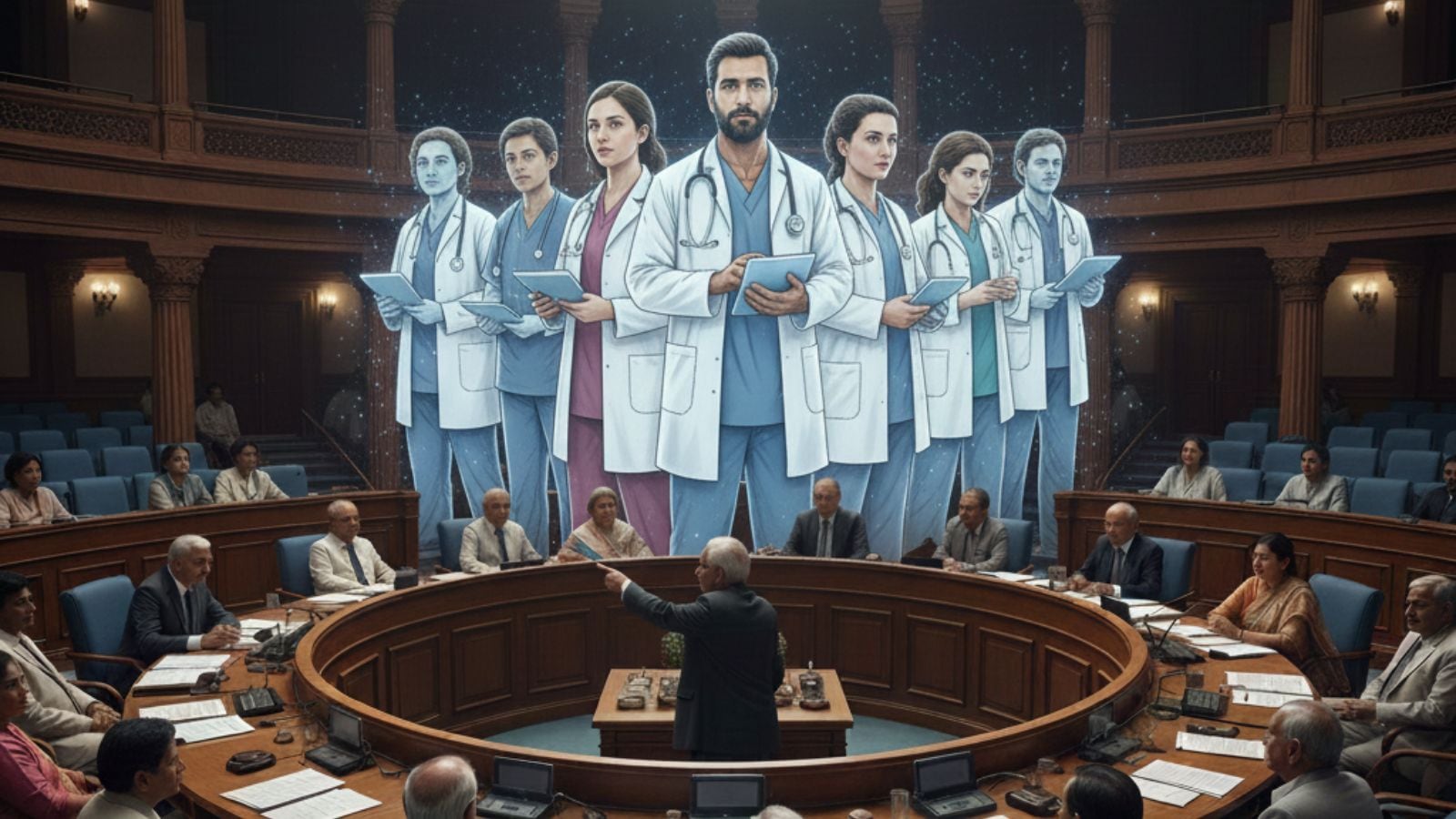
A parliamentary committee has raised serious alarm over the widening disparity in India’s medical education system. In its 167th report, presented to the Rajya Sabha on December 11, the department-related Parliamentary Standing Committee on Health and Family Welfare highlighted two critical issues: the highly uneven distribution of medical seats across states and the prohibitive cost of education, noting that it feels “as if there are no takers for the poor guardian to get their offspring admitted.”

The committee specifically flagged the seat distribution problem, noting that while some states are saturated with medical colleges, others fall severely short of the national average of 75 MBBS seats per million population.
Seat issues in Indian medical education
The committee urged immediate government intervention to address the geographical crisis, specifically recommending the establishment of new medical colleges in Delhi. This move aims to ensure local students have access to quality education without being forced to travel to other states or abroad.
Read |118 medical colleges opened in India in past two years: Which state got the most?
Furthermore, the panel rejected the government’s previous “Action Taken” report on its 157th recommendation. In response, the Committee recommended that the National Medical Commission (NMC) must immediately issue guidelines for creating new medical colleges in states currently facing extreme shortages (where MBBS seats fall below the threshold of 100 per million population).
Read | Can Germany attract more Indian medical aspirants? Know more about visa policy, courses
The committee’s report highlighted the staggering regional disparities in seat availability. It noted that southern states like Karnataka, Telangana, and Tamil Nadu enjoy approximately 150 MBBS seats per million population, with Puducherry having an extreme concentration of close to 2,000 seats per million. In stark contrast, several states have less than 50 seats per million, with Bihar recording a crisis-level low of only 21 seats per million.
Story continues below this ad
Increase the intake of MBBS seats
Furthermore, while the Committee appreciated the flexibility of the new UG-MSR 2023 guidelines for new colleges (allowing 50/100/150 seat capacity), it underscored that colleges, both new and old, should be allowed to increase their intake up to a maximum of 250 MBBS seats in a phased manner, provided the necessary infrastructure and faculty are in place.
Read | Know history of Indian medical education
The Committee additionally stressed that efforts must be concentrated on opening new medical colleges in underserved districts. These new facilities should be encouraged to utilise existing local government medical colleges and hospitals to simultaneously deliver healthcare services and education.
Rs 60 lakhs to Rs 1 crore: Panel recommends reforms in fees
Regulations on the fee structure
Reiterating its concern, the panel highlighted that the affordability of medical education remains a critical crisis. The ‘huge cost’, ranging from Rs 60 lakh to over Rs 1 crore, effectively excludes poor families. To tackle this, the Committee endorsed a major fee reform: the government should regulate the fee structure for 50 per cent of seats in all private medical colleges, setting it at the state government rate. The fees for the remaining 50 per cent of seats would then be determined in consultation with each state’s fee regulatory committee.
Story continues below this ad
To further combat the affordability crisis, the panel reiterated its call for the Ministry, in collaboration with state governments, to implement need-based scholarships for deserving students. Other potential solutions suggested included running medical colleges under a Public-Private Partnership (PPP) model and offering tax benefits to companies or groups involved.
Clear criteria for promotions
Addressing the critical issue of faculty shortages, particularly in remote medical colleges, the Committee stressed the urgent need for robust incentives. It firmly stated that competitive salaries, job security, and structured career growth must be prioritised over temporary ad-hoc or contractual appointments to effectively streamline and strengthen teaching staff.
The Committee further emphasised that the system needs to be strengthened by streamlining the sanctioning of posts and maintaining a balanced reservation policy. These measures are crucial for the timely filling of vacancies, which will ultimately bolster both medical education and healthcare services.
Expansion Roadmap: Phased Seat Increase (UG-MSR 2023)
Key Parliamentary Recommendations
Establish new medical colleges in Delhi and underserved districts to address geographical crisis
NMC must issue immediate guidelines for states with fewer than 100 MBBS seats per million
Allow colleges to increase intake up to 250 seats in phased manner with proper infrastructure
Regulate 50% of private college seats at state government rate (Rs 60 lakh-Rs 1 crore crisis)
Indian Express InfoGenIE
Administrative monitoring
Regarding academic integrity, the panel agreed with the Health Ministry that ghost faculty’ is a detriment to medical education. However, the Committee expressed confidence that the recently introduced Aadhaar-based Biometric Attendance System by the NMC will be effective in combating and curbing the pervasive problem of ‘ghost faculty’ and ensuring mandatory attendance.
Story continues below this ad
The panel further suggested that administrative monitoring must be enhanced through robust IT solutions, such as face recognition and geo-positioning monitoring of attendance. Implementing these technologies, it argued, would significantly boost the effectiveness of faculty monitoring and decisively mitigate the menace of “ghost faculty.”
FMGE
Shifting focus, the Committee observed that due to the huge volume of MBBS aspirants and the limited number of domestic seats, an alarming number of students are forced to seek medical education outside India. Upon their return, however, these foreign medical graduates face “Herculean challenges” in passing the mandatory license examination and securing permanent registration across various states.
While the Foreign Medical Graduate Regulation (FMGR) 2021 mandates one year of additional compulsory rotating medical internship in designated hospitals, the Committee noted that foreign medical graduates are valuable for maintaining the doctor-to-population ratio. Therefore, the panel reiterated its recommendation that the FMGR 2021 must function as a facilitator, streamlining the registration and internship processes while rigorously maintaining the quality standards of the Indian healthcare system.
Ultimately, the Committee concluded that to improve the doctor-to-population ratio and curb the reliance on foreign medical graduates, the government must aggressively encourage the expansion of domestic medical colleges. This expansion is essential to accommodate the education of MBBS aspirants within India itself.
Story continues below this ad
Introduction of NExT
The panel reiterated its earlier stance that the introduction of the National Exit Test (NExT) is vital, as it will institute a universal and standardised assessment of medical graduates, ensuring a uniform level of knowledge and skills nationwide.
Read | NExT is future, but it will not be implemented immediately, says NMC
Agreeing with the Health Ministry, the Committee affirmed that NExT signifies a ‘paradigm shift’ in teaching methods and critical assessment throughout MBBS courses. It therefore recommended that the committee reconstituted under the NITI Aayog Chairman must submit its findings immediately to ensure the NExT Exam is implemented as per its pre-conceived schedule.
Finally, the Committee reiterated the need for the government to divide India into different zones where reputed institutions like AIIMS would function as mentor institutions. These mentors would play a significant role in monitoring and maintaining the standard of education and classes, especially in newly established or private medical colleges within their respective zones.
