

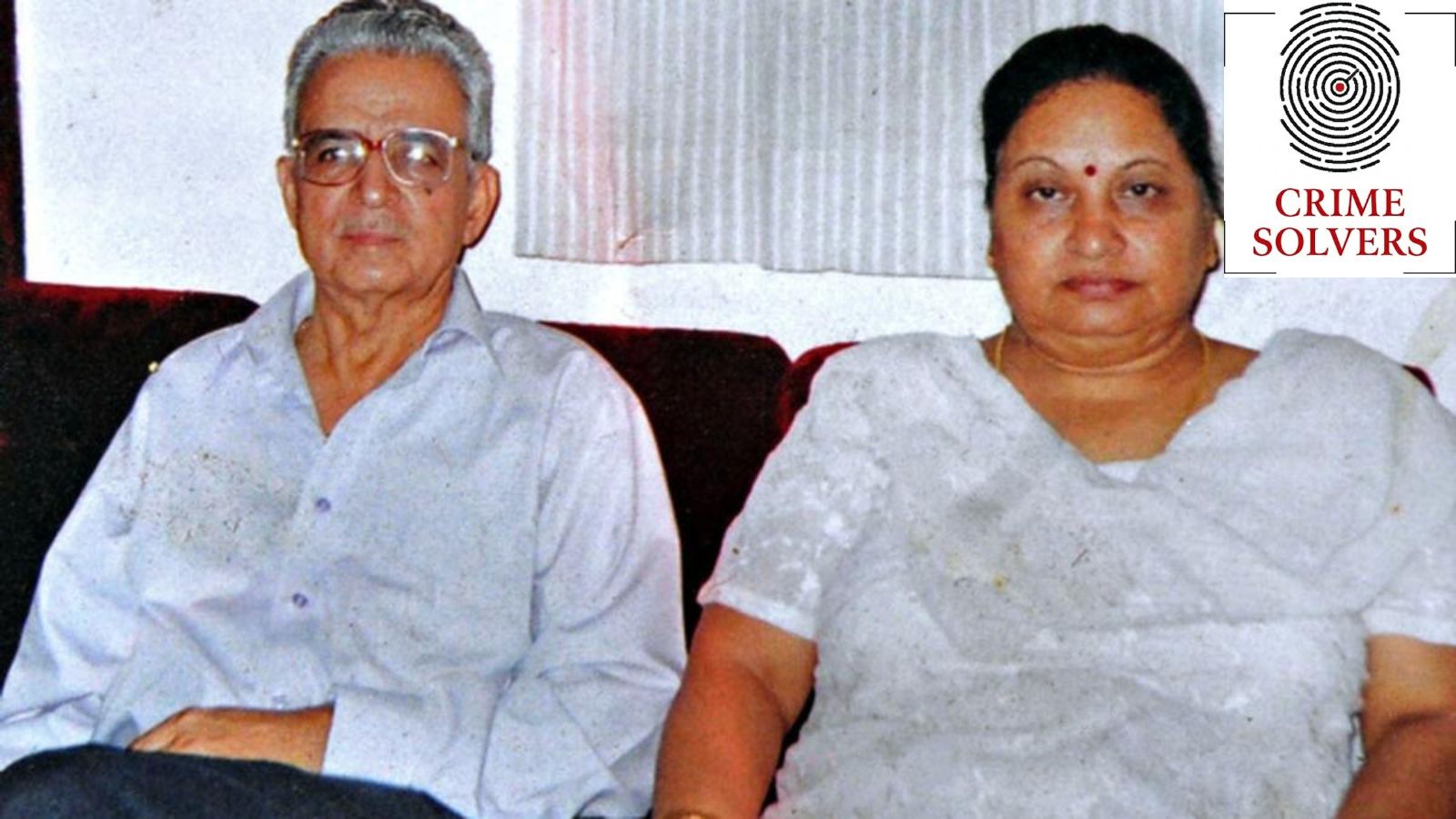
In early 2009, a triple murder shocked Bengaluru. A retired Indian Institute of Science (IISc) professor, his wife, and their physically challenged son were found murdered inside their home. The probe into the shocking crime scene unfolded into a drawn-out investigation led by a dogged team of police officials. Their search for a family stretched over a year and a half, taking them 2,000 km away into a Naxal-dominated area, and culminated in a 17-year wait before justice was finally delivered.
It was February 16, 2009. Anurag Sachdev, the nephew and adopted son of retired IISc professor Purushottam Lal Sachdev, had been trying to reach him over the phone for more than a day, but no one was answering. Worried, he called up their neighbour Rajesh Diwan and asked him to check. When Diwan arrived, he found the front door locked from the outside. When he looked through the window, he saw Purushottam’s son, Deepak Sachdev alias Munna, 35, lying on the floor in his room. Diwan immediately informed Anurag and the police.
Prasad, then an inspector at RT Nagar police station, rushed to the spot. Upon breaking open the door, he found Purushottam, 71, his wife Rita, 67, and Munna dead. Professor Purushottam, a scientist at IISc, was respected for his work in the field of applied mathematics. The couple had also adopted Anurag alias Happy.
Gathering details, the police learned that Anurag had gone out with his friends. The family’s domestic help was also missing. “Happy was the prime suspect in the case initially. He was a drug addict and had been summoned by the police several times before, and let off with a warning. But he cooperated with the investigation. We wanted to know the whereabouts of the domestic help and her family, but their mobile phone was switched off,” a police officer recalled.
Given the gravity of the incident, police teams were sent to trace the domestic help and her family—Suchitra Haldar, 31, her husband Deepak Haldar, 35, and their daughter, who was around five years of age. Suchitra worked as a domestic help, and Deepak washed Purushottam’s car. The family, originally from West Bengal, had been employed in the Sachdev household for more than a month.
“We sent teams to Delhi, West Bengal, and other cities, but there was no progress. Some of Suchitra’s relatives worked in Koramangala. They were questioned, yet there were no leads,” the police officer added.
By then, the post-mortem report suggested that the family had been killed on February 15, 2009, a day before their bodies were discovered. With no arrests or leads, pressure began to mount on the police. Police Commissioner Shankar Bidari also faced flak.
An extensive search—2,000 km away
Story continues below this ad
C W Poovaiah, then a 48-year-old police inspector with the Central Crime Branch (CCB) in Bengaluru, was summoned to meet Bidari. “I went to his office, and he told me about the case. He asked me to take up the investigation and gave me the freedom to choose a team of my choice,” Poovaiah recalls.
Poovaiah had earned a reputation as a skilled investigator as he had played a crucial role in cracking several unsolved sensational crimes, and was also involved in the Bengaluru serial blasts investigation.
“By the time the investigation was handed over to me, 10 months had passed. I had not visited the scene of the crime, but the RT Nagar police had collected all the evidence: fingerprints, a Nokia mobile phone charger wire which was used to strangulate, blood-stained cotton, nails from Rita’s body, etc.,” Poovaiah recalls. “I had to start from scratch. I called Suchitra’s relatives for questioning and was able to get a photo of the Haldars with their kid,” he adds.
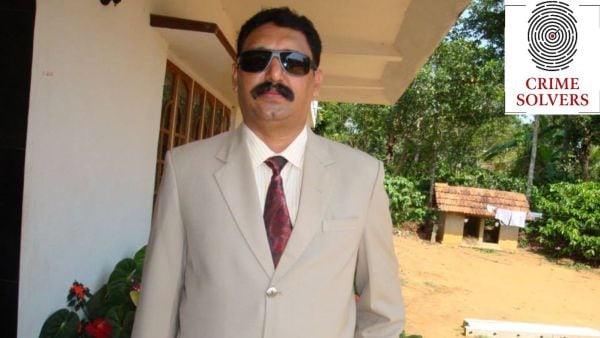 C W Poovaiah had earned a reputation as a skilled investigator when he was asked to take over the investigation into the Sachdev family triple murder case.
After four months of collecting information, Poovaiah and his team headed to West Bengal in search of the Haldars. Poovaiah recalls that several police constables joined in the early stages but returned to Bengaluru after one or two months without any leads. The only police officer who stayed with him was Vinay.
Story continues below this ad
“We landed in Kolkata. The address of the Haldar family was in the South 24 Parganas district. We did not know Bengali and had taken a man from Bengaluru for translation, but it was of no use. The local police were not cooperating, and the search was heading nowhere. We stayed in a shady lodge. We first visited the houses of Haldar’s parents, in-laws, and relatives, but we did not get any information,” he recalls.
A past help pays off
It was then that something he did in the past paid off for Poovaiah. “There was a man named Ram Prasad, a railway employee whose daughter had eloped to Bengaluru from Kolkata around 2007. Through a senior police officer, he contacted me. I arranged a stay for him, searched for his daughter, and eventually traced her. He had lost hope that he would ever be reunited with her, but made it happen,” Poovaiah recalls.
Poovaiah approached Ram Prasad. “By then, I had already spent two months in West Bengal. I had grown a beard…even my family members would not have recognised me. Ram Prasad, who had so much gratitude towards Bengaluru city police for tracing his daughter, applied for a month’s leave and joined me. From then, communication with locals became smooth,” he says.
“We carried a photograph of the Haldar family. We travelled by trains, buses, and autorickshaws, to no avail. During the search, we learned that Deepak used to have a cycle rickshaw to ferry passengers. We also learned that he was dependent on his parents,” says Poovaiah. By then, the rest of the team had returned. Only Poovaiah and Vinay were left.
Story continues below this ad
“We knew that Deepak Haldar’s in-laws stayed in Kupli village. Our last attempt was to go to clinics, hospitals, and schools near the village with their photo. As the Haldars had a daughter, we were sure that they would have visited a clinic or admitted her to a nearby school,” says Poovaiah.
A school teacher and their first break
It was around the first week of November in 2010. A teacher in one of the schools recognised the child and said she was a student there. Finally, Poovaiah and Vinay had their first break. The police learned that a man named Akash Mandal picked up and dropped off the child at school and also tutored her.
Poovaiah and Vinay waited until the next day. When Akash came to pick up the child, they approached him and sought his help to locate Deepak. “Ram Prasad was there to help us, but it was a Naxal area; you could not threaten anyone. In fact, our lives were also at risk. We did not tell Akash about the murders. We said Deepak had stolen sarees in Bengaluru, and we needed to recover them. He believed us and showed us their hut, which was far from Kulpi village, along the forest boundary,” says Poovaiah.
The huts stood about six to seven feet high. Poovaiah approached the local police, requesting just two personnel for support. He feared that too many officers might lead to an information leak. Even in the official requisition, the team entered only the crime number and deliberately avoided mentioning the murders.
Story continues below this ad
When a five-member team, including Ram Prasad, entered the hut to arrest the Haldars, the police were taken aback when Deepak said that his name was Rahul and produced an ID card. Suchitra’s ID showed that she was Sujatha. The daughter’s name, too, had been changed.
The police started to search the house, and that’s when they got hold of the same photo the Bengaluru police team had been carrying. “If he was not Deepak, why would he keep the same photo?” the police asked the Haldars. It was Suchitra who broke first, turning on Deepak and blaming him for the murders, says Poovaiah.
Poovaiah informed the higher-ups in Bengaluru, and the accused were transported to the city for further investigation. During the probe, the police learned that two other accused had helped them. Mohammed Sarbal, 38, and Bidan Shikari, 31, were arrested, even as co-accused Pradeep Naskar escaped.
During interrogation, the Haldars spilt the beans. Every day, when Suchitra came to clean the house, it was always Rita who opened the door. On February 15, following their plan, Rita opened the door when Deepak and Sarbal allegedly covered her mouth, took her to her room, and strangled her. Purushottam, who was sleeping in another room, was killed. Finally, Munna was strangled using the wire of a Nokia mobile phone charger and a dupatta.
Story continues below this ad
The accused stole gold bangles, a gold ring, Rs 30,000 in cash, seven silk sarees, two silver lamps, a wall clock, a mangalsutra, and other articles.
An acquittal comes as a shock
After the arrests, the police filed a chargesheet that included 45 pieces of evidence and 33 witness statements. In 2016, seven years after the murders, the police suffered a setback when the 64th Additional City Civil and Sessions Court acquitted the accused, citing lapses.
In the February 29, 2016, judgement, judge Madhusudhan B said, “There is no any corroborative piece of evidence to complete chain of circumstance to fasten the guilt of the accused. It is established principle that, mere suspicion, however grave, cannot replace the weight attached to the evidence. Therefore, even if it is held that, there is strong suspicion about involvement of these accused in crime but that suspicion cannot be substituted for proof.”
“I have unhesitatingly come to the conclusion that, there is doubt in every step of prosecution case. It is cardinal principle of criminal jurisprudence that, benefit of doubt should be extended to accused. In this case also I have extended benefit of doubt to the accused persons, thereby I have come to the conclusion that, prosecution has failed to prove the guilt of the accused beyond reasonable doubt,” the judgment read.
An appeal, a theory, and a conviction
Story continues below this ad
The state government decided to file a criminal appeal challenging the lower court order. Advocate Rashmi Patel, High Court Government Pleader, argued the case based on the ‘last seen’ theory. With no eyewitnesses and the police having built the case solely on circumstantial evidence, Patel argued that Vijay Kumar, a newspaper boy, was the person to have last seen the victims. In his statement to the court, Kumar had stated that when he went to deliver the newspaper on February 15, 2009, it was Suchitra who had collected it at 6.45 am. The three accused, he said, were standing in front of the gate of the Sachdev residence.
The prosecution relied on seven circumstances to establish the role of the accused: the homicidal death of the Sachdev family, the motive (murder for gain), criminal conspiracy, the ‘last seen’ theory, the recovery of gold and other articles, the conduct of the accused, and Section 106 (the burden of proving facts especially within knowledge) of the Indian Evidence Act.
Patel, explaining the last seen theory, stated that the time gap between the point of time when the accused and the deceased were last seen alive and when the deceased were found dead was so small that the possibility of any person other than the accused being the author of the crime becomes impossible.
Ten years after filing the criminal appeal and hearing the arguments, on February 27 this year, the Karnataka High Court convicted the accused. Justices H P Sandesh and Venkatesh Naik T said in the judgment, “It is contended that the police have arrested accused Nos 1 and 2 from their native village; which is evident from the documents marked in this case. These are all the circumstances, which could have been considered by the trial court. However, failure to consider these points, that too, in a triple murder case is highly improbable. The prosecution has proved the chain of circumstances viz., last seen theory, motive, recovery of gold, silver and other articles, conduct of the accused by reliable and cogent evidence beyond all reasonable doubt. The trial court ignored these points and held that prosecution has failed to prove the case beyond all reasonable doubt, which is erroneous one.”
Story continues below this ad
The court added, “If a person is last seen in the company of the deceased persons and if the facts convincingly establish as to their last seen together, the burden of proof would lie upon the accused persons to show under what circumstances the death had occurred. Whereas, in this case, the accused persons have not offered any explanation as to how and when the accused persons parted with the company of the deceased persons and their failure to offer reasonable explanation itself provide an additional link to the chain of circumstances.”
The court convicted the Haldars, Sarbal, and Bidan Shikar under sections 120b (criminal conspiracy), 302 (murder) and 201 (destruction of evidence) of the Indian Penal Code. The court sentenced all four accused to life imprisonment.
Poovaiah, now 65, has retired from service. He returned to Bengaluru from his coffee estate in Kodagu when the judgment was announced, and was elated to know that the court had convicted the criminals. “I am very happy that justice has been served. The only pain I carry, even to this day, is that Vinay should have been rewarded with a medal by the state, but it did not happen. I hope his work will be recognised now,” he said.
A message to the Karnataka government
The Karnataka High Court also directed the registry to send the judgment copy, particularly two points, to the Karnataka state chief secretary to take necessary action and implementation.
The bench noted, “It is seen in recent times, incidents have been reported where interstate migrants, who were engaged for domestic or construction work, have allegedly been involved in serious offences such as murder and robbery in the very premises where they were employed. In many such cases, the house owners or employers had engaged the workers without conducting any background verification, identity confirmation, or registration with the concerned authorities. Some of such migrant workers frequently committing crimes and fleeing away and as such, the same have to be streamlined by issuance of certain guidelines by the State Government.”
“This situation highlights the urgent need for preventive safeguards through strict enforcement of existing labour and criminal regulatory mechanisms. Further, a structured and mandatory police verification mechanism should be introduced before engaging workers who reside within private premises, similar to tenant verification systems, with simplified online registration portals accessible to the public,” the court added.
It further stated that widespread public awareness campaigns through print, electronic, and social media platforms should be undertaken to educate citizens about safe hiring practices. “However, while strengthening preventive mechanisms, it is equally important to ensure that migrant workers are not stigmatised as a class, since criminal liability is individual in nature and the constitutional guarantees under Articles 14 and 21 of the Constitution of India protect the dignity and equality of all persons. Thus, balanced judicial directions aimed at regulation, awareness, and accountability without discrimination which would serve the larger interest of public safety and social justice,” the court added.
