

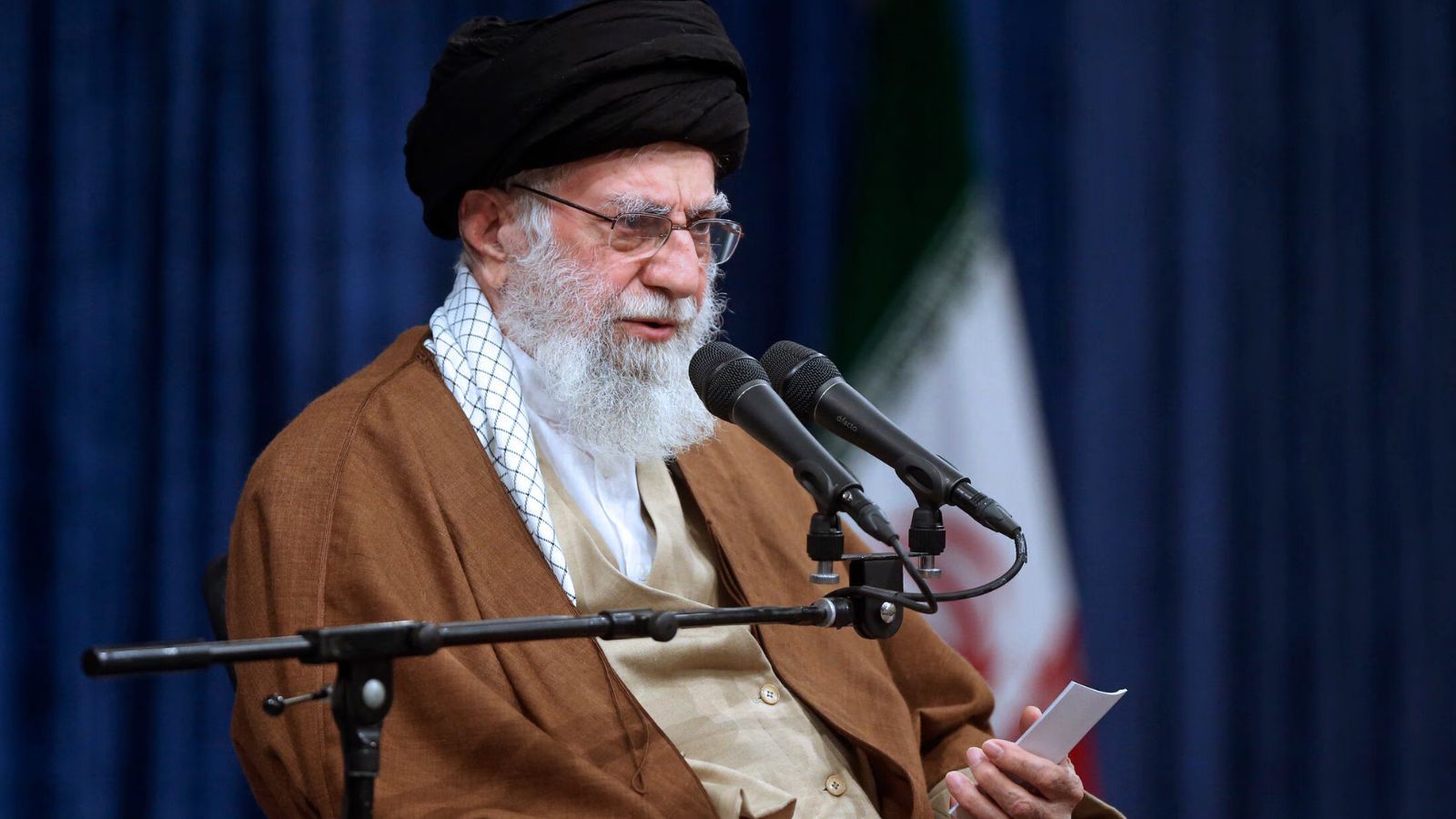
On March 1, Iran confirmed that its Supreme Leader, Ayatollah Seyed Ali Hosseini Khamenei, had been assassinated in targeted strikes carried out the previous day by the United States and Israel. The killing of a sitting head of state in the midst of ongoing negotiations marks a grave rupture in contemporary international relations. Yet, beyond the shock of the event, what stands out equally starkly is New Delhi’s silence.
The Government of India has refrained from condemning the assassination or the violation of Iranian sovereignty. Initially, ignoring the massive US-Israeli onslaught, the Prime Minister confined himself to condemning Iran’s retaliatory strike on the UAE, without addressing the sequence of events that preceded it. Later, he uttered platitudes about his “deep concern” and talked of “dialogue and diplomacy” — which is precisely what was underway before the massive unprovoked attacks launched by Israel and the US. When the targeted killing of a foreign leader draws no clear defence of sovereignty or international law from our country and impartiality is abandoned, it raises serious doubts about the direction and credibility of our foreign policy.

Silence, in this instance, is not neutral. The assassination was carried out without a formal declaration of war and during an ongoing diplomatic process. Article 2(4) of the United Nations Charter prohibits the threat or use of force against the territorial integrity or political independence of any state. A targeted killing of a serving head of state strikes at the heart of these principles. If such acts pass without principled objection from the world’s largest democracy, the erosion of international norms becomes easier to normalise.
The unease is compounded by the timing. Barely 48 hours before the assassination, the Prime Minister returned from a visit to Israel, where he reiterated unequivocal support for the government of Benjamin Netanyahu — even as the Gaza conflict continues to draw global outrage over the scale of civilian casualties, many of them women and children. At a time when much of the Global South, along with major powers —and India’s partners in BRICS such as Russia and China — have kept their distance, India’s high-profile political endorsement without moral clarity marks a visible and troubling departure. The consequences of this event extend beyond geopolitics. The ripples of this tragedy are visible across continents. And India’s stance is signalling tacit endorsement of this tragedy.
The Indian National Congress has unequivocally condemned the bombings and targeted assassinations on Iranian soil, describing them as a dangerous escalation with grave regional and global consequences. We have extended condolences to the Iranian people and to Shia communities worldwide, reiterating that India’s foreign policy is anchored in the peaceful settlement of disputes, as reflected in Article 51 of the Constitution of India. These principles — sovereign equality, non-intervention and the promotion of peace — have historically been integral to India’s diplomatic identity. The present reticence, therefore, appears not merely tactical, but discordant with our stated principles.
For India, this episode is especially troubling. Our ties with Iran are civilisational as well as strategic. In 1994, when sections within the Organisation of Islamic Cooperation sought to advance a resolution against India at the UN Commission on Human Rights over Kashmir, Tehran played a consequential role in blocking that effort. That intervention helped prevent the internationalisation of the Kashmir issue at a delicate moment in India’s economic trajectory. Iran has also enabled India’s diplomatic presence in Zahedan near the Pakistan border — a strategic counter-balance to the development of Gwadar port and the China-Pakistan Economic Corridor.
The present government would do well to remember that in April 2001, the then prime minister, Atal Bihari Vajpayee, during an official visit to Tehran, reaffirmed warmly India’s deep ties with Iran, both civilisational and contemporary. His acknowledgement of those long-standing relations seems to hold no relevance for our current government.
India’s ties with Israel have, in recent years, expanded across defence, agriculture and technology. It is precisely because India maintains relations with both Tehran and Tel Aviv that it possesses diplomatic space to urge restraint. But such space depends on credibility. Credibility, in turn, rests on the perception that India speaks from principle rather than expediency.
This is not merely a moral proposition; it is a strategic necessity. Nearly 10 million Indians live and work across the Gulf. In past crises — from the Gulf War to Yemen to Iraq and Syria — India’s ability to safeguard its citizens has rested on its credibility as an independent actor, not as a proxy.
That credibility did not emerge by accident. India’s post-Independence foreign policy was shaped by non-alignment — not as passive neutrality, but as a conscious assertion of strategic autonomy. It was a refusal to become subsumed into the rivalries of great powers. The present moment raises uncomfortable questions about whether that posture is being diluted. An uncritical silence in the face of unilateral military action by powerful states looks like retreat from that principle. And in effect, an abandonment of our legacy.
This matters not only for history, but for India’s present ambitions. For a country that seeks to represent the Global South, the optics of acquiescence carry real costs. If sovereignty can be disregarded without consequence, as it is in the case of Iran, smaller powers are left exposed to the whims of the strong. India has repeatedly argued for a rules-based international order that protects the weak from coercion. That argument rings hollow if it is not voiced when the test is immediate and uncomfortable. Why should countries in the Global South trust India to defend their territorial integrity tomorrow if it appears hesitant to defend that principle today?
The appropriate forum for resolving this dissonance is Parliament. When it reconvenes, this disturbing silence over the breakdown of international order must be debated openly and without evasion. The targeted killing of a foreign head of state, the erosion of international norms, and the widening instability in West Asia are not peripheral matters; they touch directly upon India’s strategic interests and moral commitments. A clear articulation of India’s position is overdue. Democratic accountability demands no less, and strategic clarity requires it.
India has long invoked the ideal of vasudhaiva kutumbakam — the world is one family. That civilisational ethos is not a slogan for ceremonial diplomacy; it implies a commitment to justice, restraint and dialogue, even when doing so is inconvenient. At moments when the rules-based order is under visible strain, silence is abdication. India has long aspired to be more than a regional power; it has sought to serve as the conscience-keeper of the world. That stature was built on a willingness to speak for sovereignty, peace, non-violence and justice even when doing so was inconvenient. At this moment, there is an urgent need for us to rediscover that moral strength and articulate it with clarity and commitment.
The writer is chairperson, Congress Parliamentary Party and member of Rajya Sabha
