

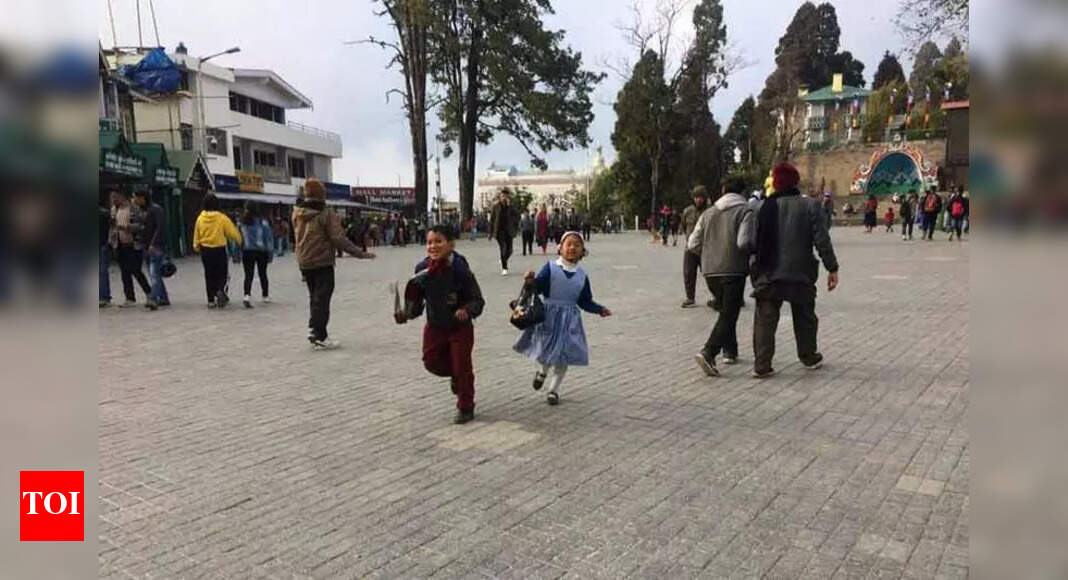

When the West Bengal Board of Secondary Education told every government and aided school to open assembly with the state anthem Banglar Mati, Banglar Jal, the Hills read a larger message: Uniform ritual, uniform identity. The Gorkhaland Territorial Administration (GTA) pushed back, saying the order won’t apply to Darjeeling schools. In a letter to the District Inspectors of Schools in Darjeeling and Kalimpong, the GTA secretary clarified that institutions in the GTA area already conduct morning assemblies with their customary anthem and prayers in Nepali. The note said that these schools will continue their existing practice, keeping in view their distinct cultural traditions and language of instruction.This decision is being read, in some quarters, as a small administrative accommodation. It is not. It tells us how daily rituals in schools — the most ordinary of spaces — become the stage upon which questions of language, belonging, and memory are negotiated. The state’s argument was straightforward: A shared song for a shared civic identity. The Hills’ argument was equally clear: Shared citizenship does not mean uniform cultural symbols.For the GTA, the anthem order touched a nerve long alive in the Hills — the sense that regional identity is perennially asked to prove its loyalty. So Darjeeling received an exemption — not as defiance, but as a reminder that national belonging in India has always allowed for layered identities.
Nationwide pattern: A steady drumbeat
Across India, the morning assembly has become a quiet battleground where the State’s idea of unity meets the school’s experience of everyday belonging. When a song shifts from habit to requirement, from shared ritual to mandatory recital, the meaning changes. And once meaning changes, people watch closely. Schools, after all, are where the State speaks directly to the child — and children remember the tone in which authority arrives.In Rajasthan (2025), the directive to sing the national anthem and national song every day did not cause friction merely because of the ritual itself — assemblies across India already end with the anthem. The tension lay in the language of enforcement: Compliance tied to attendance records, and the possibility of salary deductions for staff who did not follow. The anthem was no longer simply the anthem; it was evidence of obedience. Teachers’ unions read it not as patriotism, but as the State marking who is loyal enough to be counted.In Maharashtra (2025), the move to make the state anthem Jai Jai Maharashtra Maza compulsory in all schools, including CBSE, ICSE and international boards, created a different kind of ripple. Mumbai schools asked a pragmatic question: When children speak in several languages at home, study in an English-medium classroom, and socialise in a hybrid city idiom — what does it mean to institutionalise a single linguistic song as the daily declaration of identity? The debate here was not anti-Maharashtra. it was about whether regional belonging can be standardised at the speed of a circular.In Jammu & Kashmir (2024), the directive to begin every school assembly with the national anthem landed in a landscape where symbols are never neutral. Here, the anthem itself is not widely contested. What is contested is the weight of compulsion in a region where identity has long been scrutinised. A song that means belonging in one state can feel like a test in another.Karnataka (2022) took a firmer administrative approach: The government made daily singing of the national anthem compulsory across government, aided and private schools and PU colleges, framing the order as a correction to schools that had quietly dropped the anthem from routine. The reaction was less public, more infrastructural. Schools complied — some shifting the anthem to classrooms where space was limited — but the story revealed a truth: Even when there is little overt protest, the cultural meaning of a ritual still depends on how gently or aggressively it is reinstated.In Uttar Pradesh (2017), when the Allahabad High Court upheld the State’s right to prescribe the anthem in schools including madrasas, the ruling coexisted — delicately — with the Supreme Court’s Bijoe Emmanuel judgment (1986), which protects students who stand respectfully but do not sing on sincere religious grounds. The courts have already drawn the line clearly: The State may set the ceremony; it may not command the conscience.Yet, many state orders continue to write the first part loudly and the second not at all which is why this pattern keeps resurfacing.
Why the pushback persists: Symbolism, power, and more
The resistance that surfaces in schools is rarely about the anthem itself. It is about the conditions under which the anthem is asked to be sung. When the State inserts compulsion, it alters the emotional temperature of the act. A song that once marked shared belonging becomes, instead, a measure of compliance. And schools — perhaps more than any other institution — feel this shift first, because children intuit tone long before they understand law.Part of the pushback is shaped by symbol hierarchy. The national anthem has a constitutional gravity that most communities comfortably recognise. The national song does not occupy the same legal footing, and state anthems are woven from regional memory and linguistic belonging. When orders treat these three as interchangeable instruments of discipline, identity responds, not through loud protest alone, but through hesitation, discomfort and maybe pauses in the assembly line. The friction usually begins quietly — in the staff room, not the street.Another part of the pushback comes from the grammar of enforcement. A circular that simply says “Let us begin each day together” lands very differently from one that says “Comply, or it will be marked against you.” The moment the State attaches attendance, reports, or salary to a song, the song stops being music and becomes record-keeping. And once it becomes record-keeping, it inevitably becomes political. This is not because teachers dislike the anthem — it is because no one likes to be counted as loyal or disloyal in front of their own students.There is also the legal memory held within the education system itself. The Supreme Court’s Bijoe Emmanuel judgment made it unmistakable: Students who stand respectfully cannot be compelled to sing if it violates conscience. Many principals know this. Many district officials know this. Yet state circulars often omit any mention of this accommodation. That omission is not accidental; it is cultural. It tells schools: We expect uniformity, and you will explain the exceptions later. The pushback, then, is not against the anthem. It is against the erasure of nuance.And finally, there is history — not written in textbooks but held in collective memory. In regions with layered political pasts — Darjeeling, Kashmir, parts of Maharashtra, parts of Karnataka — symbolic assertion has always been closely watched. When a morning song becomes mandatory, it does not enter a vacuum. It enters a landscape where communities remember moments when identity had to be defended, negotiated, or proved. A daily ritual can either heal that memory — or reopen it.In short, the pushback is not defiance. It is the insistence that patriotism is strongest when it is chosen, not when it is checked, tallied, or enforced.
Belonging, not uniformity: The lesson Darjeeling schools hold up to India
What unfolded in Darjeeling is not merely a regional exception; it is the mirror held up to the nation. It shows us that unity in India has never been the product of one anthem, one language, one ritual, sung in one voice. It has always been a composition of many registers — Nepali and Bengali, Marathi and Kannada, Kashmiri and Hindi — carried together without being collapsed into uniformity. The morning assembly can be a space where those registers meet with dignity, rather than discipline. The test before us is simple: Will we choose a version of patriotism that is performed under supervision, or one that grows quietly from feeling and memory? Darjeeling has already chosen. It has reminded us that belonging is strongest when trust precedes instruction.
