

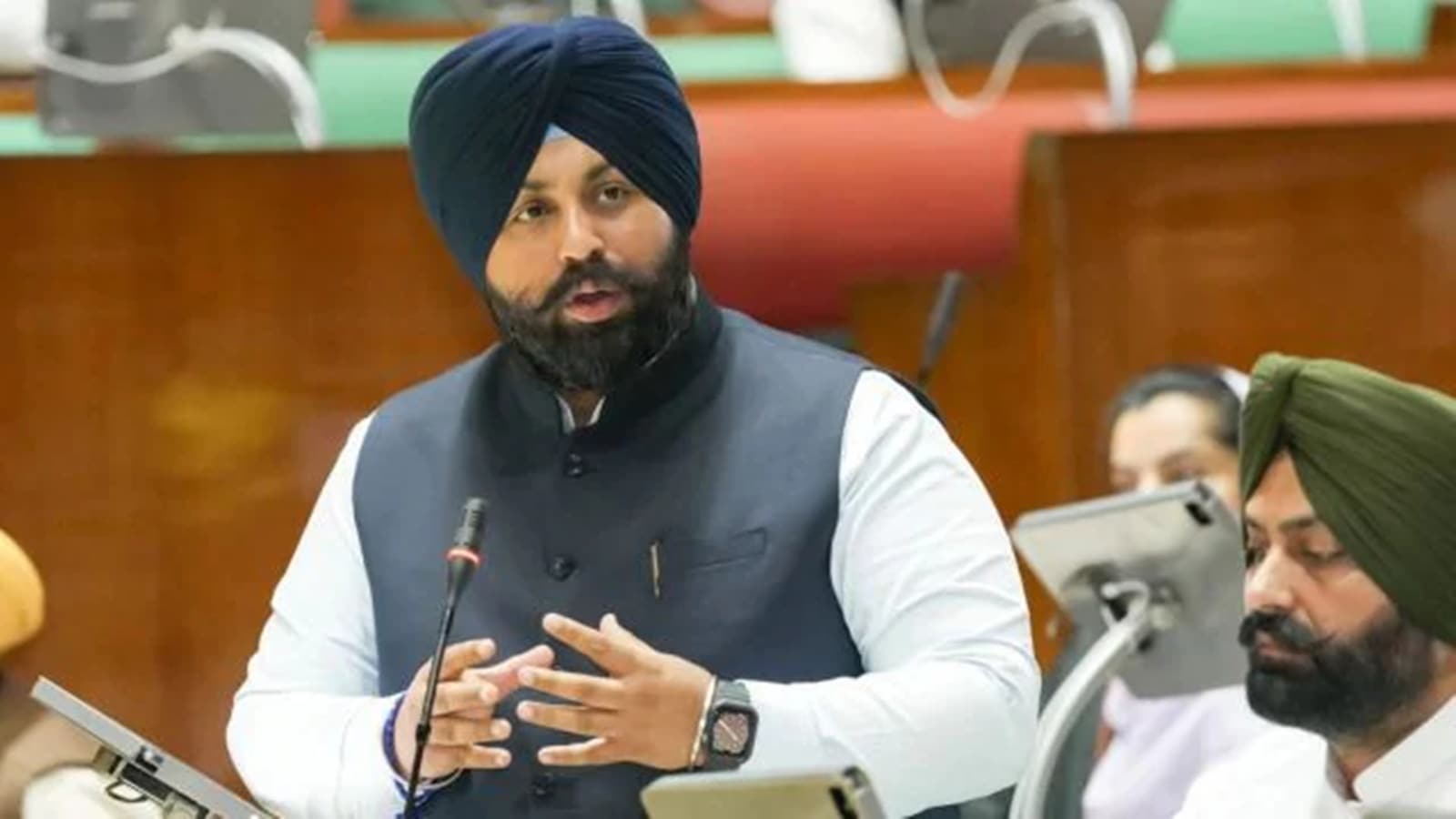
Good infrastructure, high academic confidence and social trust are the key elements that can prompt all parents, including politicians, to choose government schools for their children, Punjab Education Minister Harjot Singh Bains told The Indian Express. Edited excerpts from the full interview:
IE: What are the key initiatives taken by the AAP government to turn around government schools in Punjab?
Punjab’s school education system had suffered from decades of neglect. Of nearly 19,000 government schools, more than 8,000 did not have boundary walls, more than 3,200 did not have washrooms or were in such condition that could not be used. More than 4 lakh students used to sit on the ground due to lack of desks. When we came to office, we were very clear that if Punjab has to change, government schools have to be changed first. That is why we made education the central priority of governance, not a sideshow.
Harjot Singh Bains: First, we focused on infrastructure and dignity in schools: boundary walls, toilets, classrooms, desks, cleanliness, security and campus management. Second, we focused on teacher capacity and accountability through training, academic monitoring and a results-oriented culture. Third, we started transforming the learning environment through Schools of Eminence, digital classrooms, interactive flat panels, computer labs, and stronger science and commerce education. Fourth, we pushed career counselling, exposure and competitive exam preparation so that government school children can compete with anyone in the country. Fifth, we brought education to the centre of public conversation through Punjab Sikhya Kranti — for the first time, school transformation became a political mission.
The result is that today Punjab’s government schools are not being discussed as symbols of neglect, but as symbols of possibility.
IE: What is the progress of the AAP government’s flagship “Schools of Eminence”. How many of the proposed 117 are now fully operational?
Story continues below this ad
Harjot Singh Bains: Schools of Eminence are one of the most important reforms undertaken by our government because they are setting a new benchmark for what quality public education should look like.
These schools are not just about better buildings. They represent a complete shift in approach — better infrastructure, modern labs, smart classrooms, sports facilities, career guidance, leadership development, and structured academic support for competitive exams like JEE and NEET. I am happy to inform that this year, 267 students from SoEs have cleared JEE Mains and 847 have cleared NEET.
As of now, the Schools of Eminence have been made operational in a phased manner, and the network is being continuously strengthened in terms of staffing, facilities and academic programming. More than 50 schools are fully ready while full swing construction is going on in many and in some it will begin in April.
For us, Schools of Eminence are not the final destination. They are the model through which the standards of the entire system will rise.
Story continues below this ad
IE: What more do you think can be done in terms of policy and infrastructure to inspire MLAs to send their own children to government schools?
Harjot Singh Bains: This is not just a policy question, it is also a moral and political question.
The day public representatives begin to feel fully confident that a government school can give their child the same dignity, safety, exposure in English language, digital access, sports opportunities and future prospects as any private school, the entire conversation will change.
For that, three things are necessary. First, good infrastructure: excellent classrooms, clean toilets, secure campuses, labs, libraries, sports grounds and digital learning tools. Second, high academic confidence: strong foundational learning, good English communication, science and maths proficiency, and visible pathways to higher education and jobs. Third, social confidence: parents, including legislators, must feel that choosing a government school is not a compromise but a statement of trust.
Story continues below this ad
My own effort has been to move in exactly that direction. Schools of Eminence are one step. Teacher training is another. Digital transformation is another. But ultimately, the larger mission is this: government school education should become so strong that no one asks why an MLA sent his child there, it should feel natural… We have an IAS officer also who is sending his child to a government primary school. Due to the safety of students, names should not be disclosed. Also in the past four years, more than 3,000 government teachers have shifted their children from private to government schools.
IE: Teacher shortage is a major issue. Over 50 per cent of government schools do not have principals, 30 per cent are without headmasters and over 40 per cent posts of block primary education officers are vacant. Pre-primary wings have been started in government schools without hiring specialist teachers. How is this problem being solved?
Harjot Singh Bains: Teacher shortage is a genuine challenge, and it did not arise overnight. It is the result of years of systemic neglect. We inherited that reality.
Recruitment processes have been accelerated and more than 14,000 teachers have been recruited in the last four years and recruitment of thousands more are in the pipeline. Punjab has one of the best teacher pupil ratios in the entire country. Challenge is rationalisation and we are working on it.
Story continues below this ad
The recent Hon’ble Supreme Court’s judgment (last year) on TET (Teachers’ Eligibility Test) exam being compulsory for even already recruited teachers has put every promotion on halt. More than 4,500 promotions were hit and most of them were of principals, head masters and lecturers. If this is sorted, 500 schools will get principals. Also, at the same time, there is a stay on recruitment of fresh principals, too. But I can say with confidence that for the first time in many years, there is a government that is treating staffing gaps as a core governance issue.
IE: Recently, you visited several government schools, and found that children in primary classes could not follow basic math. Yet, Punjab has been topping educational surveys. Is the ground reality different from what is being portrayed on paper by officials?
Harjot Singh Bains: I have visited more than 2000 schools in the last 4 years. Education is my passion. And I feel change can only happen when we hit the ground and learn first hand from our teachers what needs to be done right.
Whenever I visit a school, if there are some good practices in that school I motivate my teachers to do even better and appreciate their efforts. And if in some schools negligence on part of staff is found they are questioned also. After all, it’s about the future of our students. I do not believe in denial. If I visit a school and I find a child in Class 4 or 5 struggling with basic reading or arithmetic, I will say it openly. That honesty is the starting point of reform.
Story continues below this ad
At the same time, one must understand that a state-level survey captures aggregate performance, while a school visit can expose deep local gaps. My job is not to hide behind rankings. My job is to treat rankings as encouragement, not as an excuse for complacency. Our government’s goal is that no child should be left behind.
That is precisely why we are now moving with sharper focus on foundational literacy and numeracy, academic supervision, teacher support and school-level accountability through our flagship FLN programme Mission Samrath.
