

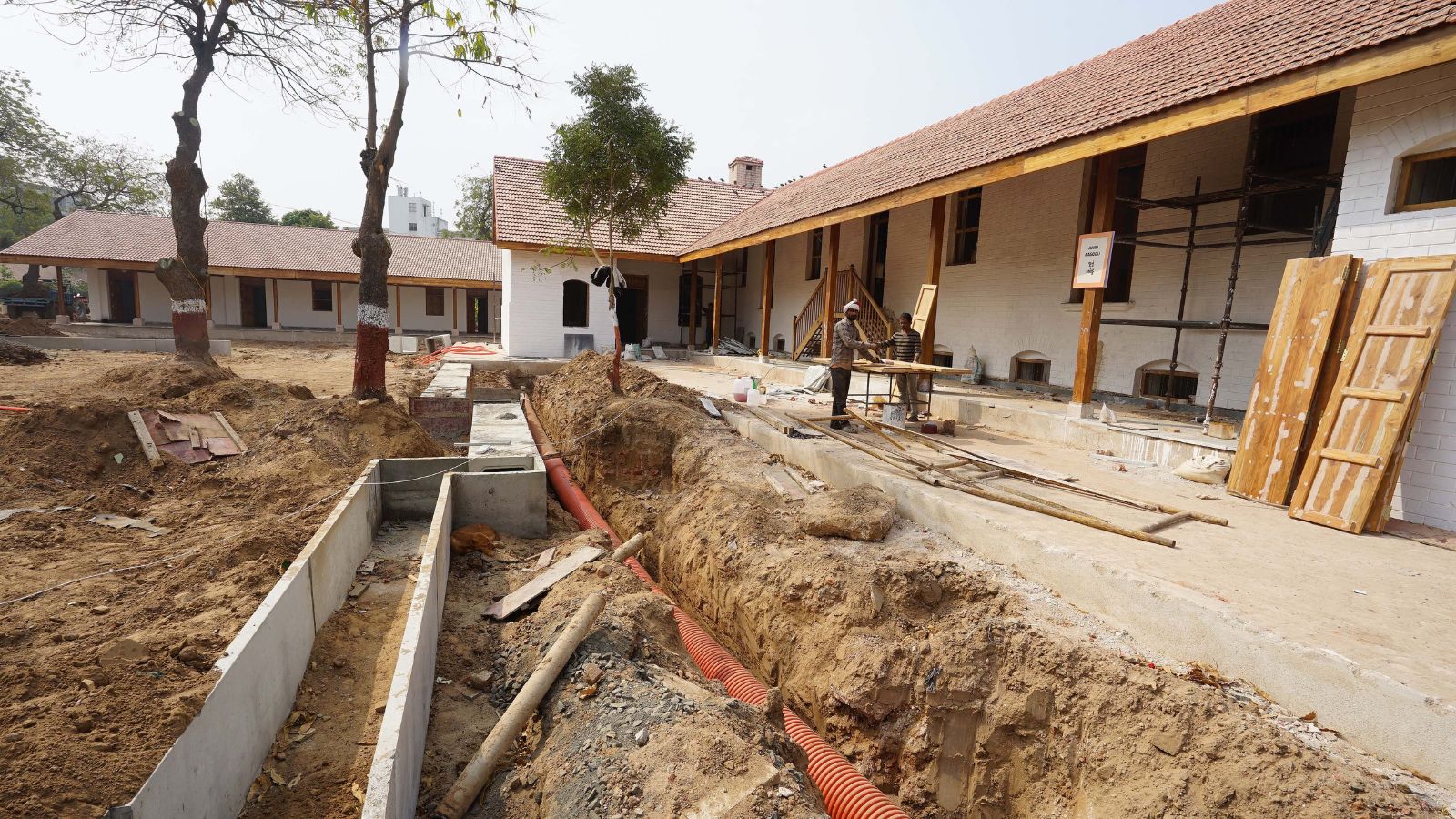
In sharp contrast to the highrise concrete buildings around it, neat white lime plastered cottage-like buildings with terracotta tiled roofs, largely single-storeyed, are being restored or rebuilt in their original form. The redevelopment project of the Gandhi ashram is taking shape largely on the space on the opposite side of the present day Sabarmati Ashram in Ahmedabad. The busy motorable road through the expanded space has been closed and is soon going to be a cobblestone pathway, with heavy machines unloading bundles of granite cobblestones blocks.
The Mahatma Gandhi Sabarmati Ashram Memorial Trust (MGSAMT) is implementing the Rs 1,200-crore Sabarmati Ashram Redevelopment project, which is largely drawn from the original plan when the ashram was built in 1917 spread over 55 acres that comprised residences for ashramvasis, prayer area, school, hostel, a guest house and so on.

The plan follows a ‘concept note’ drafted by the Sabarmati Ashram Preservation and Memorial Trust (SAPMT) to maintain Gandhian principles in the process.
An average tourist, who spends around one-and-a-half hours touring the five-acre space of the Gandhi Ashram under SAPMT, might have to reserve a full day to complete a seamless tour of the redeveloped 55-acre ashram.
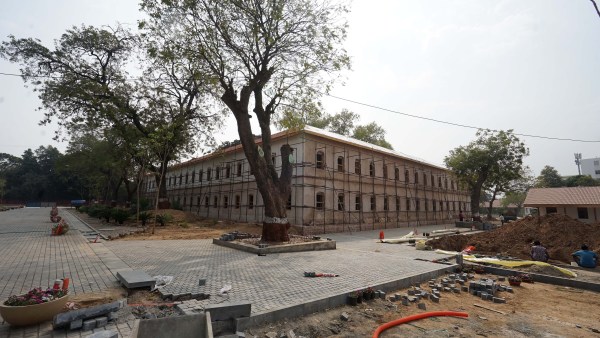 This large building of approximately 100 rooms was used as a community living quarters.
“So much work has been done and there is so much to see in the form of restored buildings in the redeveloped space that a visitor will have to spend at least four to five hours to visit all the places and just take a cursory look. Adding other times during the visit like having snacks or taking pictures etc, one would need close to a full day to visit the entire Ashram,” said a regular visitor.
No cement: Building materials sourced from ‘kitchen’
The permanent closing of the busy 800-metre stretch of the Ashram Road from Cargo Motors to Batrisi Bhavan near Ahmedabad Collector Office in November 2024 was a major development that gave the project shape and meant the city getting a new road connecting northwards through Ranip bus stop.
“That closure paved the way for visualising the ashram as a collective unit. Before that, it was divided by the road. With the road closure, one can easily visualise the 55-acre Ashram as a wholesome unit,” an official told The Indian Express.
Story continues below this ad
The road, now shut for vehicular traffic, has been dug for the project and work is on to develop it as a pathway of the project. The pathways for the entire project are going to be made of grey cobblestone as directed by top authorities to give the project an aesthetic appeal, said a source connected with the project.
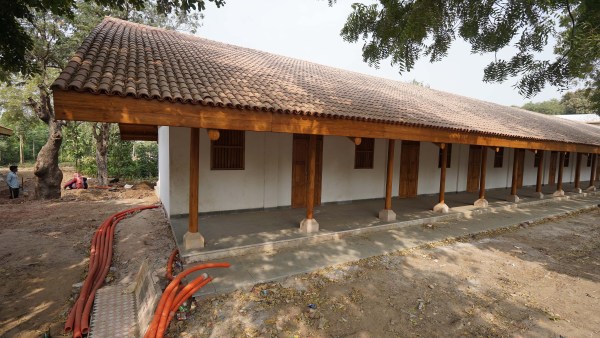 The building, when established in 1921-22, was used for spinning and weaving activities. After 1950, it was used as a residence for families.
Special care is being taken to maintain the original form of the buildings, while they are being restored. No cement is being used, instead a mixture of lime is being used for the restoration work.
Savani Heritage Conservation Pvt Ltd, which is carrying out the restoration of many of the buildings, first analysed the material found in the old structures and decided to source the very materials to rebuild and restore.
Kevin Raymagiya, a Project Coordinator from Savani Heritage Conservation, tells The Indian Express, “Accordingly, we are using a mixture of lime, brick powder, jaggery water, fenugreek, urad (black gram) and gugal (fragrant gum with medicinal value) in the construction work. The buildings have lots of wood work. We are using Valsadi teak after passing it through a special preservative treatment. Under the treatment, the wood is being heated in a special box containing a mixture of linseed oil and tobacco. We then polish the wood to secure it from moisture.”
Story continues below this ad
This lime mixture takes much more time to be prepared than cement and it gains strength with age. The flooring of the new buildings will use Kota stone as it is in the Hriday Kunj, where Mahatma Gandhi lived for 13 years, says Raymagiya.
The extensions that residents had made to the original buildings in cement-concrete had to be removed before the restoration began.
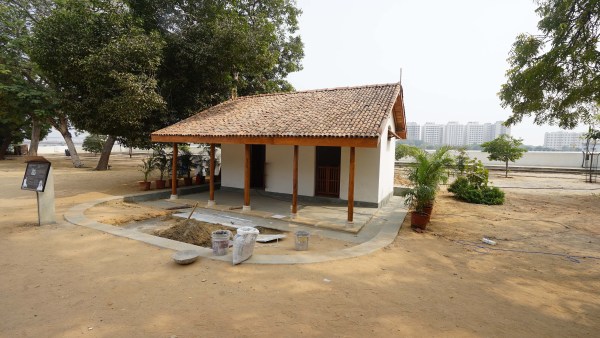 Situated on the right side of Hriday Kunj, Vinoba-Mira Kutir got its name from two ardent Gandhi followers, Vinoba Bhave and British-Indian author Madeleine Slade, who stayed there.
“Roof tiles for the buildings under restoration are being sourced from Morbi. ‘Mangalore’ tiles or country tiles, whichever was used in the buildings originally, are being used in the restoration work. The only difference is that at the relevant time, hand-mould tiles must have been used whereas, currently we are using machine-mould tiles for providing increased strength to the heritage structures,” an official working on the project said.
Granite pathway
The under-construction pathway has already connected some of the iconic buildings under restoration.
Story continues below this ad
Saffron-coloured double wall corrugated (DWC) pipes of various sizes are being laid for the underground utilities. The entire redeveloped ashram will be a Wi-fi enabled space offering audio tour guides.
Carpenters are seen busy in cutting the wood for the Somnath Chhatralay, while others are busy planting saplings around the pathway and the buildings.
While one half of the project has been firmed up, work on the other half is in full swing around buildings such as Imam Manzil, Anand Bhuvan Exhibition and an artificial lake which is being developed on the periphery of one end of the project. Unlike the other half where laying of cobblestone flooring has begun, this part of the project still has a relatively rustic look with dusty pathways, land dug up at places and wild vegetation.
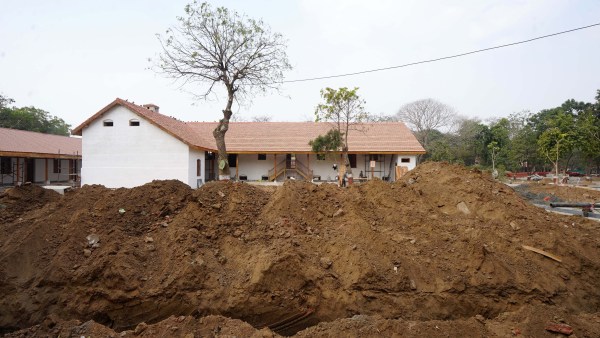 This building – a low-rise structure – served as a community kitchen during the times of Gandhi.
The new entrance to the ashram will be from the Ashray Hotel side on the northern-end where the parking area and orientation centre are taking shape. The earlier entrance to the Hriday kunj area was from the road that is now closed and was west facing. The redeveloped ashram will also have another entrance in front of the Cargo Motors on the southern end.
Story continues below this ad
On March 12, 2024, Prime Minister Narendra Modi launched the masterplan of the Sabarmati Ashram redevelopment project which is being jointly implemented by the Central and state governments. The work on the project had already begun in 2021 under the direct supervision of K Kailashnathan, the then Chief Principal Secretary to the CM.
As part of the project, a total of 256 families have been resettled from the Ashram. Most of the units in the ashram were in possession of descendants of those who had settled with Mahatma Gandhi at the Ashram in the early 1900s. For resettlement, they were either given monetary compensation or four BHK flats, home in a government built housing society or home in a private cooperative society near the Ashram.
The state government constituted MGSAMT, headed by the Chief Minister, for the execution of the project with architect and urban planner Bimal Patel’s firm HCP Design, Planning and Management Pvt Ltd as Project Consultant.
There is also a Governing Council headed by Chief Minister Bhupendra Patel and an Executive Council headed by retired IAS officer I P Gautam, who replaced Kailashnathan.
Story continues below this ad
Recently, the state government nominated Deputy Chief Minister Harsh Sanghavi to the Governing Council as vice chairman. Retired IAS officer I K Patel, who has been Officer on Special Duty on the project, was appointed its member-secretary. I K Patel was also involved with the Statue of Unity project.
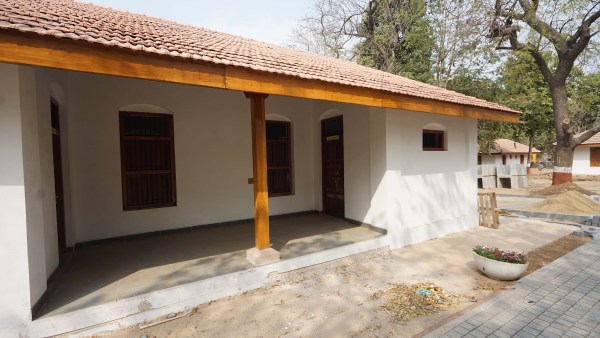 Various Ashram inmates lived at here with their families.
So far, the MGSAMT has floated as many as 11 tenders for restoration and reproduction of 28 buildings, building an outer wall, setting up a water treatment plant, construction of entrance gate, orientation centre, parking, cafeteria and souvenir shop and other facilities, external infrastructure and designing and developing museums and exhibitions at the ashram under redevelopment.
The plantation and landscaping of the project has been allotted to a Hyderabad-based group, Heartfulness, at a cost of Rs 15 crore.
Last month, a Rs 113 -crore contract was awarded to a Tata Group subsidiary to design and develop museums and exhibitions in the new ashram space, which is likely to be the final tender in the project.
Story continues below this ad
For restoration work, the trust has allotted six tenders to three firms; Savani Heritage Conservation Pvt Ltd, Knospe & Co. LLP and PSP Projects Ltd. Of which Savani has three tenders to restore or rebuild 13 of the total 28 buildings. Some of the buildings under restoration or reproduction include Kutumb (family) Niwas, Young India, Ashram Shala, Shikshak (teachers) Niwas, Chimanbhai Kutum Niwas, Das Oradi (10 Quarters), Vanik Parivar ni Chali, Dehla Puni Kendra (Centre to store row cotton and cotton slivers), Junu Rasodu (old kitchen), Rangshala (dyeing house), Saat Oradi (7 quarters), Jamna Kutir, Somnath Chhatralay, Imam Manzil, Udyog Mandir, Sardar Kutir, Bal Mandir and Gau Shala.
Negotiations with trusts holding land
Five different trusts had ownership of the land within the 55-acre Ashram area: SAPMT, Harijan Ashram Trust, Sabarmati Ashram Gaushala Trust, Khadi Gramodhyog Prayog Samiti and Gujarat Khadi Gramodhyog Mandal. Except the SAPMT, lands of the rest of the trusts have been procured by giving “sufficient” lands elsewhere, says a top officer.
The SAPMT holds the current core ashram area with the Hriday Kunj, Magan Niwas, Vinoba-Mira Kutir, Nandini, Udyog Mandir, Museum and so on.
Restoration at present-day ashram
The present-day Sabarmati Ashram campus managed by the SAPMT has also begun restoring some of the buildings in its jurisdiction under the supervision of a renowned architect from Ahmedabad, Rabindra Vasavada. So far, the trust has restored two buildings — Nandini and Vinoba-Mira Kutir.
Story continues below this ad
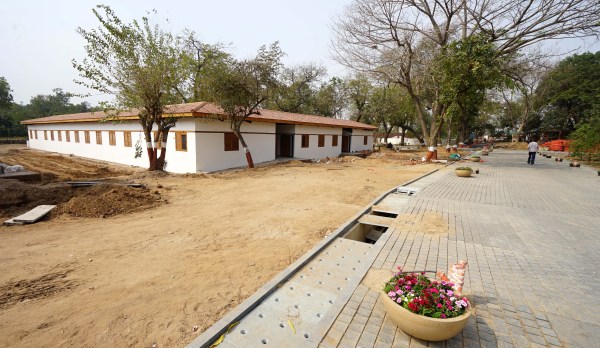 Row cotton and slivers made from it were being stored at this building at the relevant time.
A trustee at SAPMT, Kartikeya Sarabhai, tells The Indian Express that Hriday Kunj, where Gandhi and Kasturba stayed till 1930, will undergo restoration work shortly.
The restoration work of Vinoba-Mira Kutir, situated on the right hand side of Hriday Kunj where Mahatma Gandhi stayed, had led to the surprise discovery of a one-and-half-feet high plinth that the cottage stood on, which had literally got buried in the sand over the years. During the restoration process, the cottage that got its name from two ardent Gandhi followers – Vinoba Bhave and British-Indian author Madeleine Slade (whom Gandhi rechristened as Mira Behn) – has got a sort of elevation with two steps leading to it.
Bhave and Slade had stayed in this cottage at different times in the lifetime of Gandhi.
Nandini is the building that served as the guesthouse of the Ashram in which some notable persons, such as Rabindranath Tagore, Jawaharlal Nehru, Rajendra Prasad, Reginald Reynolds, Henry Polak and Maulana Azad and several other leaders have stayed during their visits.
