

With the 2026 West Bengal Assembly election now announced, loudspeakers are being set up for fiery speeches, campaign songs are circulating on WhatsApp, new hashtags are emerging on social media to promote candidates, and city walls are being covered with slogans and colourful messages to attract voters’ attention.
Although it has recently become more virulent, election season in West Bengal has always been vibrant and inventive. The expression of this creativity, however, continues to evolve. Earlier, electoral battles were fought on city walls; today, they play out on phone and laptop screens.
The contest has shifted from the physical walls of buildings to the virtual spaces of social media. Between fading paint and viral memes lies the story of how Bengal campaigns, debates, mocks, votes, and ultimately elects its legislative representatives.
From pristine walls to political canvases
Interestingly, wall writing was not a common medium of campaigning in Bengal, including Kolkata, during the first two general elections after Independence in 1952 and 1957, and even during the Kolkata Corporation local body elections in 1961. Campaigning then relied largely on posters, buntings, festoons, placards and public meetings. Political messaging travelled through rallies, newspapers, street-corner meetings, and word of mouth. The city walls were pristine.
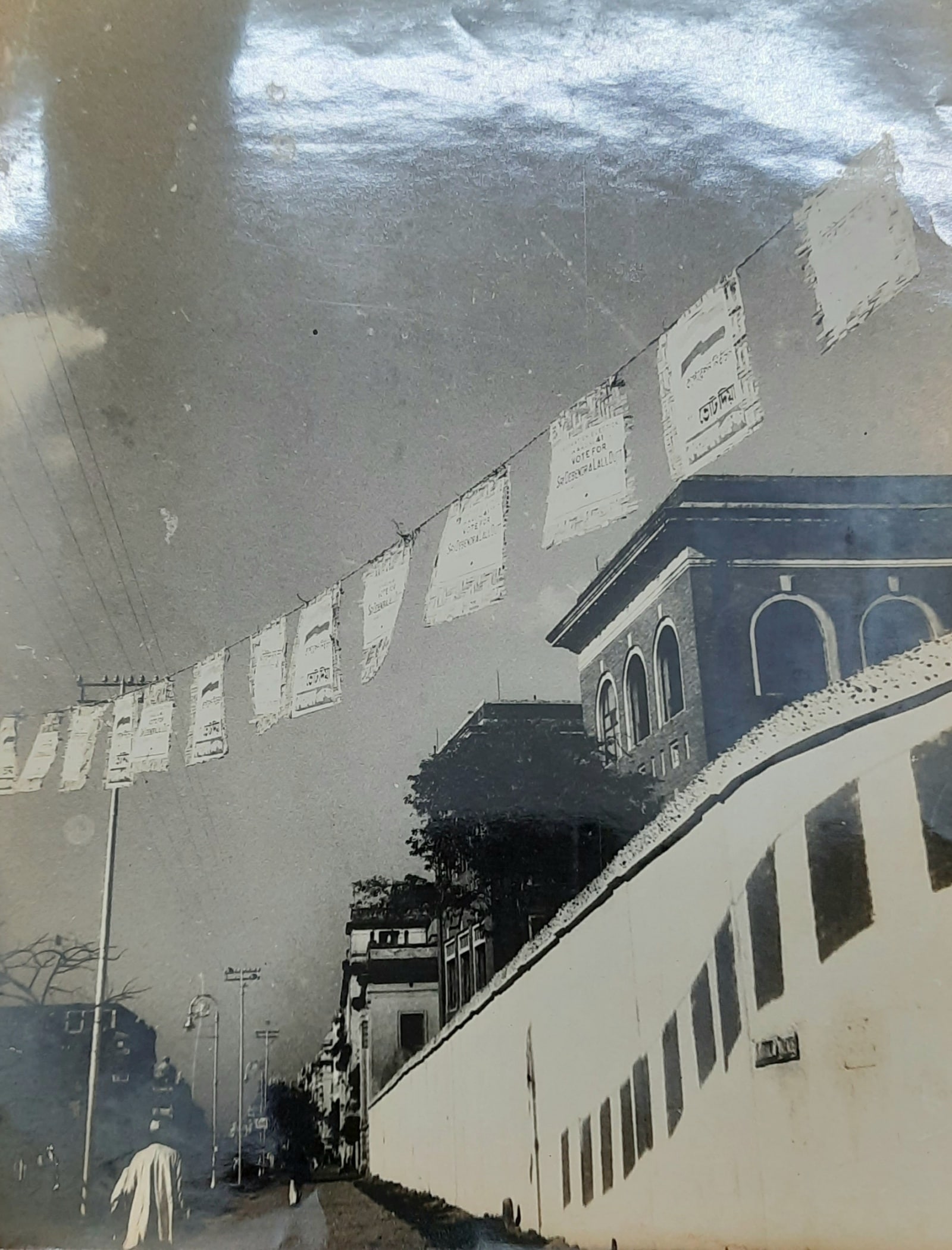 Kolkata Corporation local body elections in 1961 (Devasis Chattopadhyay’s private collection)
One fascinating example originated from the Communist Party of India (CPI), which trialled a Tibetan thangka-like scroll poster that parodied a well-known Shyama Sangeet, a devotional song dedicated to Goddess Kali. The irony was remarkable. A political party that openly professed atheism borrowed religious imagery to communicate with voters. The familiar rhythm and lyrical symbolism immediately attracted their attention. This subtle fusion of politics with culture became a hallmark of Bengal’s election campaigns. Not gross or malicious religious fanaticism.
By the early 1960s, global socialist political movements began adopting newer visual methods for protest. Latin American revolutionary movements popularised quick wall slogans as a tool for mass mobilisation. These messages were sharp, short, and easy to reproduce, perfect for political movements operating with limited resources. Kolkata quickly absorbed this technique.
Story continues below this ad
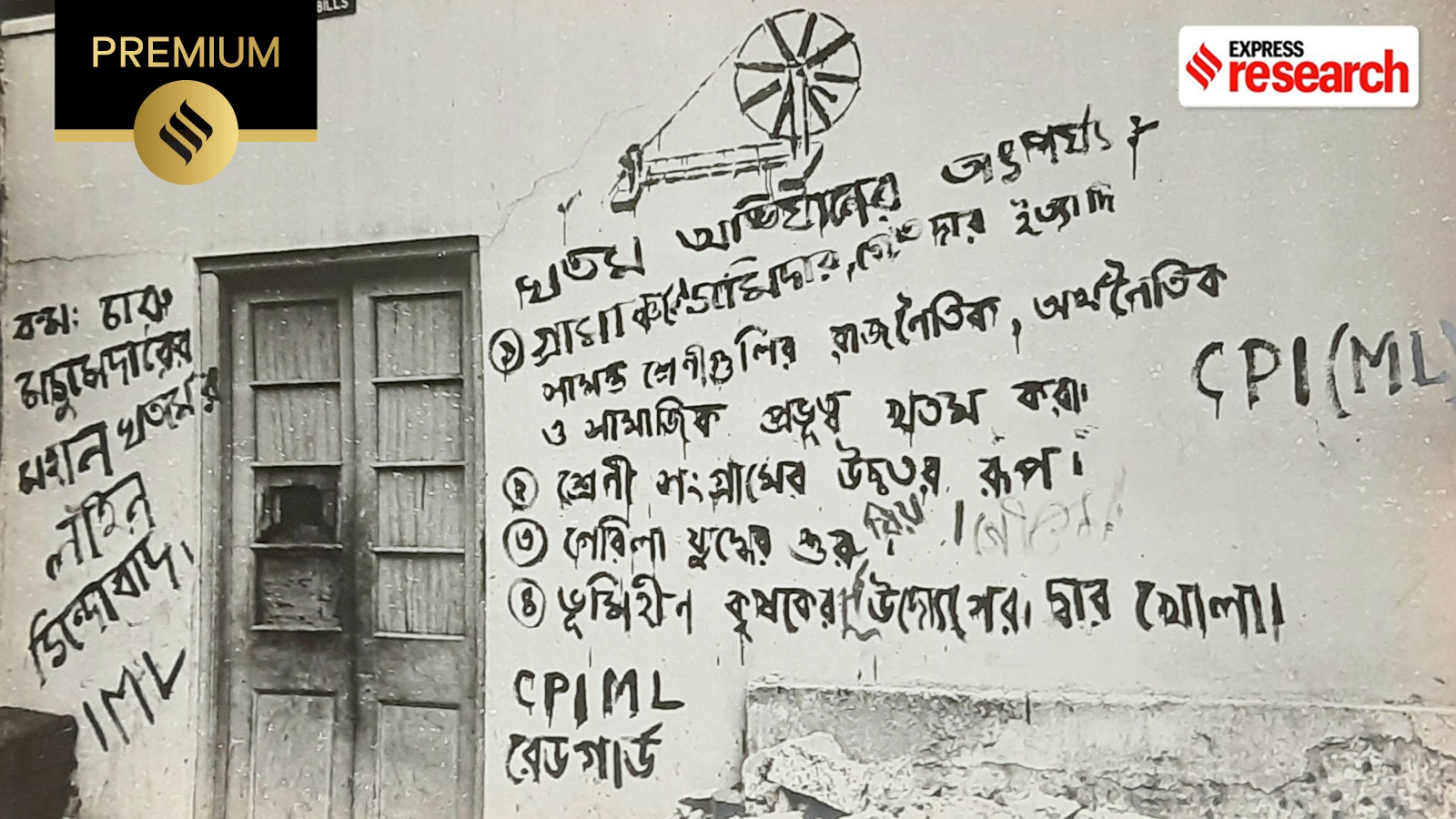
By the mid-1960s, a new visual culture of campaigning was emerging in the city. The practice exploded during the turbulent years of the Naxalite movement between 1967 and 1970. Newspapers and radio stations were largely hostile towards the rebels, leaving them with few platforms to communicate their message. City walls became their canvas. With a brush and a tin of black paint, activists could spread slogans across the neighbourhood overnight. The method was inexpensive, quick to execute, and impossible to censor entirely. Over time, Kolkata’s wall writing evolved into something far richer than crude political scribbles, spreading throughout the state of West Bengal and beyond.
However, these wall writings should not be called graffiti. The Italian word graffito originally referred to scratching or casual markings on ancient walls. Archaeologists used the term to describe informal inscriptions found on ruins. The political wall writings in Kolkata and Bengal are very different. They are carefully composed pieces of messaging that often employ rhyme, metaphor, satire, and parody. Many slogans resemble miniature poems with illustrations and graphic symbols to attract attention.
In the 1960s and 1970s, the building walls often bore lines that reflected both political anger and literary flair. During the Vietnam War, a powerful slogan appeared across Kolkata proclaiming: “Tomar naam, Amar naam, Vietnam, Vietnam” or Your name, my name: Vietnam, Vietnam!
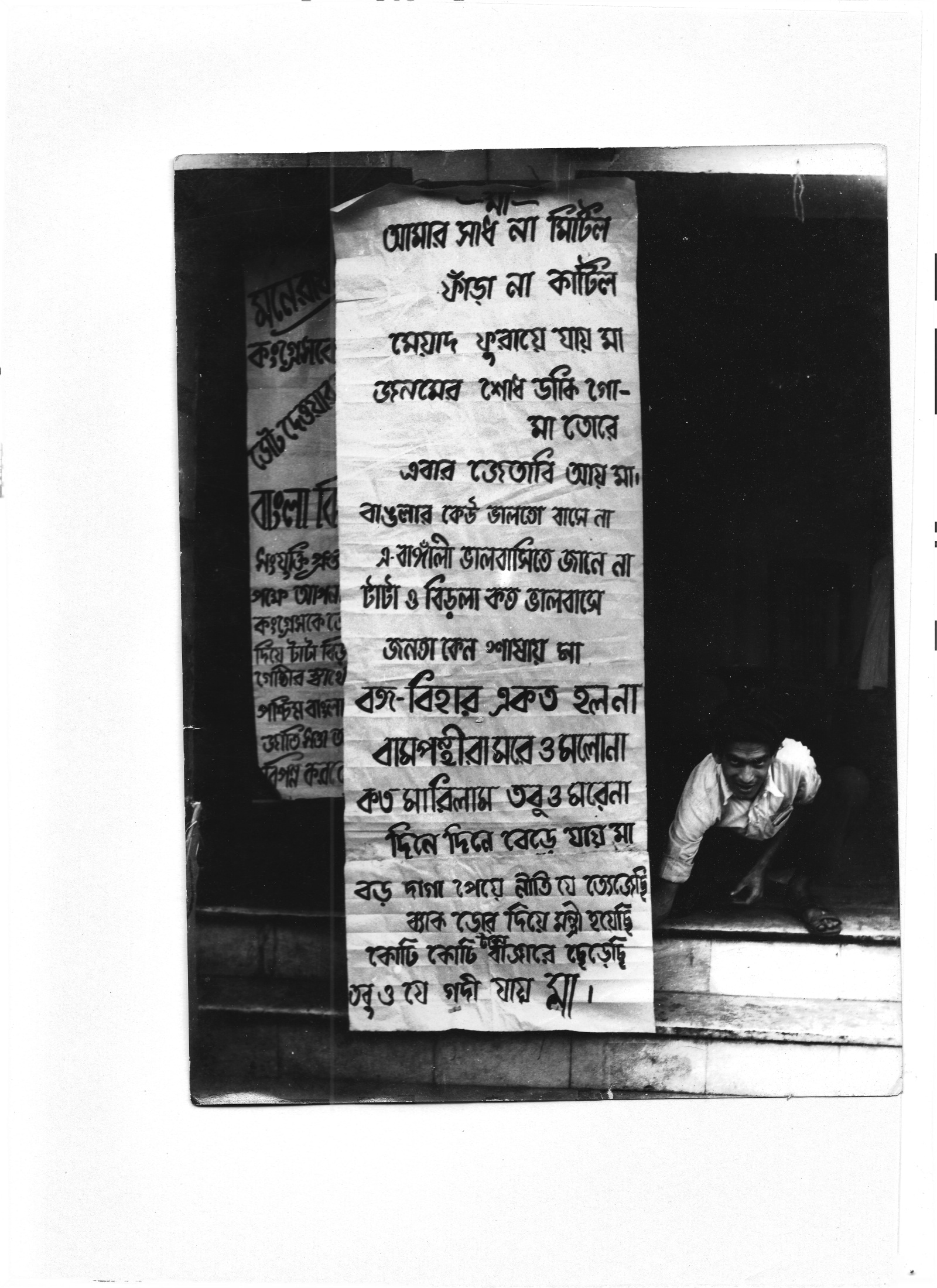 One fascinating example originated from the Communist Party of India (CPI), which trialled a Tibetan thangka-like scroll poster that parodied a well-known Shyama Sangeet, a devotional song dedicated to Goddess Kali. (Devasis Chattopadhyay’s private collection)
The line expressed solidarity with the Vietnamese resistance against American forces, but it also had rhythm and emotional impact. In six words, it transformed a distant geopolitical conflict into a shared moral cause. That is why poet Shakti Chattopadhyay, the esteemed Sahitya Akademi Award winner, famously described the wall writings as “wall poetry”.
The golden age of wall writing
Story continues below this ad
Over time, wall writing went through several distinct phases. The pre-Naxalbari period saw relatively limited use of walls as campaign messaging relied more on posters and meetings. During the peak of the Naxalite movement, walls became powerful tools for political resistance. Short slogans, warnings, and ideological messages appeared overnight across neighbourhoods.
Under the long Left Front rule from 1977 to 2011, wall writing evolved into a sophisticated form of political advertising. All political parties began paying attention to typography, layout, and colour combinations. The city’s walls gradually resembled outdoor billboards. Political parties adopted basic advertising principles: bold lettering, simple messages, and bright colours visible from a distance. Red, black, blue, and green were commonly used. Yellow or white often served as the background colour to provide contrast.
Each party has developed its own visual preferences. Left parties tend to avoid green and blue whenever possible, favouring red and black. The Trinamool Congress avoided red in the past, though not recently, and mostly used colours other than saffron. The Bharatiya Janata Party (BJP) employed saffron alongside green and black. Congress primarily relied on green, blue, black, and red.
In Kolkata, wall writings also reflected the city’s extraordinary diversity – Bengali dominated most neighbourhoods, but Hindi, Urdu, and English often appeared alongside. In areas with migrant communities, one could also find Gurmukhi, Tamil, Telugu or Odia lettering. In the city’s historic Chinatown, Mandarin typography occasionally appeared in the campaign messages, a reminder that the city’s political language could adapt to its syncretic identity.
Story continues below this ad
There was even a strange custom among all political organisations. Parties rarely painted over a rival’s wall. Instead, an informal system of ‘forward or future booking’ of walls existed. Local branches of all political parties would informally reserve wall spaces well before elections to prevent disputes.
The digital campaign era
Then arrived the smartphone revolution.
Over the last decade, election campaigning in Bengal has increasingly shifted online, as it has elsewhere. WhatsApp groups, Facebook pages, Instagram Reels, and YouTube videos now transmit political messages far more quickly than any painted wall ever could, though painted walls still exist.
Music videos have become the new campaign tool. Political parties remix popular songs, produce parody videos, and release catchy campaign anthems to go viral among voters. Digital campaigns can reach millions overnight, something no physical wall could ever match.
The famous ‘Khela Hobe’ song by the Trinamool Congress demonstrated the power of this strategy. The BJP responded with its own musical jabs, borrowing the tune of the mismatched anti-fascist Italian left-wing international protest song ‘Bella Ciao’ for ‘Pishi Jao’ (Aunty Go!) and remixing other Bengali pop songs.
Story continues below this ad
The fight for votes increasingly echoes a battle for online attention. However, even though digital media has transformed the platform, it hasn’t changed Bengal’s preferred political messaging tool – humour and parody. After the 2021 election results, social media burst with limericks, memes, and comic verses. One viral couplet declared:
“Jai Kali Kalkattawali / Chhappan inch ki hawa nikali” (Hail Kolkata’s goddess Kali / the 56-inch has been punctured.) Another mischievous line played on a well-known political chant: “Jai Shri Aam / Ebare chuse chuse khaan.” (Hail the mango / now suck it slowly.)
The humour referenced everything from campaign speeches to television interviews, to political leaders’ mispronunciations, wardrobe choices, and even someone’s beard becoming the butt of jokes. In Bengal, humour and parody are not merely entertainment; they are tools for political commentary. They shape public perception, amplify dissatisfaction, and sometimes puncture carefully crafted political narratives.
Despite the dominance of digital campaigning, political parties in many neighbourhoods still believe that painted walls foster a sense of territorial presence. A slogan outside a small tea stall daily reminds residents of a party’s symbol. It signals local affinity.
Story continues below this ad
The 2026 West Bengal Assembly election promises another fierce political contest. Somewhere in a quiet lane of North Kolkata’s Shyampukur or South Kolkata’s Jadavpur, a young party worker will crack open a can of paint late at night and write a slogan on a city wall that might resonate with a voter’s sensibilities. Later, a reel featuring that wall writing will be shared on Facebook and go viral the following day.
Welcome to the election season!
(Devasis Chattopadhyay is a narrative history writer and columnist)
