


India’s biggest companies set aside more than Rs 13,000 crore in the October-December 2025 quarter to account for the impact of the new Labour Codes, according to data compiled by The Indian Express. These provisions were 3 per cent or lower as a percentage of last financial year’s employee costs for major IT companies and private banks; for airline carrier IndiGo, it was 13 per cent.
The data shows that the 41 Nifty 50 companies that have so far announced their latest financial results provided Rs 13,307 crore in the reporting quarter for the first nine months of 2025-26. These 41 companies’ consolidated profit after tax amounted to nearly Rs 1.75 lakh crore.

The Nifty 50 is the flagship index of the National Stock Exchange and is made up of 50 of the largest Indian companies listed on the exchange.
Notified by the Government in November 2025 — more than five years after the Parliament’s clearance — the four Labour Codes comprise the Code on Wages, 2019, the Industrial Relations Code, 2020, the Code on Social Security, 2020, and the Occupational Safety, Health and Working Conditions Code, 2020.
These four codes, which consolidate 29 existing labour laws, widen the social security net for all workers, including gig workers, set the floor for the sum of basic pay, dearness allowance, and retaining allowance at 50 per cent of total remuneration, and make employees eligible for gratuity after one year of service, among other changes. As such, these exceptional and one-off provisions are to take care of these additional employee benefits.
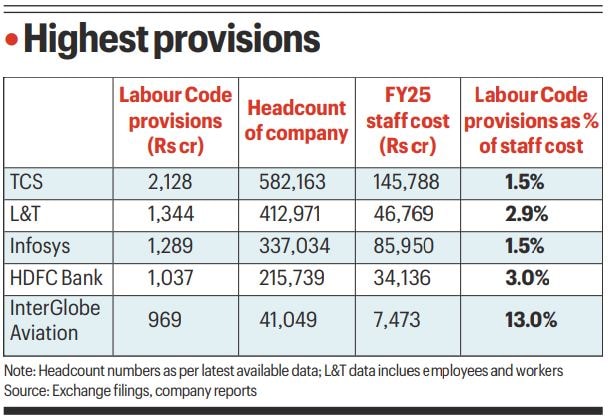
The data shows that a third of the Rs 13,307 crore was provisioned by three IT companies: Tata Consultancy Services, Infosys, and HCL Technologies. This is because these companies employ more people than others.
Some companies from other sectors have made similar-sized provisions, including the likes of infrastructure major Larsen & Toubro, which set aside Rs 1,344 crore, net of taxes, and IndiGo (Rs 969 crore). IndiGo’s one-off provision was nearly double its quarter consolidated net profit of Rs 550 crore.
Story continues below this ad
Others have not. For instance, Axis Bank — India’s third-largest private bank with a staff of more than 1 lakh — provided just shy of Rs 33 crore in October-December 2025 on a consolidated basis towards gratuity, primarily due to changes in the definition of wage.
“…divergent to industry trend, we have been accruing for social security expenses from year 2020. And consequently, we’ve had only an Rs 25 crore rupee catch-up provision to make under the social security code versus the larger market, both manufacturing and financial services,” Puneet Sharma, Chief Financial Officer of Axis Bank, told reporters last month while referring to the bank’s standalone financial results.
Axis Bank’s private sector peers HDFC Bank, ICICI Bank, and Kotak Mahindra Bank set aside Rs 1,037 crore, Rs 215 crore, and Rs 128 crore, respectively, during October-December 2025.
Meanwhile, five Nifty 50 companies — Reliance Industries, public sector enterprises State Bank of India (SBI), NTPC, Power Grid Corporation of India, and Eternal (formerly Zomato) — made no additional provisions at all, with most of them saying the incremental impact of the new Labour Codes is “not material”.
Story continues below this ad
Eternal, which said there was no material impact of the Labour Codes provisions “currently in force” on its financials, also said that the financial impact, if any, “of the remaining provisions will be assessed upon notification of the final rules and their effective dates”.
The total Labour Codes provisioning by Nifty 50 companies will likely further increase as more and more companies announce their results. A few companies with large workforces are yet to release their quarterly results, such as Coal India, which employed 2.2 lakh people as on March 31, 2025.
However, with provisions made by public sector companies either negligible or fairly small compared to private ones, it is possible that Coal India may not do so either. For instance, SBI, said that it “continues to comply with the major provisions”, with fellow public sector lender Punjab National Bank — a non-Nifty 50 company — saying last month that it was “already implementing all those clauses which the labour code has provided and absolutely nil impact”.
