

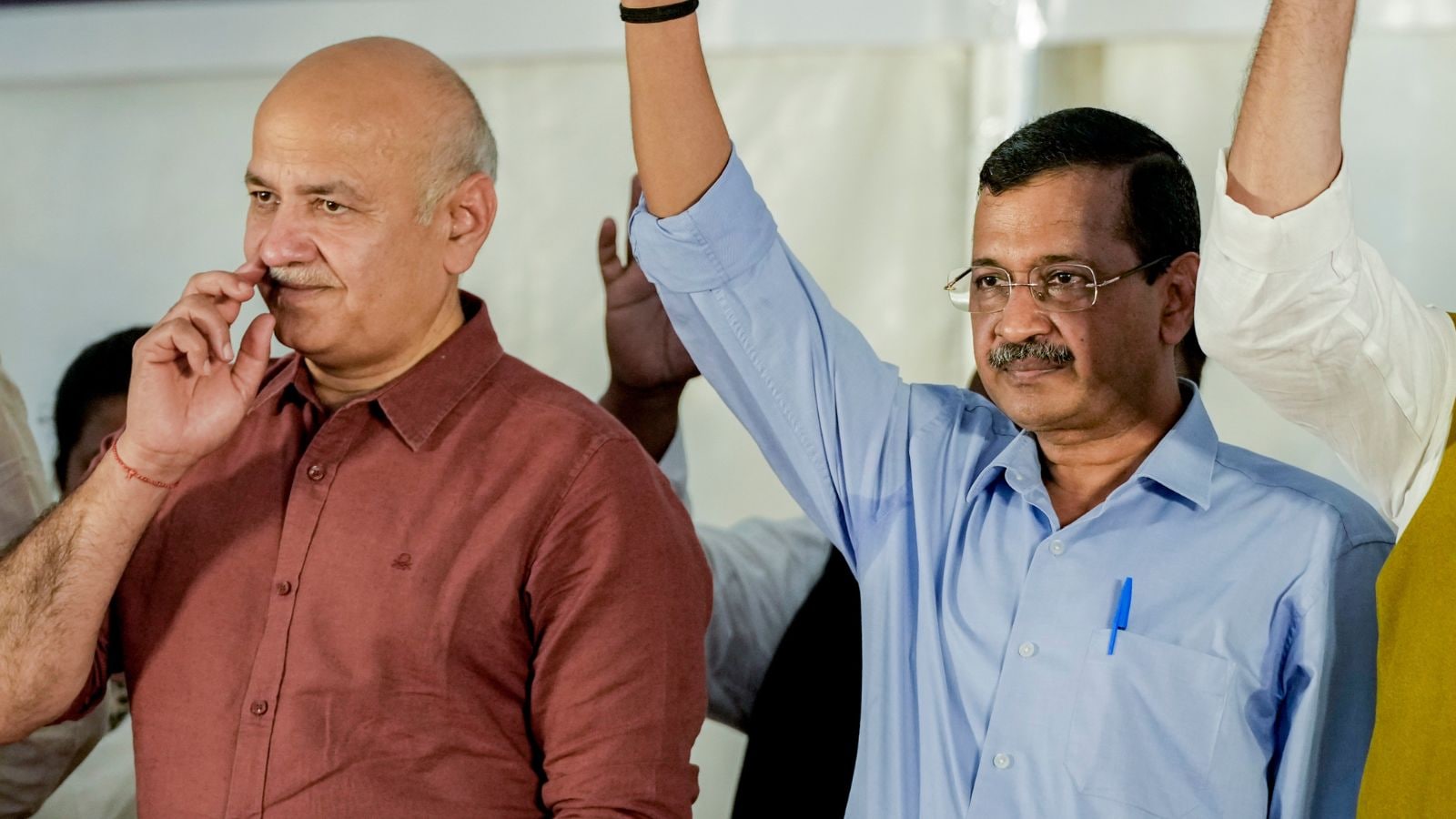
The Central Bureau of Investigation (CBI), in a revision petition before the Delhi High Court seeking the discharge of AAP leaders Arvind Kejriwal and Manish Sisodia be set aside, has argued that its case establishes a “chain of conspiracy” where the two leaders formulated a “tailor-made policy” to fund Goa elections by favouring parties — the so-called South Group — who would pay “upfront money” to fund the AAP’s Goa poll campaign.
While expounding the role of Kejriwal, former Chief Minister (CM), and Sisodia, his deputy who was also handling the Excise department at the time, the CBI also pointed as evidence to its assertion: “the undue haste in the file movement during peak Covid time”.

Reiterating on the “chain of conspiracy”, which it said involved meetings with the so-called South Group members, including former BRS leader K Kavitha, her CA and close aide Butchibabu Gorantala, the CBI said that “the undue haste in the file movement during peak Covid time” as the so-called South Group was in Delhi, meeting close aides of Kejriwal and Sisodia “clearly establish the conspiracy in its entirety between the accused herein in lieu of the upfront bribe money of INR 100 crores paid by South Group”.
A trial court, in its order discharging the leaders and others, has repeatedly stated that at the stage of framing of charge, “suspicion must be founded on material placed on record, and not on conjecture or reverse inference”. However, the CBI submitted that “exact details of the upfront money [paid by the South Group] remaining missing is a matter of trial”.
CBI on Kejriwal’s role
The CBI also argued that the trial court had erred in analysing Kejriwal’s role only through the lens of Sisodia’s involvement, and not the fact that owing to his position, he was “party to the conspiracy” … “since the inception”.
As party head, Kejriwal was the “ultimate beneficiary” of the “ill-gotten” money and all such activities were thus in his knowledge, the CBI stated. Relying on statements by approvers and others from the party, the central agency also argued that evidence shows that he was seeking monetary support for the party for the upcoming Goa elections and had promised financial support of Rs 90 lakh to each candidate contesting on its ticket.
The trial court, however, had dismissed these statements as they do not directly attribute any “act of cash handling, transfer, receipt or disbursement and the mere assertion that party volunteers or campaign functionaries incurred expenditure in cash does not, in the absence of linkage evidence…establish the alleged funding trail.”
CBI on Sisodia’s role
Story continues below this ad
In its revision plea, a key argument made by the CBI to refer to the conspiracy at play is that Sisodia was “working with preconceived ideas for the formulation of excise policy”.
Submitting that the trial court “has conveniently ignored the said contention of the prosecution”, the CBI referred to the supportive evidence: Sisodia allegedly “planting manufactured public opinion” in support of the policy; tweaking of policy clauses at Sisodia’s insistence following meetings of the the so-called ‘South Group’ which was planning to enter the Delhi liquor market with Sisodia and Kejriwal, as well as their confidantes and aides; and witness statements to the effect that AAP received payments to fund its campaign for the Goa state elections. The CBI also referred to the fact that a GoM report, which had incorporated the legal opinions of two Chief Justices of India and the former Attorney General for India — recommending a status quo on the policy — went “missing” after last being in Sisodia’s custody.
The trial court, while clearing the allegations against Sisodia, had held that a conspiracy theory based on “misattribution of inputs” could not stand when official documents showed “shared deliberation”, and that suppression of legal opinions could not be inferred and “cannot rest on conjecture” without proof of intentional concealment. It had also noted that the substance of legal opinions was later incorporated into subsequent documents.
While the CBI had accused Sisodia of destroying a mobile phone which allegedly contained evidence of the conspiracy, evidencing the allegation by the fact that Sisodia changed his handset on the day the case was referred to the CBI, it contended that the said evidence was only cited to reflect Sisodia’s conduct, and the trial court has “erred” in in dealing with it in detail.
Story continues below this ad
The trial court had recorded that such an allegation did not establish obstruction of investigation and that “a simpliciter change of a mobile handset… is not per se unlawful” in the absence of proof that incriminating material existed on the device.
