

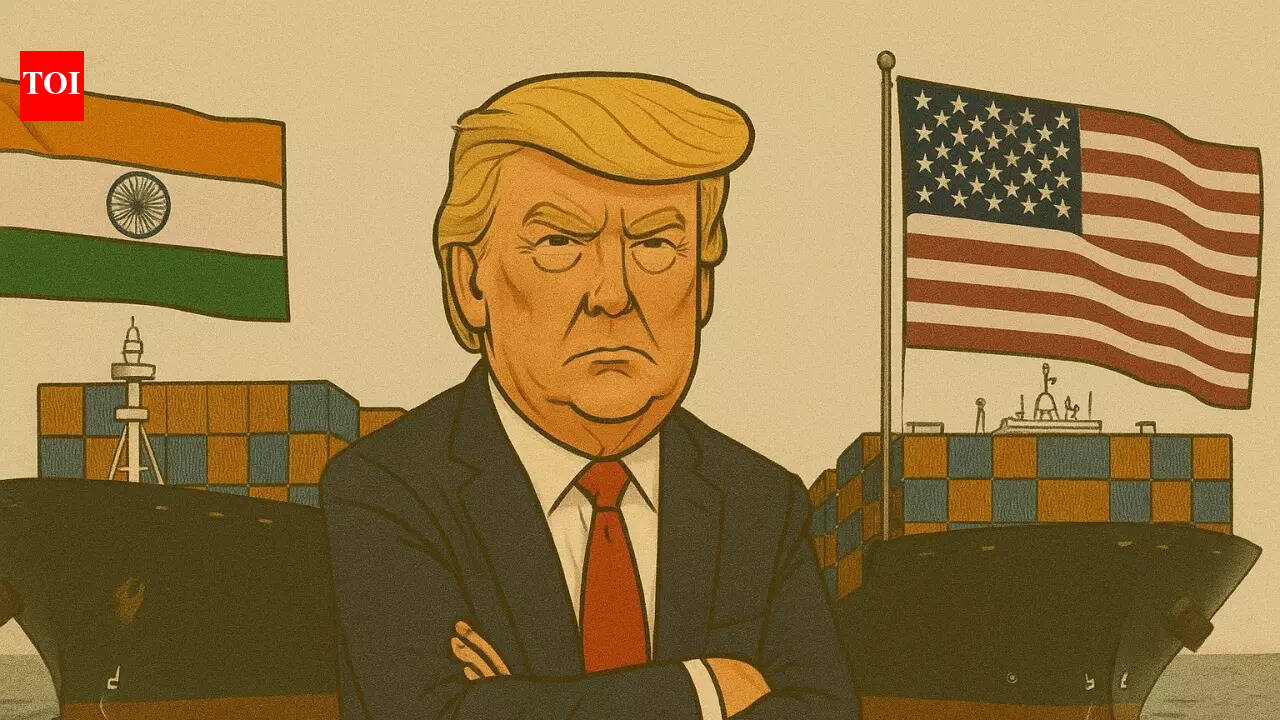
The US Supreme Court’s ruling striking down president Donald Trump’s tariffs will mean that 55% of India’s exports to the US will not face the 18% reciprocal tariffs. The US Supreme Court on Friday deemed Trump’s reciprocal tariffs as ‘illegal’, a move that is a big blow to the American President’s trade war. The ruling invalidates country-specific “reciprocal tariffs” and fentanyl-linked duties imposed on imports from major trading partners. Trump had recently removed the 50% tariffs that he had imposed on India, bringing it down to 18%. An India-US joint statement on the same was issued earlier this month and an Indian delegation is travelling to the US in the coming days to finalise the interim trade deal.
SC ruling on Trump tariffs: What does it mean for India?
According to Global Trade Research Initiative (GTRI) founder Ajay Srivastava, the ruling by the topmost US court should prompt India to re-examine its trade deal with the United States.“Removal of reciprocal tariffs will free about 55% of India’s exports to the US from the 18% duty, leaving them subject only to standard MFN tariffs,” says a GTRI analysis.Also Read | Why were Trump tariffs ruled illegal by Supreme Court? Top points from what SC said in its rulingAccording to the think tank, on the remaining exports; (i) Section 232 tariffs will continue — 50% on steel and aluminium and 25% on certain auto components(ii) products accounting for roughly 40% of export value, including smartphones, petroleum products and medicines, will remain exempt from US tariffs“The decision effectively renders recent trade deals initiated or concluded by the United States with the UK, Japan, the EU, Malaysia, Indonesia, Vietnam and India one-sided and useless. Partner countries may now find reasons to dump these deals,” says GTRI.News reports in the US suggest that the ruling may cast uncertainty over previously negotiated trade arrangements, with Congress expected to play a more active role in overseeing or reshaping them.Analysts indicated that, following the Supreme Court’s decision, Indian exporters might benefit from further tariff relief.They also suggested that the apex court’s ruling in the US could introduce fresh dynamics into discussions aimed at concluding the Interim Trade Agreement, which had been slated for signing next month.“This outcome was largely priced in by the markets, which explains the positive movement in US equities. India’s GIFT Nifty has climbed more than 250 points, reflecting an optimistic response. The key issue now is what alternative course of action the Trump administration may pursue. Refunding $175 billion in customs collections would significantly widen the fiscal deficit. There are also multiple investment linkages involved,” said Ajay Bagga, a banking and market specialist.Commenting on the ruling, Manoj Mishra, Partner and Tax Controversy Management Leader at Grant Thornton Bharat said the decision would be a competitive boost to Indian exports.“The US Supreme Court’s ruling against reciprocal tariffs brings significant legal clarity and reduces tariff uncertainty for India, reinforcing limits on unilateral tariff actions. Notably, under the interim trade arrangement the US had agreed to reduce reciprocal tariffs on India to 18% which shall no longer remain relevant following the Court’s decision,” he said.“Any attempt to levy such tariffs would require Congressional approval. This is likely to give much-needed relief and a competitive boost to Indian exporters, while also paving the way for potential refunds of tariffs collected without adequate legal basis. However, the US is expected to continue relying on sector-specific tariffs under Section 232 in strategic sectors, underscoring the importance of advancing the bilateral trade agreement to secure durable tariff certainty and stable market access for Indian exporters,” he added.
What the US Supreme Court said
The court ruled that President Donald Trump had overstepped his authority by levying tariffs under the International Emergency Economic Powers Act (IEEPA), a 1977 statute that has been designed to address national emergencies. The decision reinforces Congress’s central role in shaping trade policy, significantly limiting the president’s discretion to use tariffs as a strategic tool and redefining how future administrations may rely on emergency economic powers.Chief Justice John Roberts said that IEEPA does not grant the president the power to impose tariffs unilaterally and noted that the administration failed to identify any law that authorized such action.The judgment strikes down the country-specific “reciprocal” tariffs as well as fentanyl-related duties applied to imports from key trading partners. Although Trump may seek to reinstate tariffs under Section 301 or Section 232, those provisions require fresh investigations and formal justification, which would slow implementation and likely trigger additional legal disputes. Moreover, these statutes cannot be deployed as a blanket enforcement mechanism.
