

When George W Bush stood beneath a “Mission Accomplished” banner in 2003, the statement reflected real battlefield success but not political closure. The Iraqi state had collapsed, yet insurgency, sectarian conflict, and prolonged instability followed, transforming an apparent victory into a protracted strategic burden. The lesson was not about rhetoric alone; it was about mistaking regime disruption for durable order. A similar risk now looms. Declaring success in the absence of a stable end-state risks converting military superiority into strategic illusion.
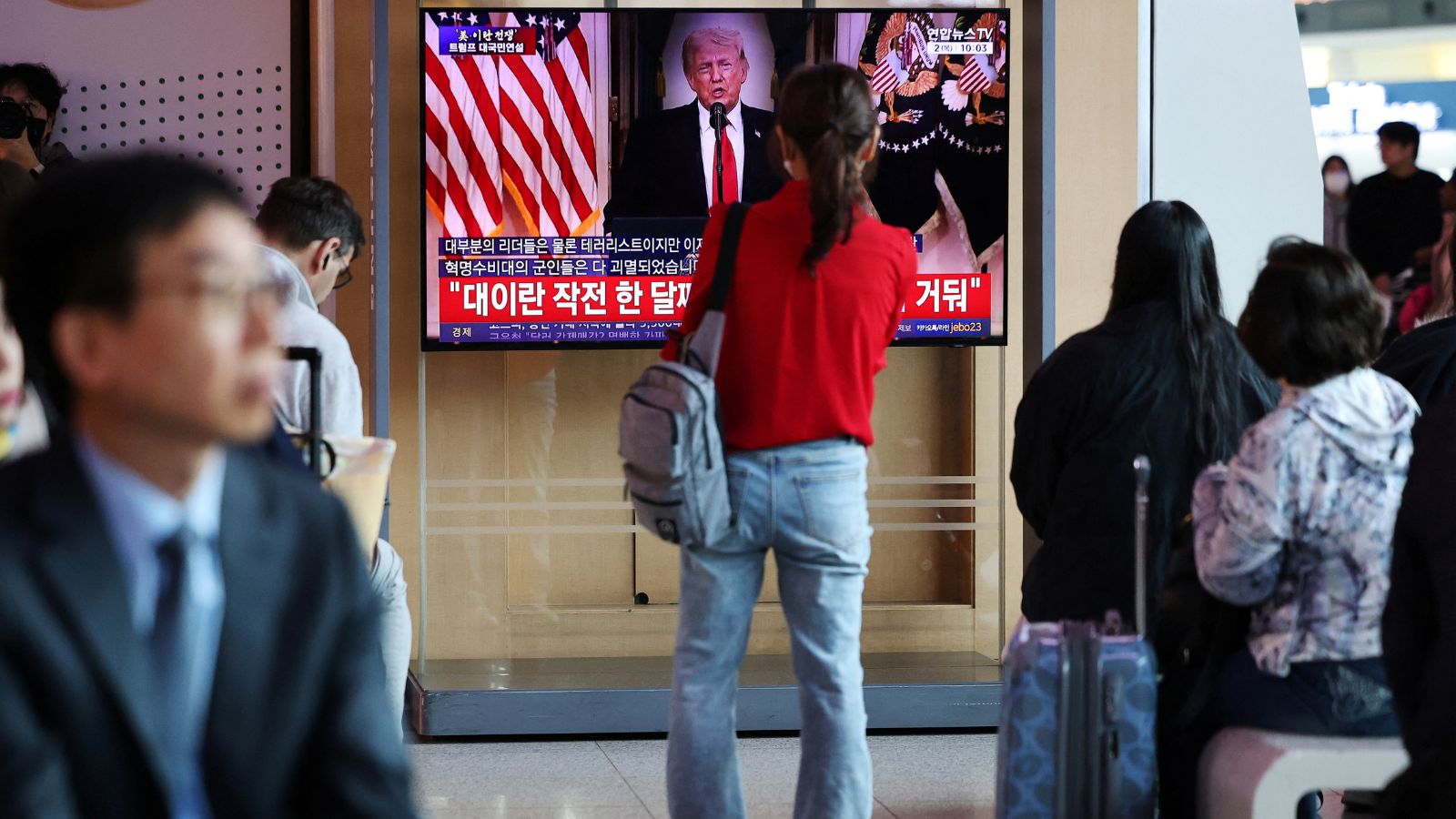
Indeed, only hours ago, President Donald Trump delivered a brief prime-time address on the Iran conflict that projected confidence but offered little strategic clarity. He declared that US objectives were “nearing completion,” asserted that Iranian military capabilities had been crippled, and promised forces would continue striking “extremely hard” for another “two to three weeks, to take Iran to the Stone Age,” an ugly, pejorative commonplace that belongs to the annals of colonial history, even as he suggested in the same breath that the war could conclude “very shortly.”

The remarks lacked even the semblance of a defined political end state, a diplomatic framework, or a stabilisation plan. Analysts noted the subdued tone, the absence of timelines, and the tension between claims of decisive success and the admission that further escalation remained necessary. The result was a speech that sounded less like a conclusion than rhetorical bluster: A declaration of victory in advance of one, coupled with continued military pressure without articulated resolution.
If the United States were to disengage at this juncture and declare victory, the historical record would likely render a far more qualified judgment. Once immediacy recedes and analytical distance takes hold, wars are rarely evaluated by operational brilliance alone. They are measured by the durability of political outcomes. In that light, what would emerge is not a narrative of decisive resolution but one of asymmetry between military achievement and strategic effect.
The United States and its partners have demonstrated overwhelming aerial dominance, degraded Iranian air defenses, struck missile infrastructure, disrupted naval capabilities, and imposed substantial costs on command-and-control networks. Yet these outcomes, however significant in operational terms, do not automatically translate into political transformation, deterrence stability, or long-term regional recalibration. The central question is therefore not whether the campaign succeeded tactically, but whether it altered the structural drivers of conflict. On that measure, the answer remains uncertain and, currently, deeply flawed.
The Iranian state, though severely damaged, has not disintegrated. Leadership decapitation, including the removal of senior figures central to regime continuity, did not produce systemic collapse. Instead, power appears to have consolidated within hardened security institutions, particularly those designed to operate under siege conditions. Moderating factions have weakened. In this sense, the conflict may have strengthened precisely those actors most resistant to accommodation. The result is not regime transformation but regime contraction around its most resilient core. This outcome complicates any claim of strategic victory, since the political entity targeted for deterrence remains intact and, in certain respects, more internally cohesive.
The persistence of confrontation further underscores this ambiguity. Missile exchanges continue. American assets across the Gulf remain exposed. Maritime tensions in the Strait of Hormuz have introduced sustained volatility into global energy markets. Insurance premiums, shipping routes, and tanker flows have adjusted to an environment of conditional risk rather than restored stability.
Afghanistan demonstrated that regime removal does not guarantee institutional transformation, and has returned to Taliban rule within two decades. Pakistan illustrated the endurance of structural contradictions after Zia-ul-Haq’s takeover despite alternating alliances. Iran now appears to follow a similar trajectory since the 1979 revolution, wherein ideological continuity outlasts material degradation. These cases collectively suggest that political orders grounded in revolutionary identity and security-centric governance possess adaptive capacities underestimated by external planners. Airpower can degrade infrastructure. It cannot easily reconfigure legitimacy, identity, or institutional incentives.
The economic dimension further complicates the notion of victory. Disruption in the Strait of Hormuz has amplified energy price volatility and reshaped global shipping calculations. Even partial interference with a corridor central to global oil supply reverberates across inflation, logistics, and financial markets. These consequences extend far beyond the battlefield. They redistribute economic risk, alter investment flows, and influence domestic political environments in distant states. War, in this sense, becomes a macroeconomic event. Tactical success coexists with systemic instability. The cost-benefit calculus therefore extends beyond military metrics to include broader global repercussions.
Every plausible pathway out of this conflict carries the outline of failure. If the United States withdraws after degrading Iranian capabilities, Tehran can claim survival and reconstitution, turning endurance into victory. If Washington escalates further to compel capitulation, it risks regional spillover, energy shocks, and a widening war whose costs eclipse the original objectives. If negotiations follow the strikes, diplomacy will effectively concede that military force did not resolve the underlying dispute. If deterrence settles into a long-term standoff, the result is not victory but a frozen confrontation punctuated by periodic crises. Even regime destabilisation would offer no guarantee of stability, inviting fragmentation, proxy competition, and prolonged uncertainty. In each scenario, the outcome falls short of decisive strategic transformation.
The paradox, then, is stark. Withdrawal looks like survival for Iran. Escalation looks like entrapment for the United States. A declaration of victory in such circumstances would not mark the end of the conflict, only the point at which the definition of winning was lowered enough to make departure possible. History tends to recognise that distinction, even when leaders do not.
The writer is the humanitarian food security and diplomacy ambassador, India, for President Volodymyr Zelenskyy’s office
