

UPSC Essentialsbrings to you its initiative of subject-wise quizzes. These quizzes are designed to help you revise some of the most important topics from the static part of the syllabus. Attempt today’s subject quiz on theEconomyto check your progress.
🚨Click Hereto read the UPSC Essentials magazine forJanuary 2026.Share your views and suggestions in the comment box or at manas.srivastava@indianexpress.com🚨
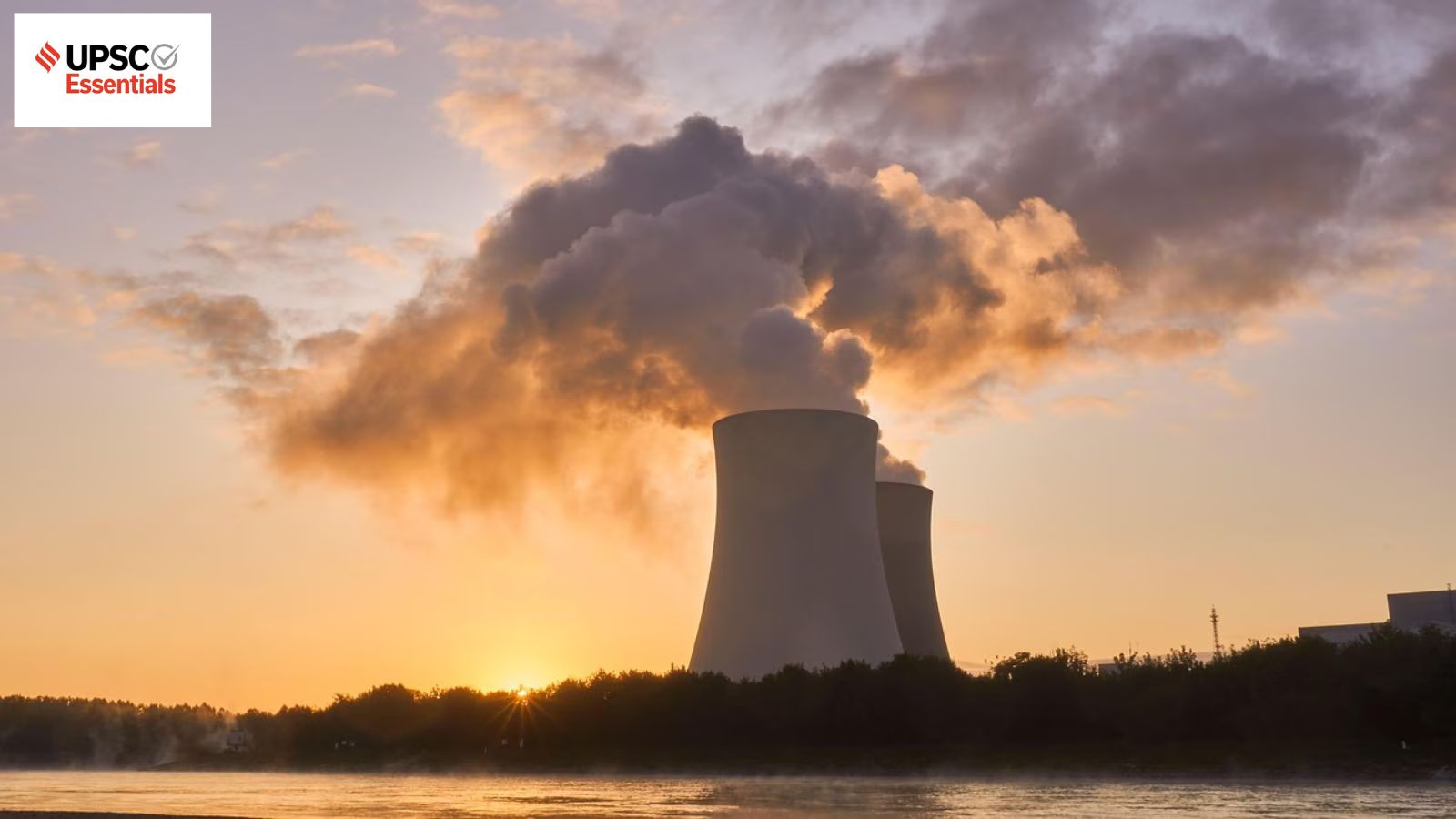
With reference to the Light Water Reactors (LWRs), consider the following statements:
1. They use normal water as both coolant and moderator.
2. LWRs currently account for over 85% of the civil nuclear reactor capacity in the world.
3. They use natural uranium instead of enriched uranium as fuel.
How many of the statements given above are correct?
(a) Only one
(b) Only two
(c) All three
(d) None
Relevance: This question tests core concepts of nuclear reactor technology, fuel types, and moderator–coolant systems. UPSC often frames MCQs from reactor classifications and global nuclear capacity trends.
Explanation
—Light Water Reactors form a mainstay of the global n-program; these use light water, enriched uranium, and have simpler design, lower construction cost, economies of scale, and high thermal efficiency.
Story continues below this ad
—LWRs currently account for over 85% of the civil nuclear reactor capacity in the world. Hence, statement 2 is correct.
—Because LWRs employ normal water as both a coolant and a moderator, their design and engineering are simpler than those of heavy water reactors. Hence, statement 1 is correct.
—LWRs use ordinary water, and they need enriched uranium as fuel, whereas PHWRs are regarded for fuel versatility and the potential to run on natural uranium. Hence, statement 3 is not correct.
Therefore, option (b) is the correct answer.
QUESTION 2
With reference to crude oil, consider the following statements:
1. Crude oil is exactly a fungible commodity.
Story continues below this ad
2. An increase in crude oil prices always leads to an improvement in India’s current account balance.
3. Venezuelan crude is classified as a heavy sour crude because of its high sulphur content.
How many of the statements given above are correct?
(a) Only one
(b) Only two
(c) All three
(d) None
Relevance: Crude oil is crucial due to its impact on India’s CAD, inflation, fiscal balance, and energy security, and its linkage with global geopolitics and OPEC decisions. UPSC frequently tests technical concepts and economic implications through trap-based MCQs.
Explanation
—The bulk of Venezuelan crude is classified as a heavy sour crude—heavy because it is thicker and denser than the lighter crude oil grades, and sour because of its high sulphur content. Hence, statement 3 is correct.
Story continues below this ad
—Crude oil is not exactly a fungible commodity in practice because of the differences in quality of various types or grades of oil. Hence, statement 1 is not correct.
—An increase in crude oil prices does not always lead to an improvement in India’s current account balance. Hence, statement 2 is not correct.
Therefore, option (a) is the correct answer.
QUESTION 3
With reference to the Indian rupee, consider the following statements:
1. A strong balance of payments position supports the stability of the rupee.
Story continues below this ad
2. External factors, such as the performance of the US dollar, do not affect the value of the Indian rupee.
3. A depreciation of the Indian rupee always improves India’s trade balance.
Which of the statements given above is/are correct?
(a) 1 and 3 only
(b) 1 and 2 only
(c) 1, 2 and 3
(d) 1 only
Relevance: This question tests understanding of exchange rate determinants, BoP, and global linkages of the Indian rupee, which are core areas in the Indian Economy.
Explanation
— Current account transactions primarily include the export and import of commodities and services. A good balance of payments situation helps the currency remain stable. Hence, statement 1 is correct.
Story continues below this ad
— In terms of merchandise trade, India has always been a net importer. In 2023-24, its merchandise exports were $441.48 billion, far less than imports of $683.55 billion, resulting in a $242.07 billion trade imbalance.
— A free fall in the rupee’s value is primarily prevented by interventions from the Reserve Bank of India (RBI).
— External factors, such as the performance of the US dollar, also affect the value of the Indian rupee. Hence, statement 2 is not correct.
— A depreciation of the Indian rupee does not always improves India’s trade balance. Hence, statement 3 is not correct.
Therefore, option (d) is the correct answer.
Story continues below this ad
QUESTION 4
With reference to the India-EU trade, consider the following statements:
1. The EU is India’s second-largest trading partner in 2024.
2. Trade in goods between the EU and India has increased by almost 90% in the last decade.
3. India enjoys a persistent and large trade surplus with the European Union.
Which of the statements given above is/are correct?
(a) 2 only
(b) 1 and 3 only
(c) 1 and 2 only
(d) 2 and 3 only
Relevance: This question tests knowledge of India’s major trading partners, trade trends, and external sector dynamics, which are core areas in the Indian Economy.
Explanation
Story continues below this ad
— The EU is India’s second-largest commercial partner, accounting for goods worth €120 billion in 2024, or 11.5% of overall trade. India is the EU’s ninth largest trading partner, accounting for 2.4% of total EU trade in goods in 2024, well behind the United States (17.3%), China (14.6%), and the United Kingdom (10.1%). Over the previous decade, trade between the EU and India has surged by about 90%. Hence, statements 1 and 2 are correct.
— The EU’s biggest imports from India are machinery and appliances, chemicals, basic metals, mineral goods, and textiles. The EU’s biggest exports to India are machinery and appliances, transportation equipment, and chemicals.
— India does not maintain a huge surplus; the trade balance is frequently low or even in deficit, depending on the year. In 2023, trade in services was worth €59.7 billion, with the EU incurring a €7.9 billion deficit. Hence, statement 3 is not correct.
Therefore, option (c) is the correct answer.
QUESTION 5
Which of the following sectors fall within the scope of the Carbon Border Adjustment Mechanism (CBAM)?
1. Iron and Steel
2. Fertilisers
3. Electricity and Hydrogen
4. Cement
Select the correct answer using the codes given below:
(a) 1 and 4 only
(b) 1, 2 and 4
(c) 2, 3 and 4
(d) 1, 2, 3 and 4
Relevance: CBAM is important due to its direct impact on Indian exports and climate–trade linkage, a key current affairs topic. UPSC often frames sector-identification and policy-impact based MCQs from such international mechanisms.
Explanation
— The Carbon Border Adjustment Mechanism (CBAM) is the EU’s instrument for putting a fair price on carbon emissions from the manufacture of carbon-intensive commodities entering the EU, as well as encouraging cleaner industrial output in non-EU nations.
— CBAM came into effect in its final form in January 2026, after a transition period from 2023 to 2025. This progressive implementation is consistent with the phase-out of free allowances under the EU Emissions Trading System (ETS) to encourage the decarbonisation of EU industry.
— CBAM will first apply to imports of certain items and selected precursors whose manufacturing is carbon-intensive and poses the greatest danger of carbon leakage: cement, iron and steel, aluminium, fertilisers, power, and hydrogen.
Therefore, option (d) is the correct answer.
(Source: taxation-customs.ec.europa.eu)
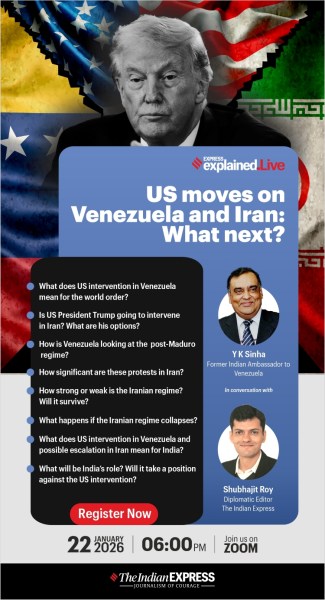
Explained.live – US moves on Venezuela and Iran: What next?
The US’ capture of Venezuelan President Nicolas Maduro and threats to intervene in Iran have brought back memories of US intervention in the Middle East and Afghanistan. President Donald Trump has said that he is running Venezuela and has publicly told Iranian protesters that help is on its way.
What does US intervention in Venezuela mean for the world order? Is US President Trump going to intervene in Iran? What are his options? How is Venezuela looking at the post-Maduro regime? How significant are these protests in Iran? How strong or weak is the Iranian regime? Will it survive? What happens if the Iranian regime collapses? What does US intervention in Venezuela and possible escalation in Iran mean for India? What will be India’s role? Will it take a position against the US intervention?
Join us in the next edition of Explained.Live with Y K Sinha, Former Indian Ambassador to Venezuela in conversation with Shubhajit Roy, Diplomatic Editor, The Indian Express.
January 22nd, 2026 | 6:00 PM | Zoom
Register Now: https://zoom.us/webinar/register/2617684554726/WN_u6N92Q0sTh6uwf4-E6gCCw
Previous Daily Subject-Wise-Quiz
Daily Subject-wise quiz — History, Culture, and Social Issues (Week 141)
Daily subject-wise quiz — Polity and Governance (Week 146)
Daily subject-wise quiz — Science and Technology (Week 146)
Daily subject-wise quiz — Economy (Week 145)
Daily subject-wise quiz — Environment and Geography (Week 145)
Daily subject-wise quiz – International Relations (Week 145)
Subscribeto ourUPSC newsletterand stay updated with the news cues from the past week.
Stay updatedwith the latestUPSC articlesby joining ourTelegram channel–IndianExpressUPSC Hub, and follow us onInstagramandX.
