

Mains Examination: General Studies-II, III: Bilateral, regional and global groupings and agreements involving India and/or affecting India’s interests; Indian Economy and issues relating to planning, mobilisation, of resources, growth, development and employment
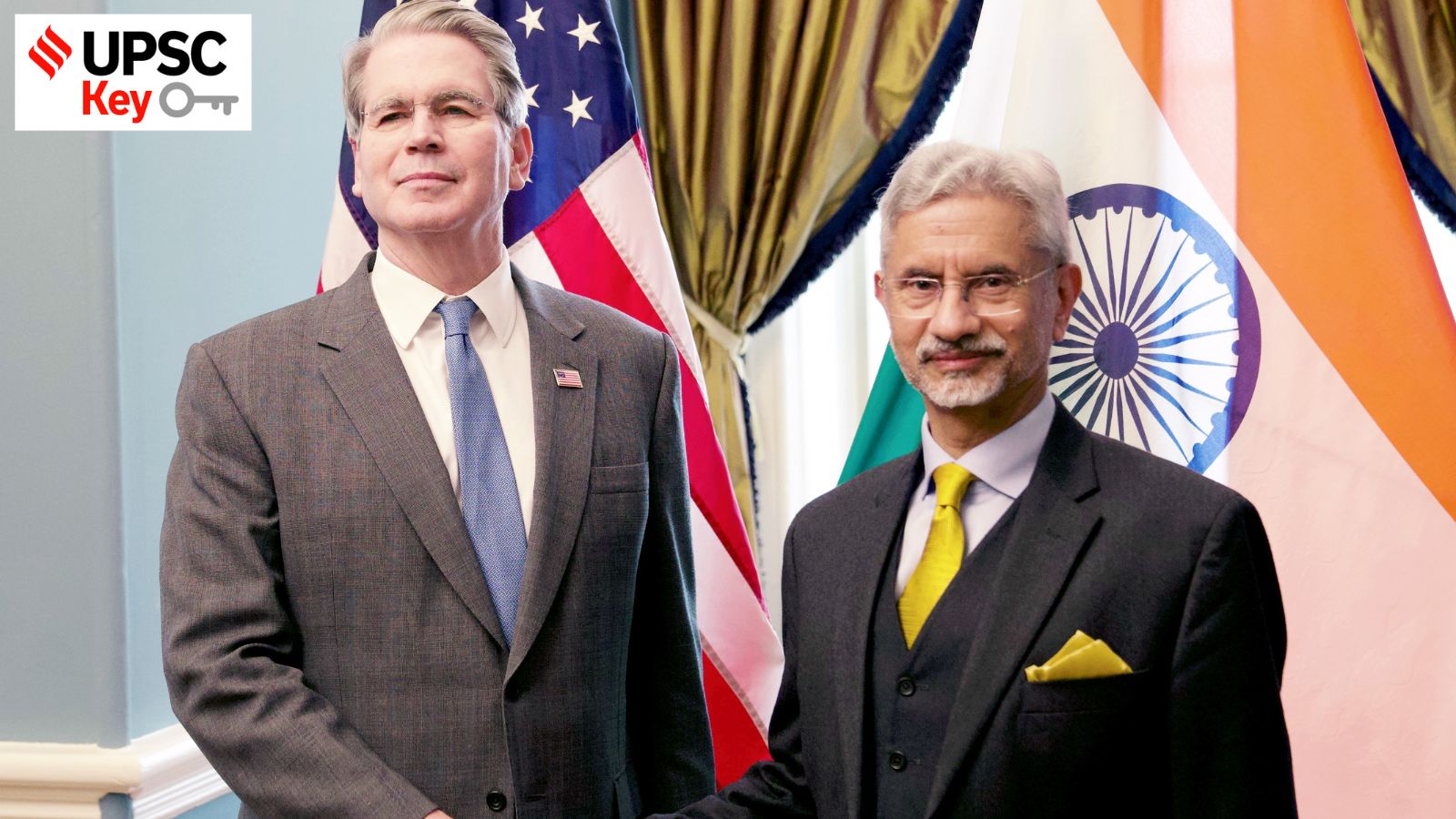
What’s the ongoing story: A day after India and the US announced a trade deal, External Affairs Minister S Jaishankar met US Secretary of State Marco Rubio and Secretary of the Treasury Scott Bessent in Washington DC. Welcoming the trade pact, they focused on “energy security” in their meetings that took place early Wednesday India time.
Key Points to Ponder:
— What is the significance of critical minerals?
— What are the announcements made in the Union Budget 2026 regarding critical minerals?
— What are the major agreements signed by India regarding critical minerals?
— Why is it called critical minerals?
— What is the significance of America for India regarding critical minerals?
— Why has India’s purchase of Russian oil declined?
Story continues below this ad
— What is the significance of the prosperous Indo-Pacific region for India?
— What is QUAD?
— What is the National Critical Minerals Mission?
Key Takeaways:
— The energy issue, mentioned in social media posts on the talks by both Jaishankar and the US State Department spokesperson, is important given that President Donald Trump has said India will stop buying Russian oil, and instead look at US and Venezuelan oil to meet its energy needs.
— India has not commented on the announcement regarding oil, but its purchase of Russian oil has been on the decline ever since the punitive 25 per cent US tariff kicked in.
— “Secretary Rubio and Minister Jaishankar concluded their meeting by expressing their commitment to expanding bilateral and multilateral cooperation through the Quad.They acknowledged that a prosperous Indo-Pacific region remains vital to advancing our shared interests,” he said. India is expected to host the Quad leaders’ summit this year – it was supposed to be held last year.
Story continues below this ad
— Later in the day, after speaking at the inaugural critical minerals ministerial meeting, Jaishankar said, “Underlined challenges of excessive concentration and the importance of de-risking supply chains through structured international cooperation.”
— “Highlighted India’s efforts towards greater resilience through initiatives including National Critical Minerals Mission, Rare Earth Corridors and responsible commerce,” he wrote on X, adding that he “conveyed India’s support to the FORGE initiative on critical minerals.”
Do You Know:
— In her Budget 2026-27 speech, Union Finance Minister Nirmala Sitharaman proposed the establishment of dedicated rare earth corridors in India’s coastal states Odisha, Kerala, Andhra Pradesh and Tamil Nadu.
— The finance minister said the proposal is in line with the recently announced scheme to promote the manufacturing of Sintered Rare Earth Permanent Magnets (REPM).
Story continues below this ad
— Under the ‘Scheme to Promote Manufacturing of Sintered Rare Earth Permanent Magnets’ , the government aims to support 6,000 metric tonnes per annum (MTPA) of integrated REPM manufacturing capacity, which will be allocated among five beneficiaries selected through a competitive bidding process, with each eligible for up to 1,200 MTPA.
— India launched the National Critical Mineral Mission (NCMM) in January for a period of seven years from 2024-25 to 2030-31. With a proposed outlay of Rs 16,300 crore, it aims to secure India’s critical mineral supply chain by ensuring reliable access to key minerals at home and overseas, and strengthening the entire value chain by improving technology, regulation and financing for exploration, mining, processing and recycling.
Other Important Articles Covering the same topic:
📍At the Critical Minerals Ministerial, India should list four priorities
Previous year UPSC Prelims Question Covering similar theme:
Story continues below this ad
(1) Recently, there has been a concern over the short supply of a group of elements called ‘rare earth metals’. Why? (UPSC CSE 2012)
1. China, which is the largest producer of these elements, has imposed some restrictions on their export.
2. Other than China, Australia, Canada and Chile, these elements are not found in any country.
3. Rare earth metals are essential for the manufacture of various kinds of electronic items and there is a growing demand for these elements.
Which of the statements given above is/are correct?
(a) 1 only
(b) 2 and 3 only
(c) 1 and 3 only
(d) 1, 2 and 3
Previous year UPSC Mains Question Covering similar theme:
Story continues below this ad
‘What introduces friction into the ties between India and the United States is that Washington is still unable to find for India a position in its global strategy, which would satisfy India’s National self-esteem and ambitions’. Explain with suitable examples. (UPSC CSE 2019)
NATION
NDMA’s first-ever guidelines for identification of disaster victims
Syllabus:
Preliminary Examination: Current events of national and international importance
Mains Examination: General Studies-III: Disaster and disaster management
What’s the ongoing story: THE NATIONAL Disaster Management Authority (NDMA) has released the country’s first-ever Standard Operating Procedure, including guidelines, for the identification of victims in the event of “mass fatality incidents”.
Key Points to Ponder:
— What are the roles and functions of the NDMA?
— What was the need of this SOP?
— What are the various forms of disasters that India is prone to?
— Know about India’s disaster management mechanism
Story continues below this ad
— What are the major initiatives taken by India for disaster management?
Key Takeaways:
— The document highlights critical gaps when it comes to handling such incidents currently, and recommends steps for the recognition, registration and dignified handover of human remains to families.
— One of the most notable recommendations in the guidelines is the creation of a ‘National Dental Data Registry’, so that teeth and jaws could be used to identify victims.
— The guidelines also include the use of “forensic archaeology”, to help in identification of bodies months or years after a disaster.
Story continues below this ad
— The NDMA move follows five major tragedies last year, including the Air India crash in Ahmedabad in June, the chemical factory explosion in Sangareddy, Telangana, the same month, the Gambhira bridge collapse in Vadodara, Gujarat, in July, the flash floods in Dharali, Uttarakhand, in August, and the Delhi car bomb blast of November.
— The document titled ‘National Disaster Management Guidelines on Comprehensive Disaster Victim Identification and Management’ was released on Republic Day by Union Minister of State for Home Bandi Sanjay Kumar in Delhi – exactly 25 years after Gujarat saw one of its worst tragedies in the 2001 earthquake.
— The expansive document details the role of all stakeholders in the aftermath of a disaster, including the composition of teams for identification process, and highlights critical lacunae, such as the lack of manpower and training, logistical gaps and problems with coordination and leadership at disaster sites, where hundreds of personnel from multiple agencies and administrative jurisdictions at the local, state and Central government levels can be expected to be present.
— After a disaster, the hurdles that can come up in victim identification include fragmentation and mingling of human remains, rapid decomposition in high-humidity or hot areas, displacement of bodies during floods, or charring in cases of fire. Logistical challenges include mortuary spaces, cold chain transport and storage.
— Professor (Dr) G Rajesh Babu, the Dean of the School of Medico-Legal Studies at National Forensic Sciences University and a member of the drafting committee of the guidelines, described it as “humanitarian forensics”. “In a mass fatality event, we cannot conduct a physical autopsy of all the victims… The process must be carried out with sensitivity to the community customs of the victims. A part of the process is emotional support and counselling.”
Do You Know:
— One of the major initiatives under Coalition for Disaster Resilient Infrastructure (CDRI) is Infrastructure for Resilient Island States (IRIS) which was launched by Prime Minister Narendra Modi at COP26 in 2021. Small island states are the most vulnerable to the impacts of climate change. As sea levels rise, they face a threat of being wiped off the map. According to CDRI, several small island states have lost 9 per cent of their GDPs in single disasters during the last few years.
— Infrastructure Resilience Accelerator Fund (IRAF) was announced by CDRI at COP27 in Egypt in 2022. It is established with the support of UNDP and UNDRR to support global action on disaster resilience of infrastructure systems, especially in developing countries and Small Island Developing States (SIDS).
Other Important Articles Covering the same topic:
📍How to harness technology for effective disaster management
Previous year UPSC Mains Question Covering similar theme:
What is disaster resilience? How is it determined? Describe various elements of a resilience framework. Also mention the global targets of the Sendai Framework for Disaster Risk Reduction (2015-2030). (UPSC CSE 2024)
SC sets aside HC order staying TN Bills on V-C appointment
Syllabus:
Preliminary Examination: Indian Polity and Governance-Constitution, Political System, Panchayati Raj, Public Policy, Rights Issues, etc.
Mains Examination: General Studies-II, III: Appointment to various Constitutional posts, powers, functions and responsibilities of various Constitutional Bodies. Functions and responsibilities of the Union and the States, issues and challenges pertaining to the federal structure, devolution of powers and finances up to local levels and challenges therein.
What’s the ongoing story: The Supreme Court on Wednesday set aside the Madras High Court order through which it had stayed the Tamil Nadu government’s laws on Vice Chancellor appointment, asking the HC to hear it afresh.
Key Points to Ponder:
— Office of Governor-know the historical background
— What are the important constitutional provisions related to the Governor?
— What are the powers and functions of the Governor?
— Why has the Governor’s role and powers recently become a matter of contention?
— What is the relationship between the Governor and the state government?
— Administrative Reforms Commission of 1968, the Rajamanar Committee of 1969, the Sarkaria commission of 1988 and Punchhi Commission-What were their recommendations in the context of the role of Governor?
— How do conflicts between Governors and State governments impact governance at the state level?
Key Takeaways:
— A three-judge bench of Chief Justice Surya Kant and Justices Joymalya Bagchi and Vipul M Pancholi agreed with the submission of the state that it ought to have been given a reasonable time before passing the order.
— The SC asked the HC Chief Justice to hear the matter himself or allot it to any bench he may deem appropriate, and hear it after granting reasonable time to the state to file counter affidavit.
— The top court also recorded the assurance given by the state government that it will not make any appointments to the V-C post till the matter is decided by the HC.
— The state had challenged the May 21, 2025, judgment of a division bench of the Madras High Court, which had stayed the operation of 10 bills that essentially took away from the Chancellor the power of appointment of Vice Chancellors of universities, and vested the same in the state government.
— Senior Counsel A M Singhvi and P Wilson, appearing for the Tamil Nadu government, contended that the matter was taken up during vacation, not giving the state enough time to present its case.
—Wilson said the matter was initially taken up on May 14, 2025, when the state said it had filed a petition seeking transfer of the matter to the Supreme Court. “The judge posted it to the next week and despite our arguments, repeatedly saying we have not filed a counter affidavit, the judge switched off the mic and passed an interim order… Something unheard of in the manner it was conducted,” said Wilson.
— Advocate D S Naidu, who appeared for the original petitioner on whose plea the HC stayed the bills, objected to this and said it is “unfair and unethical attributing motive to the court if they (the state government) don’t have a point.”
— Justice Bagchi asked why it was taken up in the vacation when it was already a pending matter. “Why in the vacation bench? This was not filed during vacation, this was already pending matter…Vacation court sitting, question of constitutionality of some university statutes, what is the tearing hurry (to decide it during the vacation itself)?,” asked Justice Bagchi. Naidu pointed out that the urgency was because the state was going to make the appointments.
— The senior counsel said that the HC, after noting that the state government had already constituted search committees for the appointment, had asked whether it was willing to put the process on hold till the matter is disposed of but the state expressed its unwillingness to do so.
— The CJI said that even if some illegal appointments were made, the HC could have set those aside.
Do You Know:
— Article 153 of the Constitution of India states, “There shall be a Governor for each State.” Article 155 says that the “Governor of a State shall be appointed by the President by warrant under his hand and seal”. Under Article 156, “the Governor shall hold office during the pleasure of the President”, but his normal term of office will be five years.
— The Constitution also specifies that the Governor must act on the advice of the Council of Ministers of the state. Article 163 states: “There shall be a Council of Ministers with the Chief Minister at the head to aid and advise the Governor in the exercise of his functions, except in so far as he is by or under this Constitution required to exercise his functions or any of them in his discretion.”
— The Constitution also empowers the Governor to summon, prorogue, or dissolve the State Assembly. However, the Governor can exercise this power only after due consultation with the Council of Ministers.
— As the executive head of the state, the Governor is entrusted with powers such as the appointment of the Chief Minister, Council of Ministers, Advocate General, State Election Commissioner, State Universities officials, Chairman and members of the State Public Service Commission and others.
Other Important Articles Covering the same topic:
📍Governor vs. State: Supreme Court draws the line
Previous year UPSC Prelims/Mains Question Covering similar theme:
(2) Which one of the following suggested that the Governor should be an eminent person from outside the State and should be a detached figure without intense political links or should not have taken part in politics in the recent past? (UPSC CSE 2019)
(a) First Administrative Reforms Commission (1966)
(b) Rajamannar Committee (1969)
(c) Sarkaria Commission (1983)
(d) National Commission to Review the Working of the Constitution (2000)
THE IDEAS PAGE
For India-Pak, peace is not weakness, dialogue is not defeat
Syllabus:
Preliminary Examination: Current events of national and international importance
Mains Examination: General Studies-II: Bilateral, regional and global groupings and agreements involving India and/or affecting India’s interests.
What’s the ongoing story: Shashi Tharoor writes: For over two decades, the trajectory of India-Pakistan relations has followed a grimly familiar pattern: Cautious overtures, hopeful summits, and then, inevitably, a terrorist attack that derails the process.
Key Points to Ponder:
— What are the security concerns for India regarding Pakistan?
— What is the bilateral relationship status between India and Pakistan?
— Trace the development in India-Pakistan relationship in the past two years
— What are the steps needed to be taken by India to address state-sponsored terrorism?
— Suggest measures that can be taken to address the security challenges between India and Pakistan
— What is the significance of regional multilateralism for a peaceful environment?
— How significant is a peaceful neighbourhood for the growth of India?
Key Takeaways:
— From Agra to Lahore to Ufa, each attempt at dialogue has been shadowed by violence — invariably traced back to actors operating from Pakistani soil.
— The narrative has become tiresomely predictable: Indian peace initiatives undermined by Pakistani terrorism – which the civilians in Islamabad seem unable or unwilling to curb.
— The result is a diplomatic impasse that has hardened into doctrine: India will not talk until Pakistan dismantles the infrastructure of terrorism. Pakistan, in turn, insists that dialogue must precede progress. The stalemate persists.
— The Indian establishment, weary of being blindsided, has concluded that dialogue without accountability is not diplomacy; it is self-deception.
— Yet “no dialogue” cannot be a permanent answer. Silence is not strategy, it is stasis. In a region as volatile as our Indian subcontinent, stasis is dangerous. The absence of communication does not freeze tensions; it allows them to fester.
— The challenge, then, is to imagine a framework for engagement that acknowledges India’s legitimate security concerns while also preventing the two countries’ seemingly irresistible descent into permanent estrangement.
— In the long run, the most effective deterrent to cross-border hostility may not be military might or diplomatic isolation, but the presence of human relationships that resist the logic of enmity. This calls for enhanced people-to-people engagement, especially in sectors where the risk of infiltration or misuse is low.
— Cultural and sporting exchanges, academic collaborations, medical visas, and pilgrimages are not panaceas, but they are pressure valves. They allow for human contact even in a climate of political hostility.
— Let’s consider the impact of relaxed visa regimes for Pakistani students, sportsmen, artists, and patients. These are individuals who are unlikely to pose security threats, yet whose experiences in India could challenge prevailing stereotypes back home… Such exchanges do not require trust; they require safeguards. And they offer returns that far exceed their risks.
— Moreover, the idea that Pakistan must make the “first move” is not incompatible with calibrated outreach. India can set clear benchmarks: For instance, visible action against known terror outfits, the arrest of specific individuals, or curbs on the inflammatory words and actions of proscribed terror organisations.
— There is also a case for regional multilateralism. Forums like SAARC have been paralysed by bilateral tensions, but newer platforms — such as climate cooperation, disaster relief or pandemic response, maybe even Indus waters management — could offer neutral humanitarian ground. These are areas where collaboration is not just desirable but necessary.
— Ultimately, the goal is not to resume dialogue for its own sake, but to create conditions where dialogue is sustainable. This means recognising that peace is not an event but a process.
— India–Pakistan relations will never be frictionless. The wounds of history are deep, and the provocations of the present are real. But permanent disengagement is not a solution. It is a surrender to cynicism.
— Indians have a well-justified mistrust of the Pakistan military and in particular of its “deep state”, who have often proved duplicitous and are not above lying to their own people to frame military engagements as victories.
— Perhaps the first truth that we must both realise and explain to our people is that peace is not weakness — and dialogue, when conducted wisely, is not defeat.
Do You Know:
— Since August 1947 when Partition led to the creation of these two independent countries, disputes, in particular with regard to the claim over Kashmir, have been a consistent feature of the relationship between India and Pakistan.
— On several occasions the conflict over Kashmir gave way to military attacks. The only other time when Kashmir was not the main issue causing an armed struggle was during the Bangladesh liberation war of 1971.
— The first instance of an armed conflict between the two countries was immediately after Independence and Partition in October 1947. The fear of Kashmir acceding to India was what had triggered the struggle. The Pakistani Army infiltrated Kashmir through tribal forces in an attempt to occupy Kashmir.
— This was followed by the Maharaja of Kashmir, Hari Singh signing the agreement of accession to the dominion of India resulting in a full fledged war between India and Pakistan and the solidification of the Line of Control. Even though the war did not have a conclusive victor, India managed to claim two-thirds of Kashmir, while Pakistan got about a third of the territory.
Other Important Articles Covering the same topic:
📍Encourage direct India, Pakistan communication: US walks back on mediation
Previous year UPSC Prelims Question Covering similar theme:
(3) Consider the following countries: (UPSC CSE 2015)
1. China
2. France
3. India
4. Israel
5. Pakistan
Which among the above are Nuclear Weapons States as recognized by the Treaty on the Non-Proliferation of Nuclear Weapons, commonly known as Nuclear Non-proliferation Treaty (NPT)?
(a) 1 and 2 only
(b) 1, 3, 4 and 5 only
(c) 2, 4 and 5 only
(d) 1, 2, 3, 4 and 5
Previous year UPSC Mains Question Covering similar theme:
📍The terms ‘Hot Pursuit’ and ‘Surgical Strikes’ are often used in connection with armed action against terrorist attacks. Discuss the strategic impact of such actions. (UPSC CSE 2016)
📍The scourge of terrorism is a grave challenge to national security. What solutions do you suggest to curb this growing menace? What are the major sources of terrorist funding? (UPSC CSE 2017)
EXPLAINED
Why carbon capture is key to achieving net-zero goal
Syllabus:
Preliminary Examination: Economic and Social Development–Sustainable Development, Poverty, Inclusion, Demographics, Social Sector Initiatives, etc.
Mains Examination: General Studies-II, III: Government policies and interventions, Conservation, environmental pollution and degradation, environmental impact assessment.
What’s the ongoing story: Setting aside Rs 20,000 crore for the development of carbon capture, utilisation and storage solutions over the next five years in the Budget, the government has bet big on technologies essential to reducing the carbon footprint of some of India’s critical industries. This will help India achieve the net-zero emissions status in the long term.
Key Points to Ponder:
— What are carbon capture, utilisation and storage (CCUS) solutions?
— What are the three stages of CCUS technology?
— Is CCUS a definitive solution?
— What is the feasibility of the CCUS technology in helping India achieve its net-zero emissions goal?
— To what extent is CCUS a technically viable solution for India’s hard-to-abate industrial sectors, and what are the major barriers to its large-scale deployment?
— Read about the Carbon Border Adjustment Mechanism.
— What kind of policy architecture is needed to create a viable CCUS ecosystem in India?
Key Takeaways:
— As the name suggests, CCUS is first about ‘capturing’ carbon dioxide emitted in different industrial processes. The captured carbon dioxide can then be either stored over a prolonged period, like in some special geological formations under the Earth’s surface, or be converted into more useful chemicals.
— CCUS is not a single technology. It refers to a variety of different technologies and approaches that ensure that the emitted carbon dioxide — the main cause of global warming and consequent climate change — does not get into the atmosphere.
— Such technologies have been around for decades, but their deployment has been extremely limited, mainly because of cost and safety considerations, and difficulties in scaling them up. This situation has been changing in the past few years, with many CCUS projects, mainly in the United States, Europe and China, kicking off. Still, barely 50 million tonnes of CO2 are currently captured every year globally, to be stored or utilised. That is less than half a per cent of the nearly 40 billion tonnes of CO2 that is emitted every year.
— But with countries struggling to make any significant reduction in their actual emissions, CCUS technologies hold the key to achieving net-zero status. There is no future pathway in which the world is able to keep global warming in check and achieve a global net-zero status by 2050 without a significant intervention from CCUS technologies.
— For India, which expects its emissions to grow in the near and medium term due to construction and industrial expansion, CCUS is critical. In the past few years, particularly after it announced its intention to attain net-zero status by 2070 at the Glasgow climate conference in 2021, India has been pushing for development and deployment of indigenous CCUS technologies that are suited to its specific needs and circumstances.
— Some pilot and demonstration projects are already operational in steel, cement and chemicals industries. Potential sites for largescale carbon capture, and those feasible for long-term storage have been mapped.
— Several research groups across different institutions have been working on developing homegrown CCUS solutions. Centres of Excellence like the ones at IIT Bombay and Jawaharlal Nehru Centre for Advanced Scientific Research in Bengaluru have been set up specifically for this purpose.
— Several studies have been conducted to assess the needs and gaps. Though the overall science of CCUS is fairly well-established, innovations in engineering, processes and materials are required at every stage of the pipeline — capture, transportation, storage, utilisation — to bring in greater efficiency, cost-effectiveness and safety.
— In December last year, the Department of Science and Technology released a R&D roadmap for CCUS for 2030, identifying the technology, finance and policy bottlenecks to quicker development and adoption of these solutions.
— The budgetary outlay of Rs 20,000 crore over five years seeks to address one of the biggest gaps in this area. A number of CCUS technologies are said to be ready, having demonstrated their potential in laboratories, but need to be tested out in the field to see whether these can be deployed and scaled up in an efficient and cost-effective manner.
— This part requires substantial investments and, given the uncertainties of success, these have not been forthcoming. The budgetary allocation is meant precisely to “achieve higher readiness levels” of these technologies in end-applications.
— The CCUS technologies are particularly relevant for industrial sectors that find it extremely hard to eliminate carbon dioxide. In these industries, like steel or cement, carbon dioxide is released not only as a result of burning of fuel, but also happens to be an intrinsic part of the production process itself. So, merely switching from fossil fuels to renewable-powered electricity does not get rid of the CO2. In fact, in both cement and steel, a majority of CO2 release comes from the production process rather than from burning of fuel.
— CCUS solutions are the only way out for reducing the carbon footprint of these industries. Finance Minister’s budget speech mentioned that the Rs 20,000 crore allocation was targeted mainly at developing end-use applications in power, steel, cement, refineries and chemicals industries. These happen to be the largest contributors to India’s CO2 emissions.
— Many of these industries are facing carbon-related tariffs like CBAM (Carbon Border Adjustment Mechanism) in the European Union, a key export market for Indian companies. Lowering their carbon footprint through CCUS technologies would make their products more competitive in markets like these.
Do You Know:
— CCUS technology comprises three stages. The first stage involves the capture of carbon, the second its utilisation and the third its storage. The three stages are explained below.
— First stage: The first stage involves the capture of carbon. There are different types of carbon capture technologies, and their use is determined by the nature of the gas stream and the intended application. For instance, when the gas streams contain lower concentrations of CO₂ – such as flue gas streams in refineries – the chemical-solvent based capture technology is preferred.
But for gas streams with relatively higher concentrations of CO₂, physical solvent methods are preferred. This is commonly seen in gasification projects associated with thermal power plants. Finally, adsorption techniques are used to capture carbon when gas streams contain moderate CO₂ concentrations such as Steam Methane Reforming (SMR) flue gas.
— Second stage: The second stage involves the utilisation of captured carbon. As far as the costs of capturing carbon are concerned, gasification processes cost the least as carbon capture is already integrated into most of these systems. In comparison, coal-based plants, which emit low CO₂ concentrations, incur higher costs.
— In the second stage, the captured carbon is converted into value-added products such as green urea, dry ice, carbonated drinks, building materials and chemicals.
— Third stage: Finally, the third stage entails storing the CO₂ in saline aquifers, depleted oil and gas fields, and other similar geological formations.
Other Important Articles Covering the same topic:
📍Is carbon capture usage storage technology a real game-changer in climate action?
UPSC Prelims Practice Question Covering similar theme:
(4) With reference to the different techniques of capturing carbon, consider the following statements:
1. In post-combustion, using a chemical solvent, CO2 is separated from the exhaust or ‘flue’ gases and then captured.
2. Pre-combustion generates hydrogen, which is separated and can be used as fuel.
3. In oxyfuel combustion, the fossil fuel is burnt in the absence of oxygen, which produces CO2 and water vapour.
Which of the statements given above is/are correct?
(a) 1 and 2 only
(b) 3 only
(c) 2 only
(d) 1, 2 and 3
THE WORLD
House of Dynamite? Last US-Russia nuclear pact to expire
Syllabus:
Preliminary Examination: Current events of national and international importance.
Mains Examination: General Studies II: Bilateral, regional and global groupings and agreements involving India and/or affecting India’s interests.
What’s the ongoing story: The last remaining nuclear arms pact between Russia and the United States is set to expire Thursday, removing any caps on the two largest atomic arsenals for the first time in more than a half-century.
Key Points to Ponder:
— What is the New START?
— Know about the history of New START?
— What limits did the New START impose on Russia and the USA?
— How was the compliance with the treaty ensured?
— What is the significance of the New START Treaty in global nuclear arms control?
— What are the concerns associated with the expiration of New START?
Key Takeaways:
— The termination of the New START Treaty would set the stage for what many fear could be an unconstrained nuclear arms race.
— Russian President Vladimir Putin declared readiness to stick to the treaty’s limits for another year if Washington follows suit, but President Donald Trump has been noncommittal about extending it.
— Trump has repeatedly indicated he would like to keep limits on nuclear weapons and involve China in arms control talks, a White House official who was not authorised to talk publicly and spoke on condition of anonymity said on Monday.
— Trump will make a decision on nuclear arms control “on his own timeline” the official said. Beijing has balked at any restrictions on its smaller but growing nuclear arsenal.
— Kremlin spokesman Dmitry Peskov said Tuesday it would be a “more dangerous” world with long have voiced concern about the expiration of New START, warning it could lead to a new Russia-US arms race, foment global instability and increase the risk of nuclear conflict.
— Failure to agree on keeping the pact’s limits will likely encourage a bigger deployment, said Daryl Kimball, executive director of the Arms Control Association in Washington. “We’re at the point now where the two sides could, with the expiration of this treaty, for the first time in about 35 years, increase the number of nuclear weapons that are deployed on each side,” Kimball told The Associated Press.
— “And this would open up the possibility of an unconstrained, dangerous three-way arms race, not just between the U.S. and Russia, but also involving China, which is also increasing its smaller but still deadly nuclear arsenal.”
Other Important Articles Covering the same topic:
📍Russia suspends New START: What is its last remaining nuclear arms control treaty with US?
Previous year UPSC Prelims Question Covering similar theme:
(5) The “New START” treaty was in the news. What is this treaty? (UPSC CSE 2011)
(a) It is a bilateral strategic nuclear arms reduction treaty between the USA and the Russian Federation.
(b) It is a multilateral energy security cooperation treaty among the members of the East Asia Summit.
(c) It is a treaty between the Russian Federation and the European Union for energy security cooperation.
(d) It is a multilateral cooperation treaty among the BRICS countries for the promotion of trade
| ALSO IN NEWS | |
| A matrimonial site scam raises questions about platform liability | On Tuesday (February 3), the Supreme Court granted interim protection from arrest to Anupam Mittal, the founder and CEO of the matrimonial website Shaadi.com, in connection with a cheating case registered by a woman against a man she allegedly met through the website in Hyderabad. The court set aside an earlier order by the Telangana High Court, which had refused to quash the criminal proceedings against Mittal.
Initially, the FIR registered on February 25, 2025, did not name Mittal and was directed against only the alleged fraudster. However, during the investigation, the Hyderabad Police booked Mittal. Mittal was charged under various sections of the Bharatiya Nyaya Sanhita (BNS), including Section 318(4) – which punishes cheating – and Section 316(2) – which penalises criminal breach of trust, alongside provisions of the Information Technology (IT) Act that punish identity theft and “cheating by personation”. Their primary defence rested on Section 79 of the IT Act, which provides “safe harbour” protection to “intermediaries” – commonly used to refer to online platforms that host third-party content. The provision states that an intermediary is generally not liable for information or data made available by third parties, provided the platform observes “due diligence”. |
| Budget will deepen inequality, not mitigate it | Himanshu writes: This Budget comes at a time of global uncertainties, sluggishness in domestic investment and consumption and distress in personal incomes. These are more or less confirmed by a variety of data sources — both the government’s own data and private surveys. While the Budget may have managed to rein in the fiscal deficit, it has been achieved at the cost of expenditure compression in crucial sectors.
Overall expenditure in the revised estimates for 2025-26 is lower by more than Rs 1 lakh crore, a result of lower capital and revenue expenditure. The reduction was large in key areas such as urban and rural development, social welfare, education, health and agriculture. Clearly, commitments made in the Budget make little sense when there are large gaps between actual expenditures and Budget commitments. |
| ‘With 7 new corridors, India will be 100% atmanirbhar in making Bullet trains’ | Indigenous technologies will be used in the seven high-speed rail corridors newly announced in the latest Budget, and India will soon have its own bullet train, Ashwini Vaishnaw, the Union Minister for Railways, Information & Broadcasting, and Electronics & Information Technology said in an interview with The Indian Express.
While India’s first bullet train project — the Mumbai–Ahmedabad High Speed Rail is under construction — the government has announced Mumbai–Pune, Pune–Hyderabad, Hyderabad-Bengaluru, Hyderabad-Chennai, Chennai–Bengaluru, Delhi-Varanasi and Varanasi-Siliguri high-speed rail corridors as “Growth-Connectors”. |
| PRELIMS ANSWER KEY |
| 1. (c) 2. (c) 3. (a) 4. (a) 5. (a) |
Subscribe to our UPSC newsletter. Stay updated with the latest UPSC articles by joining our Telegram channel – IndianExpress UPSC Hub, and follow us on Instagram and X.
🚨 Click Here to read the UPSC Essentials magazine for January 2026. Share your views and suggestions in the comment box or at manas.srivastava@indianexpress.com🚨
