

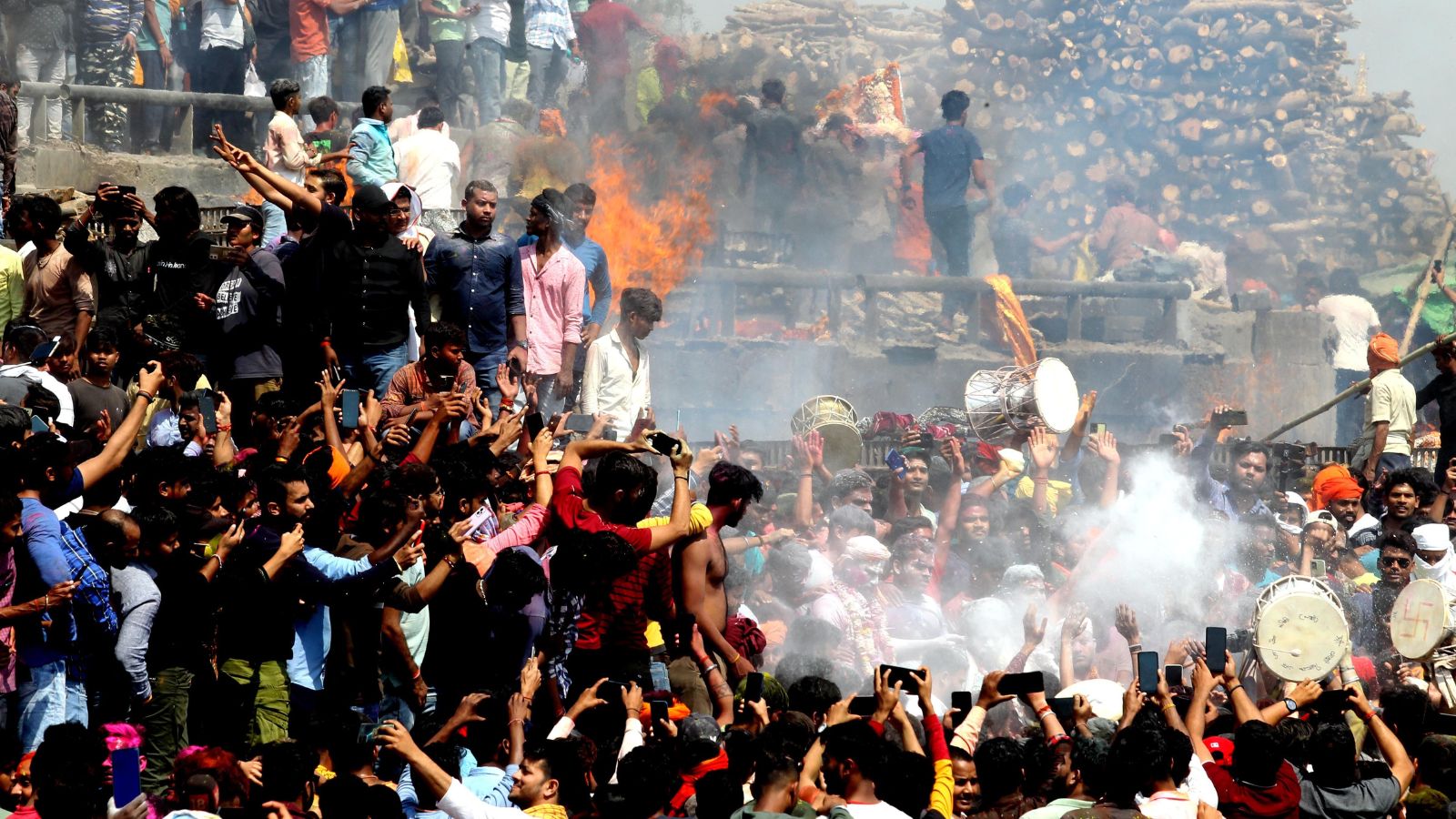
The traditional Masane ki Holi or Masaan Holi in Varanasi, in which ashes from burning funeral pyres, instead of colours, are used to celebrate the festival, has run into a controversy with calls for a curb on the festivity.
The unique Holi, which once used to be played on the premises of the Baba Mashan Nath temple, has now spilled onto the Manikarnika Ghat along the Ganga river due to its growing popularity through social media.
Ahead of the celebration on Saturday, there has been a demand for either banning the festival altogether on the grounds that it is not “sanctioned by the scriptures”, or limiting the festivities to the premises of the Baba Mashan Nath temple.
The prominent opposition has come from the descendants of the Dom Raja, the members of the Dom community, traditionally entrusted with performing cremation rites and serving as custodians of Manikarnika and Harishchandra ghats.
While organisers of Masaan Holi claim the practice is centuries old, its critics contend that it emerged only in recent years.
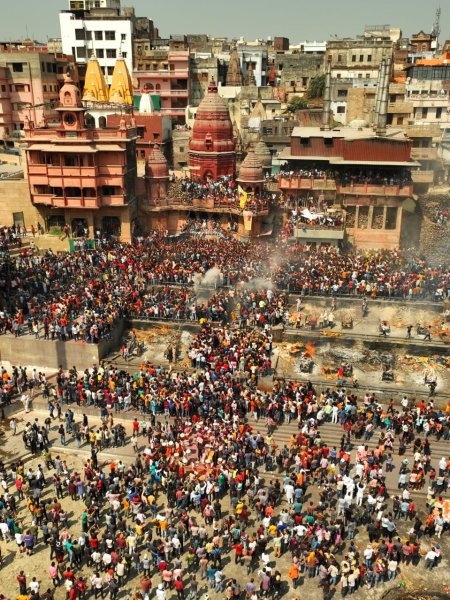 -Celebrations in 2023. Seers and devotees take part in the event. @uptourismgov
Behind the opposition
Vishwanath Chaudhary, descendant of the Dom Raja family of Kashi, said the main concern is the hardship that the festival causes to mourners who arrive to perform the last rites of their loved ones at Manikarnika Ghat.
Chaudhary said that there is no objection to playing Masane ki Holi within the premises of the Baba Mashan Nath temple, but celebrations at the cremation ground create serious difficulties.
Story continues below this ad
“Grieving families are often forced to wait five to 10 hours amid the resulting chaos. Revellers often consume alcohol and create a ruckus,” Chaudhary said, adding he has written to the Varanasi Police and administration seeking a ban on the celebration at the cremation ground.
“Our demand is that this should be stopped immediately so that grieving families can perform the cremation of their loved ones and return home peacefully,” said Chaudhary.
When contacted, Varanasi Police Commissioner Mohit Agarwal said he has not received any letter in this regard and that Chaudhary’s letter may have been submitted to some other officer.
District Magistrate Satyendra Kumar could not be reached for comment.
Story continues below this ad
Meanwhile, members of the Kashi Vidvat Parishad — a body of Sanskrit scholars and experts in Hindu scriptures — also said that celebrating Holi in a shamshan (cremation ground) goes against the established norms of the Hindu religion. They also contended that the “event” has been organised only in recent years under the guise of an ancient custom.
“A cremation ground carries a certain sanctity and is not meant for festivities… There is no mention of Masaan Holi in the scriptures, and such celebrations violate traditional practices,” said Ram Narayan Dwivedi, secretary of the Kashi Vidvat Parishad.
He added that there are specific norms regarding who may enter such places — women and children are permitted only under particular circumstances.
Vishwanath Chaudhary also dismissed claims that it is an age-old tradition, maintaining that no such practice exists. He said members of the Dom community have been present at the cremation ground for decades and are best placed to understand its sanctity.
Story continues below this ad
After the death of the titular ‘Dom Raja’ Jagdish Chaudhary in August 2020, several of his close relatives have laid claim to the title. Vishwanath is one such claimant.
However, Gulshan Kapoor, one of the organisers of Masaan ki Holi and the administrator of Baba Mashan Nath Temple, said the celebration is a traditional utsav and is conducted in accordance with established customs.
He claimed objections to the event are being raised merely for publicity. “This is an ancient tradition that has gained wider attention due to social media, with people now coming to participate after learning about it,” he said.
He added that nearly 4 lakh people from across the country attended the celebration last year, including some foreign visitors.
Story continues below this ad
With no decision yet on halting the practice, the festival is expected to go ahead on Saturday (February 28). Starting at noon, rituals will first be performed inside the temple, followed by the celebrations outside. The event is expected to conclude by 2 pm.
All about the tradition
Elaborating on the significance of the event, Gulshan Kapoor said in Kashi, it is believed that on Rangbhari Ekadashi, Baba Vishwanath (Lord Shiva) brings Mata Parvati to his abode, an occasion celebrated by devotees as the ceremonial beginning of Holi.
According to local belief, festivities are believed to be joined by deities, yakshas, gandharvas and humans, while Shiva restrains his ‘attendants’ (ghosts, spirits, pishachas, kinnaras) from mingling with the public. It is believed that, moved by compassion, he later goes to the cremation ground to celebrate Holi with them using funeral ash. Seers and devotees also take part in the event.
