

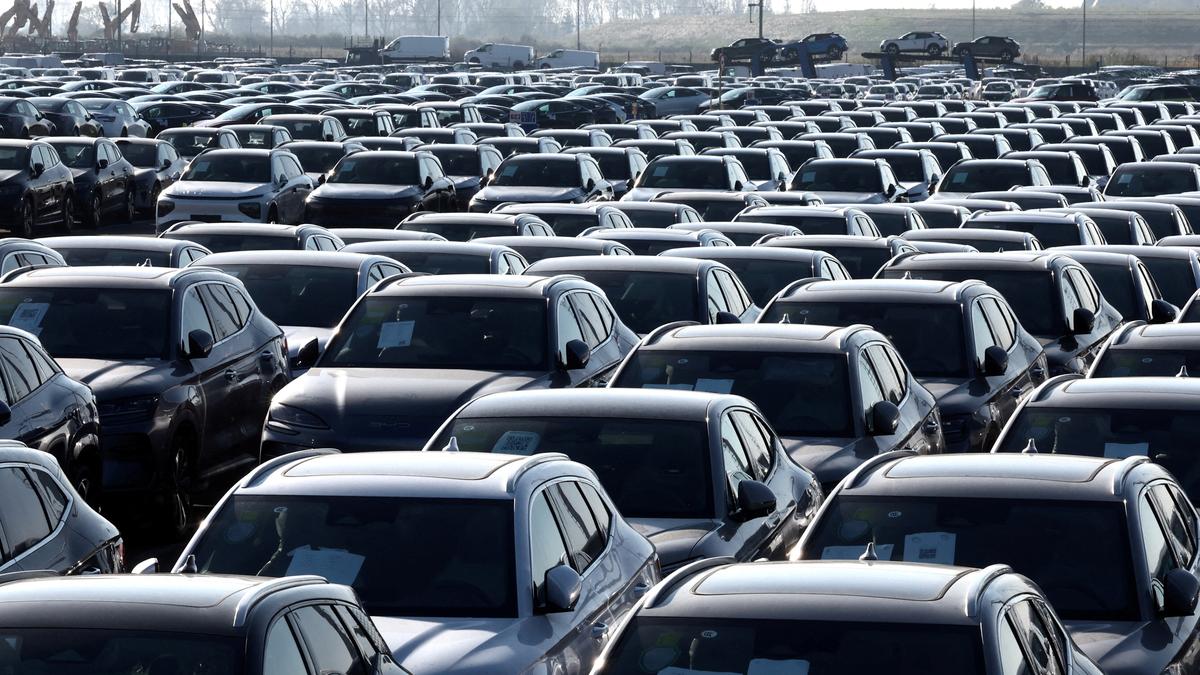
The story so far:
For some years now, the Chinese economy has faced what has locally come to be callednêijuân,oran involution. It is a process in which rivals in certain sectors indulge in price wars, attempting to capture market share and clear out oversupply of goods. However, these price wars are counterproductive, as they reach thresholds where the retail price of the product is so low that even the production costs cannot be realised, pushing firms into losses. This has been most apparent lately in China’s electric vehicle sector, so much so that China’s President Xi Jinping has prescribed corrective measures in a recent article inQiushi.This phenomenon is not new in China; a similar trend has been witnessed in the solar industry as well.
Where does the phrase “involution” originate from?
Involution is derived from the Latin phraseinvolūtiōn-em,meaning ‘to turn inwards.’ According to the Oxford English Dictionary, the earliest known use of the noun “involution” dates back to 1611, in the writings of lexicographer Randle Cotgrave. But the dictionary lists nine meanings for the noun, ranging from its usage in literature to mathematics and pathology. The term appears to have been popularised by American anthropologist Clifford Geertz in the 1960s. Geertz used “involution” in his 1969 bookAgricultural Involution: The Processes of Ecological Change in Indonesiato describe a dynamic in Java’s wet-rice (sawah) economy, where ever more labour and intricacy were packed into the same agro-ecological system, raising output per acre somewhat but not per person— so incomes stagnated even as effort and social complexity increased, according to a blurb of his book in the University of California Press website.
Have EU and U.S. tariffs exacerbated involution in the Chinese EV sector?
Yes, they have. The U.S. Section 301 tariffs on Chinese EVs, set at 100% (from 2024), along with higher duties on EV batteries and parts, effectively mean a trade embargo on Chinese EVs by the United States. Since October 30, 2024, the EU has imposed “countervailing duties” on Chinese EVs (e.g., BYD 17.0%, Geely 18.8%, SAIC ~35%), on top of the standard 10% import duty. This is to ostensibly counter the “subsidies” provided by China to its EV sector. But, Europe’s auto sector is at an inflection point with plummeting sales in its iconic brands as Europeans begin to buy the technologically superior Chinese EVs at highly competitive prices. The countervailing duties are a desperate attempt to save Europe’s once export-heavy auto industry. The commission has also entertained talks on minimum price undertakings in 2025.
Turkiye added a 40% extra tariff on Chinese vehicles in 2024, and Mexico has moved toward a 50% tariff to head off U.S.-bound transshipment.
As a result, Chinese Original Equipment Manufacturers (OEMs) intensified competition at home, fuelling price wars.
Industry leaders themselves have called this an “involution.” Beijing has begun an anti-price-war push as top executives warn of severe consolidation among the 120–130 EV makers in the country.
OEMs are localising abroad (e.g., BYD in Hungary/Turkiye) and diversifying exports to emerging markets, but timelines and capacity ramps are uneven. Meanwhile, according to the International Energy Agency, Chinese imports accounted for 75% of the increase in EV sales across emerging economies outside China in 2024.
What is the Chinese government doing to rein in the process in the EV sector?
On May 31, the Chinese Ministry of Industry and Information Technology (MIIT) assured to rein in involution in the EV sector. This was followed by June 30 news coverage in the Chinese media, which framed a Politburo communication as Mr. Xi’s “war on price wars”.
On July 24, Beijing released a draft overhaul of the pricing law to curb below-cost selling and algorithmic pricing abuses.
On Monday, Mr. Xi’sarticle inQiushi,the Chinese Communist Party’s theoretical magazine, called for curbing “disorderly price competition” and an “orderly exit” of outdated capacity, the clearest sign yet that the Central government plans a phased slowdown of price wars.
Published – September 16, 2025 08:30 am IST
