

Last month, at his sold-out concert at Mumbai’s SVP Stadium, popular Punjabi Sufi singer Satinder Sartaj went slightly off script. He reached back several decades and sang Noor Jehan.
As soon as he began her age-old Saanu neher wale pul te bula ke, te khore maahi kitthe reh gaya (After calling me to the bridge over the canal/ where is that idiot beloved of mine?) from Dupatta (1952) —one of the first few post-Partition films from Pakistan — recognition set in among the audience instantly. So much so that they cheerfully fed Sartaj the lyrics when he couldn’t get a hold of them during the impromptu performance of the ditty.

The song’s draw among millennials and Gen Z is not only because of the viral hook or the 30-second Instagram loops that have the algorithm playing it up. In a world of hyper-curated beats and filters, the song, sung by Noor Jehan, has an analogue honesty that screams authenticity, something today’s young seem to gravitate towards. But at the core of it is also the idea that it is not just content. It also comes from a particular moment in history, has context and has already lived many lives on radio, television and tapes before finding itself on the web.
Noor Jehan, who was born and raised in Kot Murad Khan, a tiny village near Kasur in Pakistan, trained under Ustad Ghulam Mohommad and later with singer and actor Kajjanbai in Calcutta — the foundational hub of the Hindustani film industry — where her family had moved so that their three daughters could pursue a career in music and cinema. Not too long after, Noor Jehan became the singing star of undivided India. She was a screen idol whose full, power-packed voice in films such as Anmol Ghadi (1946), Dost (1944) and Mirza Sahiban (1947) found a lot of attention. Lata Mangeshkar was only 14 when she met her hero Noor Jehan at the film set of Badi Maa (1945) in Kolhapur and sang raag Jaijaivanti for her. Noor Jehan, elated with what she heard, asked Mangeshkar to continue to practise. While Noor Jehan was the lead actor in the film, Mangeshkar had a small role.
Partition, however, changed the map as well as the trajectories of many artistes who were now to live in a fractured world. Noor Jehan decided to move back closer to where she was born and settled in Karachi, leaving an established career, the industry and her friends. She rebuilt her career in Lahore, becoming central to the nascent Pakistani film industry. She made her directorial debut — first woman in pakistan to do so — with Chanway (1951), which was also the first film from Pakistan. It was a runaway hit. She followed it up by acting and singing in Dupatta. Two songs from the film — Chandni raatein (remixed in the ’90s) and Neher wale pul — showcasing the confidence of her survival post the bloody split, became hits on both sides of the border. The bridge was made.
Neher wale pul also found a lot of attention after Noor Jehan gave up acting in the ’60s on her second husband’s demand. She did a lot of live music shows instead. She may have been dramatic on screen but while singing live, she was fully in command of the room. And what belonged in a film became hers.
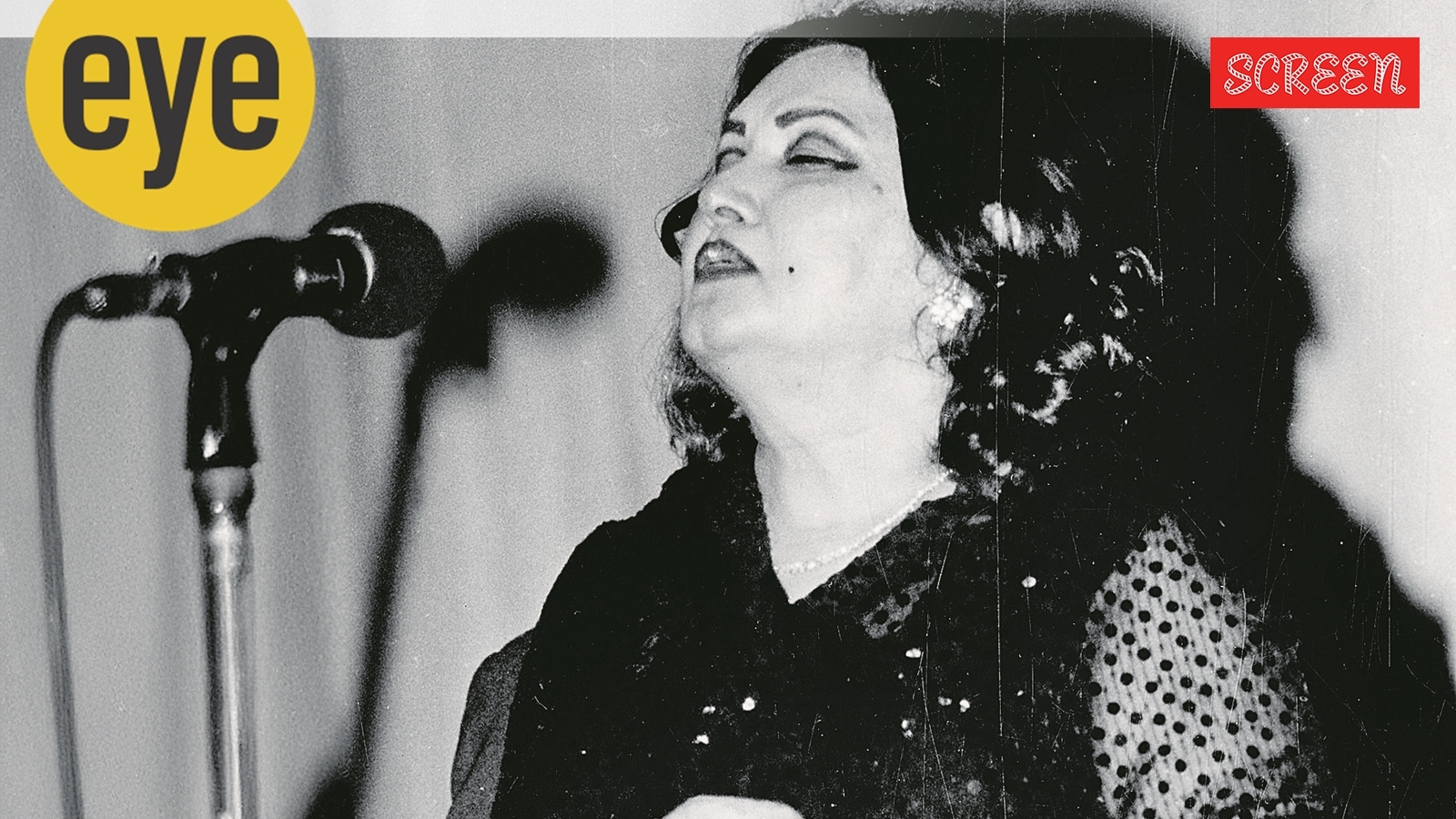
Her live version of the song for the BBC at Pebble Mill Studios is worth a watch. Noor Jehan is seen in a white shimmery sari, with an elaborate hairdo and loud makeup. A beauty spot is carefully placed on her left cheek. With a subtle tilt of the head and impish expressions, she croons the song with so much fun. It was as if she relished the act of telling the story; was independent and unapologetic.
Story continues below this ad
After all, she was the same Noor Jehan who, in 1954, had refused to sing at a government charity event because the officials didn’t want her to sing Faiz Ahmed Faiz’s Mujhse pehli si mohabbat. Faiz was in jail at the time for his alleged involvement in the Rawalpindi conspiracy case — an attempted coup to overthrow the government — resulting in his poetry being banned. Noor Jehan had said, “If this poem won’t be sung, I won’t sing at all.” The organisers relented and she sang the song. Faiz heard his poem in her composition and voice in Hyderabad jail and was deeply moved. He would later go on to say, “Ye geet ab mera kahan, ye toh ab Noor Jehan ka ho gaya (It’s not my song any more, it now belongs to Noor Jehan).
When Neher wale pul is sung today — by Sartaj or men of the popular Patiala mehfil, or playback singers Akriti Kakkar and Simran Choudhury, or an African man who does not know Punjabi but sings it with profound expression, or by Pakistani folk singer Naseebo Lal during a concert, an Assamese influencer, Pakistani singer Quratulain Balouch, at weddings on both sides of the border, even on Kappa TV, the popular Malayalam music channel — it carries a faint echo of the fearless Noor Jehan. It is as if the song was built to cross the bridge. Every time a new voice picks it up, it reinforces the fact that some melodies do not fade.
In the era of virality and unoriginal music, Neher wale pul’s afterlife is a heartening surprise.
