

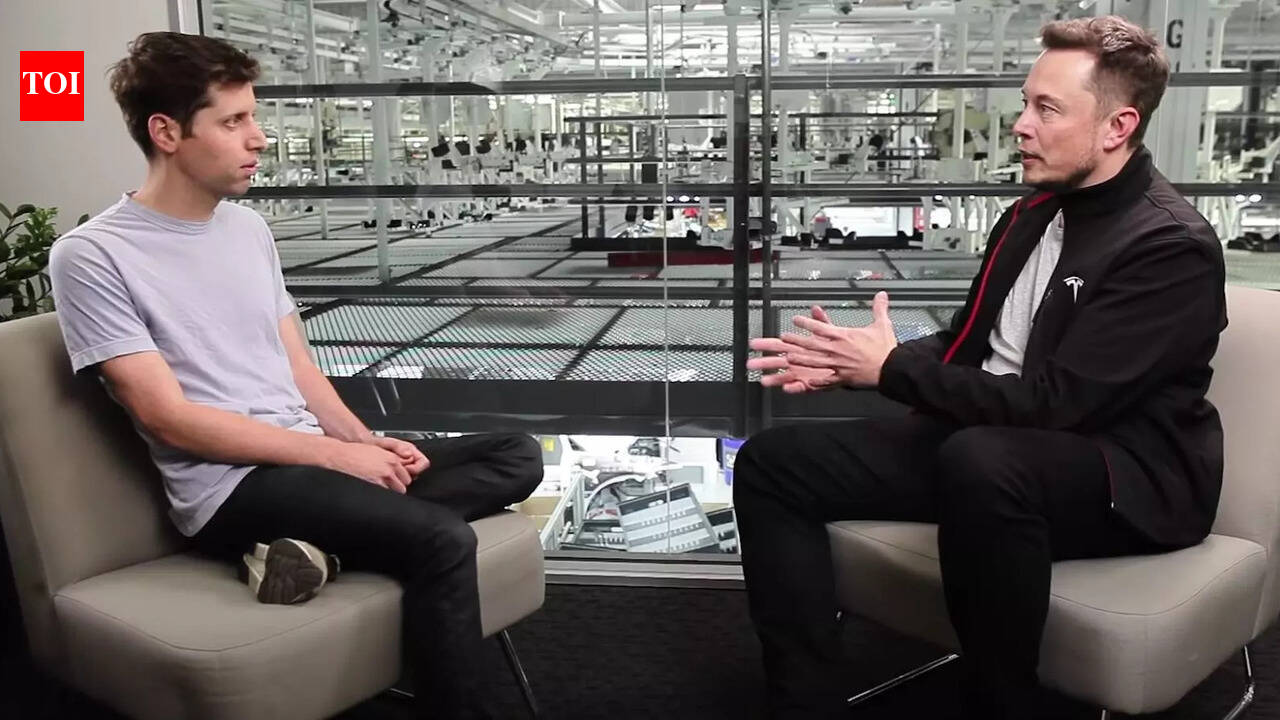
On the last day of January 2018, Elon Musk sent a chart to Sam Altman, Greg Brockman, and Ilya Sutskever. No lengthy preamble. Just a blunt takeaway: DeepMind and Google Brain were dominating AI research, and OpenAI was falling behind. “OpenAI is on a path of certain failure relative to Google,” Musk wrote. That warning—detailed in Sebastian Mallaby’s The Infinity Machine: Demis Hassabis, DeepMind, and the Quest for Superintelligence, excerpted in Colossus magazine—landed nearly eight years ago. It reads differently today.By December 2025, it was Altman sending the alarming memo. He declared a company-wide “code red” to fix ChatGPT, shaken by a surging Google Gemini and a fast-growing Anthropic eating into OpenAI’s enterprise lead. The Wall Street Journal first reported the memo’s contents. The roles had completely reversed.
Google’s Gemini comeback spooked OpenAI’s leadership
The immediate trigger was Google releasing Gemini 3 the previous month—a model that cleared industry benchmarks and pushed the app to 650 million monthly active users by October 2025. Altman told staff OpenAI needed to improve ChatGPT’s personalization, speed, reliability, and the range of questions it could answer, per the WSJ.This was a striking role reversal. It was ChatGPT’s launch in November 2022 that had originally set off a code red at Google, with Pichai warning his team that the chatbot could threaten Search itself. Now the panic was flowing the other direction.Anthropic compounded the pressure. By September 2025, it had crossed 300,000 business customers—up from fewer than 1,000 just two years prior, per CNBC. Its Claude Code and enterprise tools had become the default for software developers across Silicon Valley. By March 2026, OpenAI’s own applications chief Fidji Simo was telling staff in an all-hands that Anthropic’s success should be a “wake-up call,” urging them not to get distracted by “side quests,” the WSJ reported.
The governance fight that quietly shaped today’s AI race
None of this happened in a vacuum. Mallaby’s book traces the roots of this rivalry back to 2015, when DeepMind co-founders Demis Hassabis and Mustafa Suleyman launched an ambitious—and ultimately doomed—attempt to build a safety governance structure for AI, internally code-named “Project Mario.”The plan was a so-called 3-3-3 board: three DeepMind members, three from Alphabet, three independents. Reid Hoffman committed $1 billion to back a potential walkout from Google. The talks dragged on for three years, with Pichai and Google’s legal chief David Drummond running what DeepMind’s founders came to see as an endless good cop/bad cop routine. Nothing ever got signed.Meanwhile, the parallel drama at OpenAI was just as messy. Musk, convinced that Altman was maneuvering for control, grew increasingly erratic. He proposed folding OpenAI into Tesla. When the team refused, he quit—and stormed out of an all-hands meeting after calling an intern who questioned his judgment a “jackass.”His January 2018 memo was essentially his parting shot. Brockman pushed back the same day, arguing that conference papers were a poor measure of progress. “It doesn’t matter who wins if everyone dies,” he wrote. But Musk had already made up his mind.
Musk’s prediction, and how it aged
Musk’s 2018 warning turned out to be less a parting shot and more an early read on a structural problem OpenAI is still wrestling with today. Google had the research talent, the compute, and the revenue to sustain a long war. OpenAI had momentum and a chatbot. For a while, that was enough.But Gemini 3’s arrival in late 2025 changed the calculus. The model didn’t just beat ChatGPT on benchmarks—it deployed across Google’s entire ecosystem almost overnight, reaching billions of existing users in days. That’s the kind of distribution advantage Musk was pointing at back in 2018, when he showed Altman the chart and said the numbers didn’t lie.Altman’s code-red memo, reported by the WSJ, was in many ways an admission that Musk had a point. OpenAI still leads on weekly active users—800 million as of late 2025—but user counts don’t pay the bills when you’re burning through cash at OpenAI’s rate. The company needs to grow revenue to roughly $200 billion to turn a profit by 2030, per its own projections. Google, meanwhile, funds its AI ambitions from a search business that prints money.
Poll
Who do you think currently leads the AI research race?
Musk wanted to solve that problem by folding OpenAI into Tesla. The team said no, and he left. Seven years later, the problem he identified remains unsolved—just bigger, and with a lot more riding on the answer.
