

6 min readNew DelhiUpdated: Mar 18, 2026 04:08 PM IST
Supreme Court news: Observing that when even high court judges differ in their opinions, it would be unreasonable to expect mere law graduates competing for the post of law officer in a municipal corporation to arrive at the correct conclusion, the Supreme Court ordered the civic body to create a supernumerary post to accommodate the petitioner.
Justice Prashant Kumar Mishra was hearing a plea challenging a judgment by the division bench of the Punjab and Haryana High Court regarding a dispute on an answer to a written exam question.

“When the Judges of the High Court are at variance in their opinion as to the correct answer to Question No.73, it is least expected from mere law graduates, who are competing for a post of Law Officer, to reach to a correct conclusion while answering the multiple-choice question by process of interpretation of Constitutional provisions involving this court’s judgments in several decades,” the court said on March 17.
Considering both the petitioner and respondent candidates’ pleas, the court added that both candidates deserve to be accommodated.
The dispute
- The Municipal Corporation of Chandigarh issued an advertisement for recruitment to various posts, including one post of law officer, to be filled through a written examination consisting of 100 multiple-choice questions carrying one mark each, with a negative marking of 0.25 marks for every incorrect answer.
- The appellant and the third respondent, Amit Kumar Sharma, both applied for the post.
- The dispute arose from a question asking which Schedule of the Constitution is immune from judicial review on the ground of violation of fundamental rights.
- The third respondent selected Option D (None of the above), whereas the recruiting authority treated Option B (Ninth Schedule) as the correct answer, leading to a deduction of one mark and an additional 0.25 marks as negative marking.
- The learned single judge dismissed the writ petition by relying on Article 31B of the Constitution, which grants immunity to laws placed in the Ninth Schedule.
- The Ninth Schedule contains a list of central and state laws that cannot be challenged in courts
- The position was upheld in Shankari Prasad Singh Deo v. Union of India and Sajjan Singh v. State of Rajasthan, and although I C Golak Nath v. State of Punjab took a different view, it was overruled in Kesavananda Bharati v. State of Kerala, restoring the validity of Article 31B.
- The court relied on I R Coelho v. State of Tamil Nadu, which clarified that although laws in the Ninth Schedule enjoy protection, such immunity is not absolute and they can still be subjected to judicial review if they violate the basic structure of the Constitution.
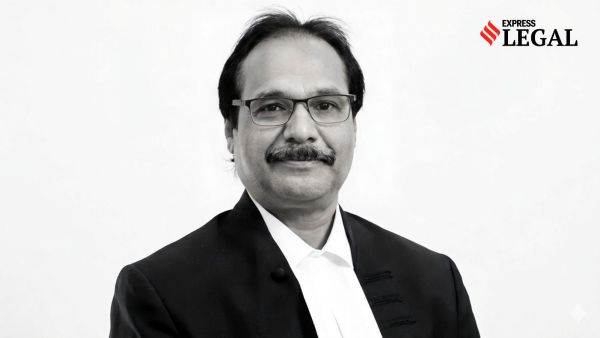 Justice Prashant Kumar Mishra was hearing a plea challenging a judgment by the division bench of the Punjab and Haryana High Court.
Intra-court appeal
- In the intra-court appeal, the division bench of the Punjab and Haryana High Court held that it is incorrect to state that the Ninth Schedule is completely immune from judicial review and that the third respondent’s answer (Option D) correctly reflected the settled position of law.
- The division bench observed that the deduction of 1.25 marks materially affected the third respondent’s merit ranking and deprived him of fair consideration, emphasising that a candidate cannot be penalised for answering in accordance with the law declared under Article 141 (law declared by the Supreme Court to be binding on all courts) of the Constitution.
- About the appellant’s appointment, the court noted that although he had already joined service, the rights of a more meritorious candidate cannot be defeated due to a delay in judicial proceedings, and relying on Vikas Pratap Singh v. State of Chhattisgarh, it held that a supernumerary post may be created to balance equities.
‘Both answers may be correct’
- Both the answers may be correct, although Option ‘B’ (Ninth Schedule) appears to be more appropriate considering the language of the question asked.
- On a deeper analysis of this court’s judgments mentioned above, Option ‘D’ (None of the above) can also be considered to be correct, as has been held by the division bench.
- We direct the Municipal Corporation, Chandigarh, to accommodate both the appellant and the third respondent/petitioner by creating a supernumerary post and appoint the third respondent as well.
- Upon appointment of the third respondent, the appellant, who was initially selected and joined and is presently working on the post, will be treated as senior.
- To determine the correctness of the answer, both the single judge and the division bench undertook a detailed examination of the relevant constitutional provisions, particularly Article 31B, along with the evolving jurisprudence on the Ninth Schedule.
- The courts relied upon landmark constitutional decisions of the Supreme Court, including Shankari Prasad Singh Deo v. Union of India, Sajjan Singh v. State of Rajasthan, I.C. Golak Nath v. State of Punjab, Kesavananda Bharati v. State of Kerala, and I R Coelho v. State of Tamil Nadu.
- The judgments collectively trace the constitutional position from absolute immunity of Ninth Schedule laws to the later development of the basic structure doctrine, under which such laws are no longer completely immune from judicial review.
With inputs from Sumit Kumar Singh, who is an intern with TheIndian Express


© IE Online Media Services Pvt Ltd
