

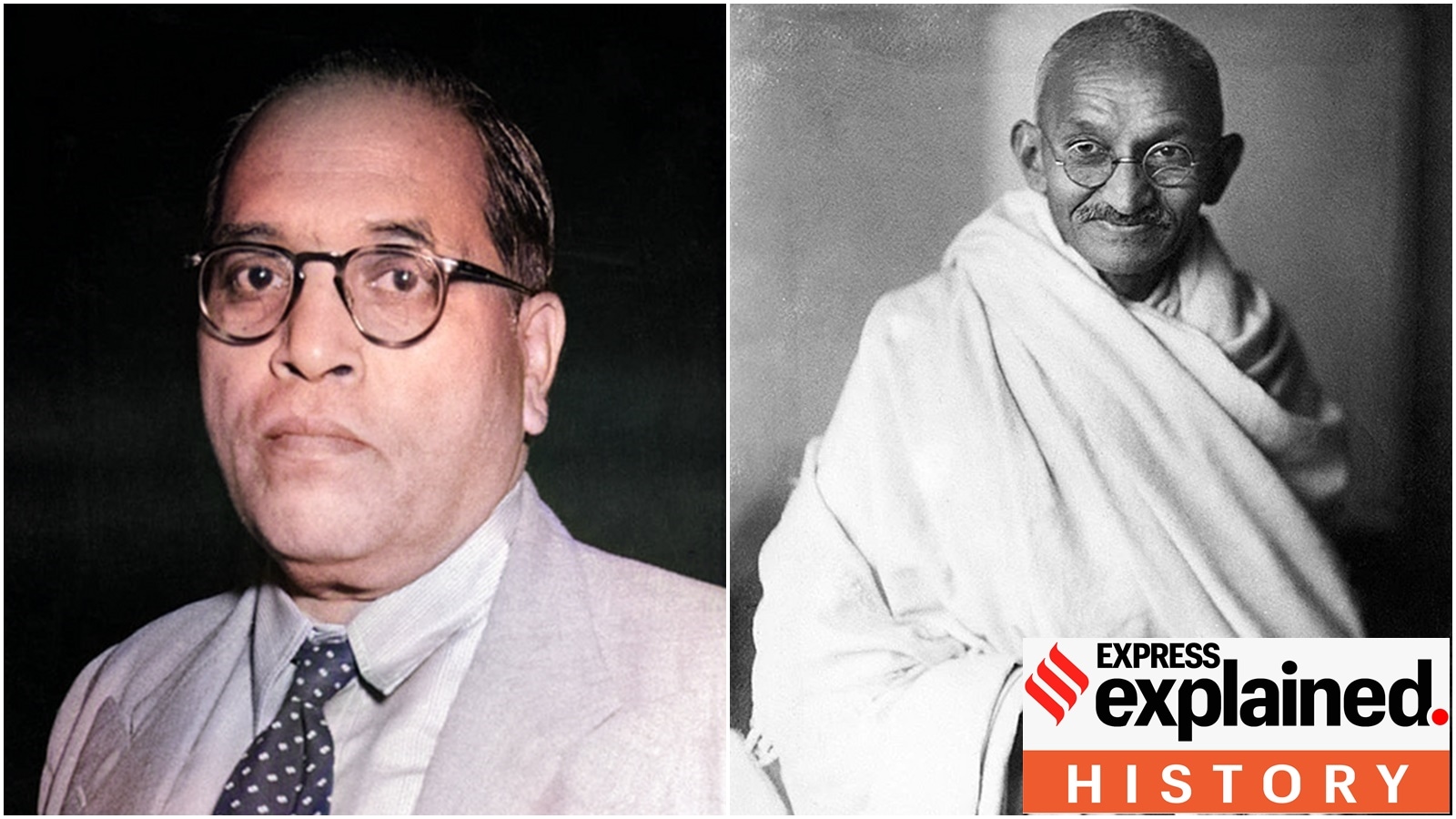
Mahatma Gandhi Ambedkar Debate: Seventy-eight years after Mahatma Gandhi’s death, the world continues to debate and engage with his relationship with his most formidable adversary—B R Ambedkar. The debate between Gandhi and Ambedkar was far more than a theoretical disagreement between two individuals. “Each represented very separate interest groups, and their battle unfolded in the heart of India’s national movement…,” writes Arundhati Roy in The Doctor and the Saint: Caste, Race, and Annihilation of Caste (2017).
Their differences over social, economic and political issues laid the foundations of independent India and continue to reverberate in the corridors of Parliament.
A few weeks before the Second Round Table Conference in 1931, Mahatma Gandhi and B R Ambedkar met for the first time in Bombay. Gandhi questioned Ambedkar about his criticism of the Congress, interpreting it as an attack on the homeland itself. Ambedkar responded: “Gandhiji, I have no homeland… No Untouchable worth the name will be proud of this land.”
The tension between their positions became public at the Second Round Table Conference in London, where Gandhi declared: “I claim myself in my own person to represent the vast mass of Untouchables,” marking their first major public confrontation.
Ambedkar, however, was of the opinion that questions of justice concerning the Depressed Classes could not be represented by anyone who did not share their identity. Central to his demands was the provision of a separate electorate, which he viewed as essential for safeguarding the political rights of those then considered Untouchables. Gandhi, however, firmly rejected this proposal. He believed that separate electorates would break Hindu society and further isolate the Untouchables. He asserted: “I would far rather that Hinduism died than that Untouchability lived.”
In 1932, British Prime Minister Ramsay MacDonald announced the government’s decision on the Communal Question, granting Untouchables a separate electorate for 20 years. At the time, Gandhi, who was imprisoned in Yerawada Central Jail in Poona, declared that he would fast unto death unless the provision for separate electorates was withdrawn.
On religion
A devout Hindu, Gandhi understood religion as a moral compass for social reform. He regarded Hinduism as a tradition open to reform and reinterpretation. This is most clearly reflected in his reading of the Bhagavad Gita. As Bindu Puri notes in The Ambedkar-Gandhi Debate on Identity, Community and Justice (2022), yajna [sacrifice] in 1930s India, for Gandhi, did not signify ritual offerings into fire but selfless service to those most distant from oneself. Through such reinterpretation, Gandhi believed that social reform was possible without renouncing religion.
Story continues below this ad
Ambedkar, by contrast, regarded Hinduism as irredeemable. As early as 1935, he said: “I was born a Hindu but I will not die a Hindu.” He argued: “You must not only discard the shastras, you must deny their authority as did Buddha and Nanak. You must have the courage to tell the Hindus that what is wrong with them is their religion—the religion which has produced in them this notion of the sacredness of caste…”
Although profoundly disillusioned with Hinduism, Ambedkar nonetheless recognised the deep human need for spiritual belonging. Neither legal rights nor constitutional guarantees alone could satisfy that longing. After nearly two decades of sustained study, including of Islam and Christianity, he turned to Buddhism in 1956, adopting it on his own terms.
On justice
Although Gandhi had studied law and was acquainted with the British legal system, he did not think that the rule of law alone could ensure justice. He opposed third-party justice and replaced abstract legal equality with the ideal of absolute equality—samata, samabhava, and samadarshita. Drawing from the Indian ethical tradition and the historical meaning of dharma, Gandhi argued that justice could be stable only if rooted in equi-mindedness and a respect for the “other,” whether oppressed or oppressor.
However, he did not entirely dismiss institutions. “In Gandhi’s view,” notes Puri, “the redressal of justice could be secured by an approach which involved both institutions (as for instance representation in legislatures for the depressed classes) and transformation of persons (by a change of heart of the oppressor).”
Story continues below this ad
Ambedkar, on the other hand, approached justice primarily through institutions—laws, rights, and constitutional safeguards capable of restraining power and correcting injustice. He insisted that justice cannot rest solely on moral feelings or individual conscience.
