

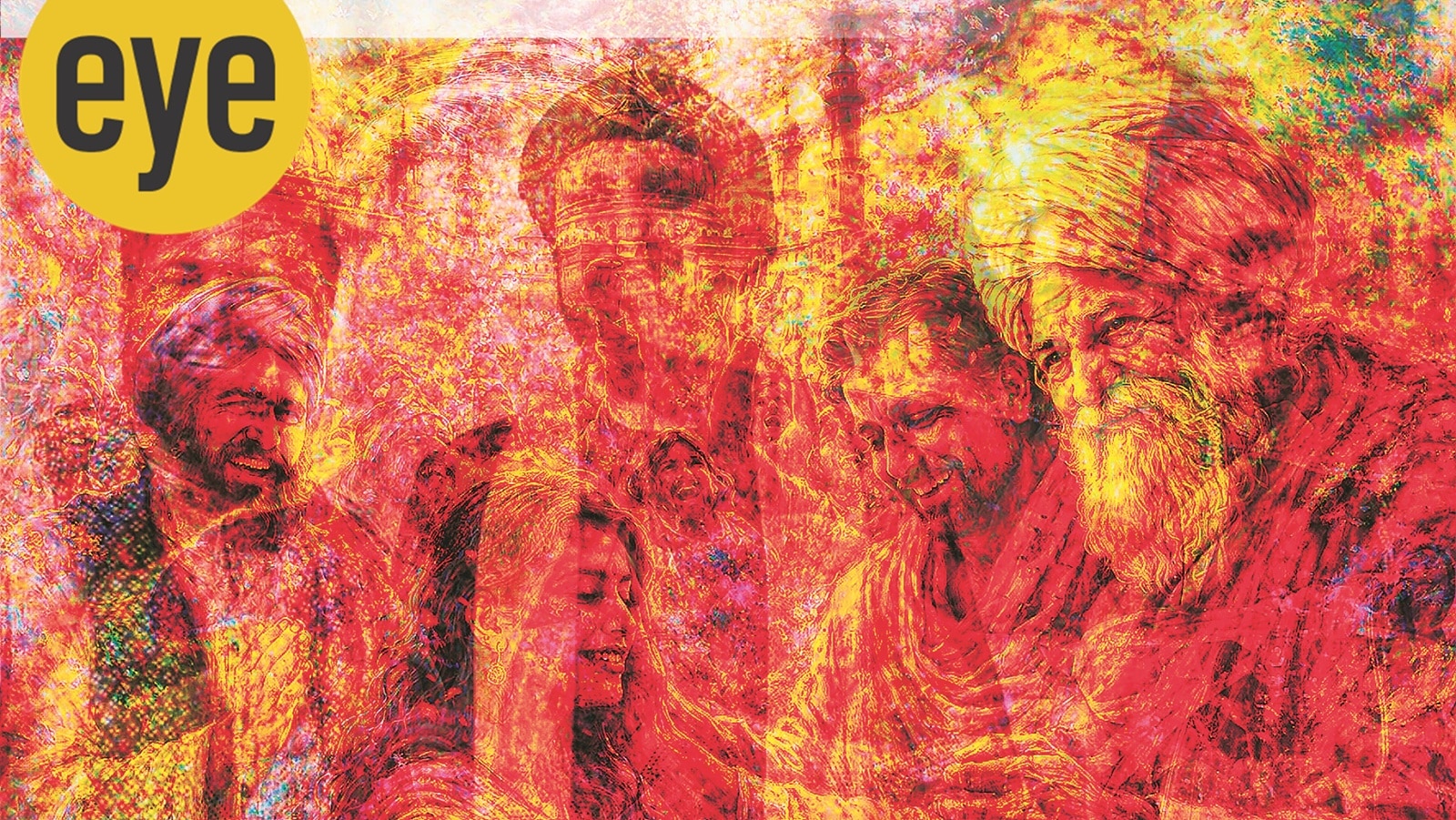
Holi has just passed, yet the pavements still blush pink and the pores of my palms still hold a stubborn stain of saffron and sky. Colour lingers long after commotion leaves; it clings to collars and consciousness alike. In the quiet after the carnival, when the drums have dulled and the laughter has loosened into memory, I find myself humming a bandish that has shaped my understanding of India more profoundly than any policy or proclamation ever could: Hori kheloongi kah Bismillah. I learned it from my music teacher, Marina Ahmad, a senior disciple of the late, luminous Sangeet Martand Pandit Jasraj, whose voice vaulted from temple to sky without ever losing tenderness.
Marina ji did not teach that hori as novelty or gimmick; she taught it as naturalness, as nourishment, as inheritance. “Mean it,” she would murmur when I smiled too easily through the phrase. “Don’t decorate it. Devote it.”

And so I stood there, a Hindu boy beginning a spring festival song with Bismillah on my breath, and something within me softened, surrendered, stretched. It was not conversion. It was convergence. It was not abandonment of identity. It was expansion of it.
To say Bismillah before playing Holi is not audacity; it is intimacy. It is India in her most incandescent expression—where invocation and irreverence intermingle, where gulal and grace share the same sky. Red does not request your religion. Blue does not demand your doctrine. Yellow does not check your caste certificate. Colour simply lands, laughing at labels, mocking militancy, dissolving division. And yet beyond our courtyards and concert halls, the world feels brittle. Borders bristle, bombs boast, leaders roar with a recklessness that rattles the fragile porcelain of peace. Madmen with microphones manufacture menace; power-drunk demagogues drag the world toward precipices it should never approach. Peace feels like a fragile filament, a trembling thread tugged by tempers and threatened by towering egos.
In such a season, I return to Bulleh Shah, that peerless Punjabi mystic whose poetry pierced pretense and protected tenderness. He sang centuries ago what politicians still cannot stomach: tear down the mosque, tear down the temple, tear down whatever you wish — but do not break a human heart, for God resides there. His rebellion was not about rubble, it was about reverence. He was not advocating vandalism, he was advocating vulnerability. The architecture he wished dismantled was arrogance. The sanctuary he sought safeguarded was the human heart. How radical, how resonant, how urgently relevant that feels today.
The first time I sang Hori kheloongi kah Bismillah with proper presence, Marina ji stopped me mid-phrase. “You are smiling too much,” she said, not sternly but softly. “Understand what you are saying.” So I stood straighter, stilled my frivolity, and allowed the raga to ripple through me. The taal throbbed like a communal heartbeat. The melody curved like colour in mid-air. Bismillah did not feel foreign on my tongue; it felt fragrant, familiar, fated. In that moment, I sensed that syncretism is not strategy, it is song. It is not secularism drafted in legal language, it is sacredness carried in cadence. It is the small, steady bravery of beginning a Hindu festival with an Islamic invocation and meaning every syllable.
India has always been brave in these quiet ways. A Muslim ustad teaching a Hindu shishya; a Sikh neighbour sending gujiya across the gate; a Christian friend smearing gulal before Easter Mass; a Parsi family hosting iftar. These gestures rarely make headlines, they make harmony. They are not spectacles, they are habits. And habits build nations more sturdily than slogans ever could. When rhetoric roars, we respond with rhythm. When fear spreads, we spread colour. When the world frays, we braid.
Story continues below this ad
Holi, at its heart, is not merely riotous, it is restorative. It levels the lofty and lifts the lowly. A CEO stands indistinguishable from a clerk once both are powdered purple. A politician looks no more powerful than a postman when drenched in indigo. Colour corrects arrogance. Gulal gentles ego. In that playful absurdity lies profound theology. We approach the neighbour we argued with and say, “Bura na mano, Holi hai.” Do not mind, it is Holi. What if we extended that mercy beyond one day? What if nations practised that pause? What if leaders, before launching into litany and liturgy of war, remembered the humility of being human, the hilarity of being harmlessly hued?
Bulleh Shah once asked, “Bullah ki jaana main kaun?” I do not know who I am. In an age obsessed with identity, he relinquished it. Who am I? Hindu, Indian, chef, columnist, student of Marina ji, distant disciple of Pandit Jasraj? Or am I simply a man with colour on his collar and Bismillah on his breath? Holi makes identity fluid; music makes it porous, love makes it possible. When I sing that hori, I am not betraying tradition, I am embodying its bravest impulse. The Indian way has never been about brittle binaries, it has been about blended breath, about plurality without paranoia, about devotion without division.
Let us not romanticise recklessly, the threats are real. There are men who mistake noise for nobility and cruelty for courage. There are leaders who wield war words like weapons and treat peace as weakness. But peace is not passive. It is chosen daily, deliberately, defiantly. It is brewed in kitchens where Holi batter is stirred by hands that have prayed in different ways. It is rehearsed in riyaaz rooms where “Bismillah” and “Radhe Radhe” share a scale. It is rehearsed again when we refuse to forward a hateful message, when we correct a careless comment, when we protect a heart even if it once broke ours.
This is personal for me. I have loved across lines. I have been mentored across faiths. I have felt the same stillness in dargahs and temples, in gurdwaras and green rooms. I have seen tears fall in tune to both bhajan and qawwali. I refuse to let the loudest voices redefine my inheritance. My inheritance is Marina ji’s meticulous mercy. My inheritance is Pandit Jasraj’s expansive embrace. My inheritance is Bulleh Shah’s insistence that Rab resides in the heart. My inheritance is Holi’s holy irreverence, its fearless fusion, its festive forgiveness.
Story continues below this ad
So this Sunday, as the last traces of pink persist in pavement cracks and the news cycles continue their relentless churn, I hum again: Hori kheloongi kah Bismillah. I will play Holi saying Bismillah. I will begin with blessing. I will scatter colour instead of suspicion. I will answer anger with alliteration of affection, respond to rage with rhythm, meet menace with music. If the thread of peace feels thin, I will not tug at it in temper; I will weave into it—raga, rhyme, remembrance.
India at her best does not shout unity; she sings it. She does not legislate love; she lives it. She does not fear difference; she dyes it until it becomes radiant. Let the madmen rage. We will respond with raga. Let the reckless roar. We will answer with ardour that is gentle, generous, just. Holi has passed, but its lesson lingers: colour conquers cruelty; music mends what might otherwise be marred; and the human heart, fragile yet fierce, is the only house we must never dare demolish. Hori kheloongi, kah Bismillah—and may the colour cling not only to our clothes but to our conscience, not only to our skin but to our shared, sacred, stubborn humanity.
