

The story so far:
Among the key areas of disagreement between the U.S. and India regarding trade is a demand that India should import U.S. corn. U.S. Commerce Secretary Howard Lutnick has said that India has 1.4 billion people but does not import a single bushel of corn from the U.S. (25 kg approximately).
Does India import corn?
India’s maize yield is quite poor and is below four tonnes per hectare whereas the world average is six tonnes. Despite that, India had been largely self-sufficient and has sometimes even exported maize, mainly for poultry and other livestock feed as well as for human consumption.
With the ramp up of ethanol blending of petrol, India has had to balance between its food needs and ethanol production. For instance, it has to decide between sugar manufacture versus diverting sugarcane products to ethanol production. Similarly, India has also had to ramp up maize feedstock for ethanol production. This Kharif-Rabi-Spring season, the maize crop is expected to supply some 10 to 12 million tonnes for ethanol production out of an overall 50 million tonnes production, says H.S. Jat, Director of the ICAR-Indian Institute of Maize Research in Ludhiana. He adds that there will not be any need to import maize this year given the bounty crop expected.
India has, however, been importing maize in recent times, apparently for ethanol. For instance, overall maize imports were some one million tonnes in 2024-25 (60% from Myanmar and much of the rest from Ukraine). This represents an almost eight times increase over the previous year.
India doesn’t import U.S. corn, much of which is Genetically Modified (GM). India has allowed only GM cotton cultivation, with GM brinjal and mustard cultivation remaining in the investigation stage. Some critics say that fears over cultivating GM crops such as alleged toxicity and diseases will apply to imported GM corn produce as well if it enters the food chain.
Why does the U.S. want to export to India?
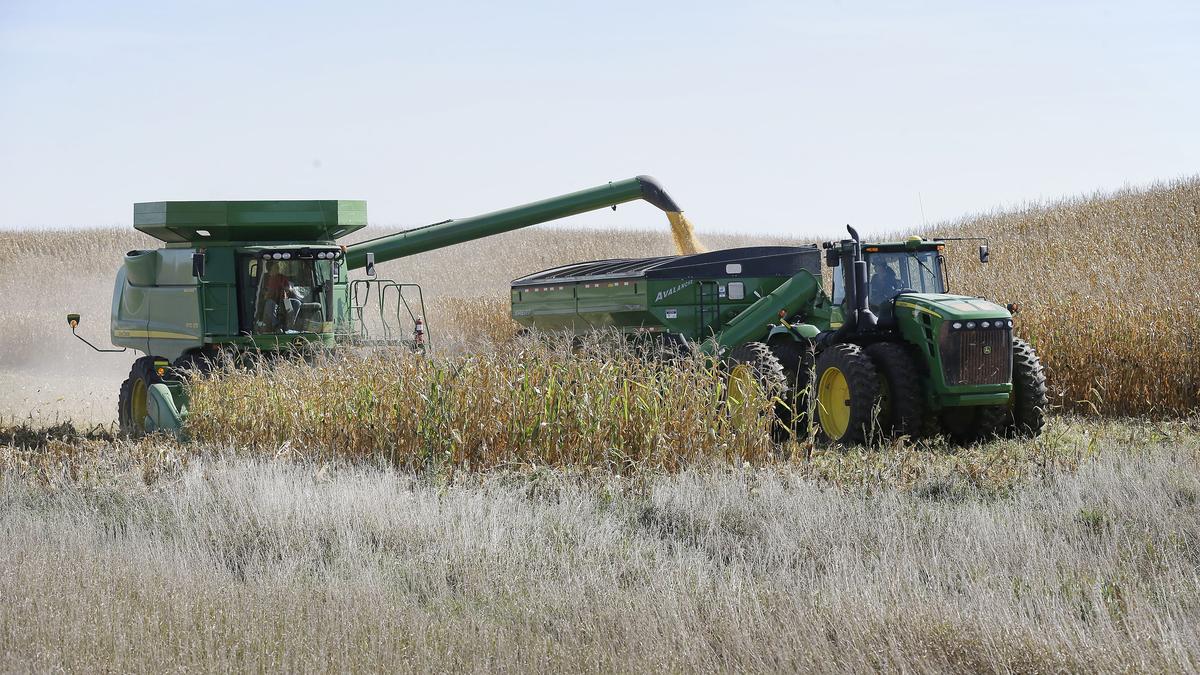
In India, farming is the occupation of the masses and is primarily targeted at removing hunger and enhancing nutrition. In the U.S., however, farming is essentially capitalist and characterised by high productivity (U.S. maize yield is three times that of India), very large land holdings (typically 500 acres per farming family or operation, as it’s called there), and high levels of mechanisation since only a little more than three million people are engaged in the two million farming operations.
U.S. agriculture is largely a feedstock producer for massive agribusinesses. This is a sharp change from the era of the Great Depression when, as hunger mounted amidst high production, the U.S. government under President Franklin D. Roosevelt moved in to institute hunger-nutrition programs through food stamps to boost consumption and ensured subsidies to pay farmers for not producing. Another key government spend within the hunger-nutrition scheme that continues today is school lunch programmes.
The 1960s and 70s saw a strengthening of hunger-nutrition programs. However, a little later, the focus of U.S. agriculture again shifted towards making it increasingly capitalist, though the government steps in from time to time, such as during the recession of the late 2000s, to beef up the food stamps programme.
As the World Trade Organization rules began to be enforced that required U.S. and other developed nations to cut farm subsidies, there has been a bigger thrust towards capitalist farming. Huge payouts such as counter-cyclical payments to farmers and agribusinesses has led to the growth of giant agri-multinationals. The dominant crops in the U.S. are the cash crops of corn and soybean whereas fruits, vegetables and wheat that often go towards direct human consumption are considered “speciality” crops. Overproduction of cash crops is characteristic of U.S. farming and there is a constant need for expanding export markets. Out of a total 350 million tonnes of yearly corn production, some 45 million tonnes are exported.
Maize is only marginally consumed directly by the people in the U.S. but it feeds a range of industries such as the manufacturing of processed products like high fructose corn syrup; ethanol production; plastic-making; as well as animal feed. Corn is a key feed for massive Concentrated Animal Feeding Operations (CAFOs) that raise cattle in confined spaces for slaughter. CAFOs are essential to America’s nearly 30-million-tonne meat production every year. The U.S. therefore is specifically eyeing ethanol blending in India for its corn exports.
What are the political stakes behind corn and soybean exports?
The corn belt is practically synonymous with the U.S. midwest region. So is soybean production. This region is the Republican heartland and the core of U.S. President Donald Trump’s voter base. California is the base for speciality crops such as fruits and vegetables and a Democrat stronghold. In the U.S., Democrat-Republican differences run deep and echo not just in political and economic viewpoints but also in lifestyles, type of power plants, agriculture crop choices and so on.
With a good forecast for corn and soy crop this year, export markets are key to keeping the agribusiness chain well-oiled. Even during the Biden administration, corn lobbyists visited India to promote American corn for ethanol. Though there has been a move to increase interest in farm legislation for its impact on food consumption, agribusiness lobbying groups still heavily influence Congress and Senate decisions.
The U.S. election cycle kicks off with primaries in Iowa, a key corn-soy producing State in the midwest. Party candidates for the post of the President are decided through primaries that happen successively in various States. Iowa broadly decides the line-up if not the eventual winner, and therefore the corn lobby wields considerable power in U.S. politics.
Moreover, following the China-U.S. standoff, China has stopped buying soybean from the U.S. China, a major soy user, imports three-fifths of its needs and is turning to other producers such as Brazil. This year’s soy crop in the U.S. has no orders from China. This has set off a crisis in midwestern States such as North Dakota.
What are the stakes for India?
Even if GM corn were safe, India’s freezing of GM crop cultivation will make it politically difficult to import GM corn produce. Moreover, India will be wary considering what happened with Mexico.
Following the signing of the North American Free Trade Agreement in the 1990s, Mexico had to import massive amounts of cheap U.S. corn, which drove more than a million Mexican farmers out of business who then had to take up employment as workers in U.S. factories. Even now, Mexico continues to import nearly 25 million tonnes of U.S. corn despite concerns over GM crop.
U.S. corn price is just about 70% of Indian maize without taking into account shipping, marketing costs and business margins. This would be equivalent to dumping.
Also, India has built a maize ecosystem for ethanol, as Mr. Jat points out. Annual maize production has nearly doubled in the last two-three years. “Maize acreage this Kharif saw a 10.5 lakh hectare increase compared to last Kharif. We will be destroying the ecosystem if we commit to cheap maize imports, leading to much distress to new maize farmers,” he said.
Bihar farmers have taken to maize and the State will go for elections soon. Allowing maize imports could play against the ruling Bharatiya Janata Party (BJP) there.
Further, importing feedstock for ethanol blending defeats a key purpose of the ethanol programme. Besides the potential to cut carbon emissions, ethanol-blended petrol serves to cut the oil import bill. Import substitution through ethanol blending of 20% of petrol can potentially prevent $10 billion of forex outgo every year, which could in turn go into the pockets of Indians including farmers.
Corn imports would defeat the purpose of India’s ethanol blending programme.
Published – September 23, 2025 08:30 am IST
