

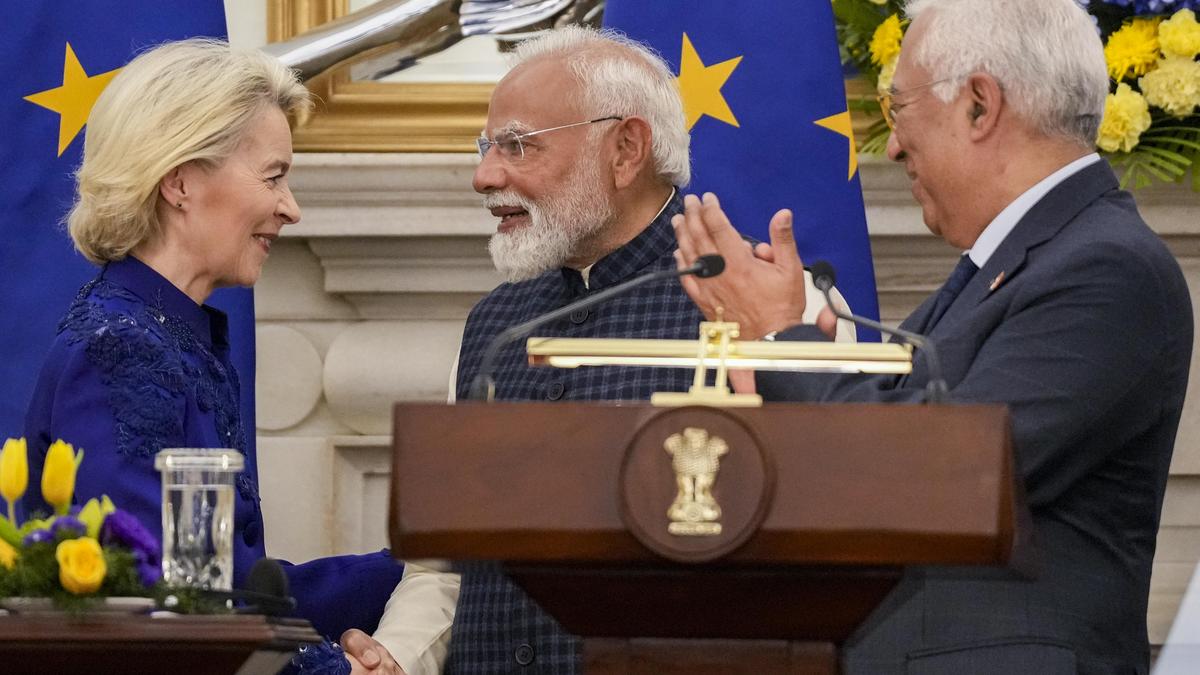
The story so far: Negotiations on the India-European Union Free Trade Agreement (FTA) — dubbed the ‘mother of all deals’ by leaders on both sides — officially concluded on January 27, closing about two decades worth of intermittent talks. The deal, which has benefits for both, simultaneously avoids intractable sensitive issues while securing advantageous concessions on most others.
Editorial | Mature and pragmatic: On India-EU FTA
Why is it the ‘mother of all deals’?
The FTA has been called thus because of the size of the economies, markets, and bilateral trade involved. The deal brings together the second- and fourth-largest single customs blocs, with the Indian government estimating the combined market size to be ₹2,091.6 lakh crore or about $24 trillion. India has signed about eight FTAs in the last four years. While the other eight FTAs together accounted for about 16% of India’s total trade in 2024-25, in the latest full year of data available, the EU itself accounted for nearly 12%. Bilateral merchandise trade between India and the EU stood at ₹11.5 lakh crore ($136.54 billion) in 2024-25, with Indian exports accounting for about ₹6.4 lakh crore ($75.85 billion) of this. The India-EU trade in services touched ₹7.2 lakh crore ($83.10 billion) in 2024.
Also Read | EU-India FTA to be implemented in 2026 itself, labour intensive sectors to benefit: Piyush Goyal
What is India gaining?
The detailed FTA document has not been made public yet, with information only available through government releases from both sides. Under the deal, the EU will eliminate duties on about 70.4% of tariff lines immediately once the deal comes into effect, covering nearly 90.7% of India’s export value. Another 20.3% of products covering 2.9% of India’s exports will see tariffs eliminated over 3-5 years from implementation for certain marine products, processed food items, arms and ammunition, among others. In addition, 6.1% tariff lines covering 6% of India’s exports will see tariffs reduced, but not eliminated, for certain poultry products, preserved vegetables, bakery products among others or be reduced through quota-based tariffs for cars, steel, certain shrimp and prawns products, among others. So, taken together, the EU’s tariff concessions cover more than 99% of the trade value of what India exports to the region. The concessions offered are not limited to merchandise either. While the services sector has not seen as wide an opening up as merchandise, the EU has offered “broader and deeper commitments” across 144 service sub-sectors, including IT/ITeS, professional services, education, and other business services, the government has said.
Also Read | India-EU FTA — Mother of All Deals: Highlights
Which sectors stand to benefit?
“The potential [of the EU FTA] on labour intensive sectors, where we’ve got huge wins, is about $35 billion. Out of the $35 billion, $33.5 billion will become 0% duty on day 1,” Commerce Minister Piyush Goyal explained to The Hindu in an interview following the closure of negotiations. These sectors, which include textiles, apparel, marine, leather, footwear, chemicals, plastics/rubber, sports goods, toys, and gems and jewellery, currently attract tariffs ranging from 4-26%. This is particularly noteworthy because these are primarily the sectors that have been hit by the 50% tariffs imposed by the U.S. on imports from India. “Preferential market access for agricultural products like tea, coffee, spices, grapes, gherkins and cucumbers, dried onion, fresh vegetables and fruits as well as for processed food products will make them more competitive in the EU,” the government said in a release. The FTA is expected to benefit Indian traditional medicine services and practitioners as well, it added. As per the deal, in EU countries where regulations do not exist, AYUSH practitioners will be able to provide their services using the qualifications they have obtained in India.
Also Read | Expanding network of FTAs supports India’s trade strategy: Economic Survey
What has India offered to the EU?
Under the deal, about 49.6% of tariff lines covering 30.6% of trade value will see their duties immediately eliminated once the deal comes into effect. Another 39.5% of tariff lines with a trade value of 63.1% will see their tariffs eliminated over five, seven, or 10 years from when the deal is implemented. Taken together, India’s total offer covers about 92.1% of tariff lines and 97.5% of trade value.
While a lot of European items are set to get cheaper for Indians, the main consumer-facing items of interest are wine and automobiles. European wine will see current duties of about 150% falling in a phased manner over seven years to 30% for wine priced between 2.5 to 10 euros and to 20% for wine over 10 euros. No concessions have been offered on cheap wine to protect domestic producers. These tariffs all apply under a quota, however, with amounts exceeding the quota limit attracting non-FTA tariffs. On motor vehicles, the tariffs will be gradually reduced to 10% from the current 110%, but also under a quota system. Cars below ₹25 lakh, which account for majority of the Indian market, are not part of the deal. Cars above that limit are divided into three quota brackets. The lowest of these brackets has the smallest quota for European cars, since Indian manufacturers do have a presence there. The highest segment has the biggest quota for European cars since the ultra-luxury segment is where European carmakers don’t have Indian competition.
WATCH | India–EU Free Trade Agreement explained: Biggest trade deal in India’s history
Which sectors are kept out of the deal?
In his interview, Mr. Goyal explained that in all his FTA negotiations the two countries begin by laying out their ‘red lines’ or sectors that they will not offer any concessions on. So, in the EU deal, India managed to keep out sensitive agricultural sectors such as beef, poultry, dairy products, fish and seafood, cereals, especially rice and wheat, fruits and vegetables, nuts, edible oils, tea, coffee, spices, and tobacco. The EU has kept beef, sugar, rice, chicken meat, milk powder, honey, bananas, soft wheat, garlic, and ethanol out of the deal, and has offered quotas on sheep and goat meat, sweetcorn, grapes, cucumbers, dried onions, and rum made of molasses and starches. Mr. Goyal has expressed his confidence that the deal will be implemented in calendar year 2026, despite the fact that the text still needs to go through legal vetting, translation into 24 European languages, approval in 27 European countries, and finally passage in the European Parliament.
Also Read | The impact of India-EU FTA on AI and semiconductor tech
What are some concerns?
The FTA could not make much headway in addressing the Carbon Border Adjustment Mechanism (CBAM), a tariff structure the EU devised to address the carbon footprint of countries and companies. The EU side argued that CBAM tariffs apply to all countries equally and so it cannot give any concessions to specific countries. However, India has secured a commitment that, if the EU gives CBAM concessions to any other country, those would automatically apply to India as well.
Another concern is that, if India is to attract investments from countries looking to take advantage of the new tariff-free route to Europe, it will have to quickly implement more reforms to make India investment-friendly.
Published – February 01, 2026 02:46 am IST
