

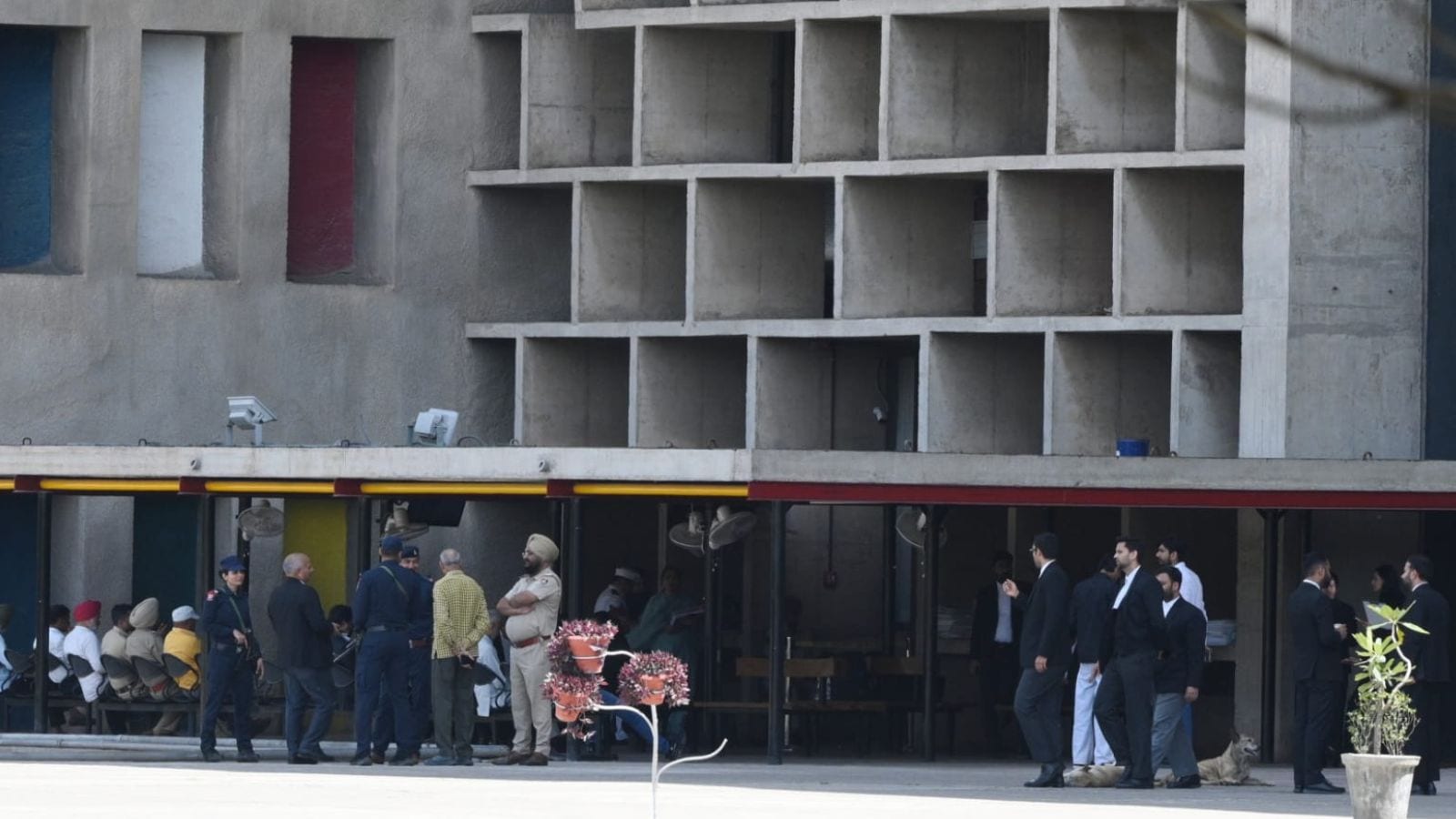
The Punjab and Haryana High Court Mondayset aside the death sentences of two men convicted in the 2019 rape and murder of a seven-and-a-half-year-old girl in Doraha,Ludhiana, citing “grave lapses” in the trial and rulingthat the sessions court failed to follow mandatory procedures.
The Division Bench comprising Justice Anoop Chitkara and Justice Sukhvinder Kaur held that the trial was vitiated by grave lapses in the manner in which incriminating circumstances were put to the accused under Section 313 of the Code of Criminal Procedure (CrPC), corresponding to Section 351 of the Bharatiya Nagarik Suraksha Sanhita (BNSS).
The bench remanded the matter to the sessions court to resume proceedings from the stage of recording the accused’s statements afresh, while keeping the murder reference and criminal appeals pending final adjudication.
Brutal crime and trial court verdict
According to the prosecution, Vinod Shah, 21, a paternal cousin of the victim’s father, abducted the girl on the pretext of buying her candies on the evening of March 9, 2019, in Doraha. He was later joined by Rohit Kumar Sharma, 19.
The two allegedly took her to an uninhabited godown near the railway lines at Lakkar Mandi, sexually assaulted her, strangled her, inflicted brick blows on her head, and concealed her body.
The girl’s naked body was recovered the same night. The post-mortem confirmed death due to asphyxia from throttling, along with head injury, and evidence of recent sexual assault.
Both accused were arrested from Doraha Railway Station while attempting to flee. The trial court convicted them under Indian Penal Code sections 302, 363, and 366 and Section 6 of the Pocso Act, awarding death sentences (subject to High Court confirmation) along with fines.
Story continues below this ad
Why Punjab and Haryana High Court set aside the conviction
Justice Anoop Chitkara, writing for the Bench, dissected the trial record and identified multiple “curable irregularities” that collectively caused prejudice to the accused and rendered the trial unfair.
The court emphasised that Section 313 CrPC is not a mere formality but a “mandatory obligation” and a “salutary provision” meant to enable the accused to explain every incriminating circumstance appearing in the evidence.
Key defects highlighted by the court:
1.Incorrect and rolled-up questions on kidnapping: The first question put to both accused wrongly stated that both had kidnapped the girl from her parents’ lawful guardianship. Evidence, including the FIR and testimony of PW-1 and PW-2, showed that only Vinod Shah had come to the house and taken her. Justice Chitkara noted: “A wrong question was put to Vinod… There was no reason to put this kind of question to Rohit… Thus, the question has to be again framed and put properly.”
Story continues below this ad
2.Complete omission of sexual assault evidence: The most serious lapse was the failure to put the gynaecological findings of PW-8 Dr. Surbhi Singhal. The question put to the accused merely referred to the post-mortem report as a whole without mentioning injuries to the private parts.
The Bench observed: “Laadli was murdered after she was subjected to rape… the most important question, i.e., the evidence that the victim was raped, was not put to the accused… on this score alone, this is a highly defective questioning under §313 CrPC.”
3.DNA evidence never put to the accused: The FSL DNA report, heavily relied upon by the trial court in paras 29, 32 and 33 of its judgment, showed the victim’s blood on the blood-stained jeans recovered from Vinod Shah and the t-shirt recovered from Rohit Sharma. This scientific evidence linking the clothes to the crime scene was never put to either accused.
Justice Chitkara wrote: “The DNA report, Ext PX alone, is the most crucial document, and if it is read in evidence without affording an opportunity to the accused under §351 BNSS [§313 CrPC] to explain the same, it is most likely to cause prejudice to the accused.”
Story continues below this ad
4.Vague, cumulative and selective questions: Several exhibits were clubbed together; incriminating material was not put “separately, distinctly and simply”; questions were framed in legalistic language incomprehensible to ordinary persons; and some witnesses, for instance PW-13 referred to wrongly as PW-12, were misidentified.
The bench quoted extensively from landmark Supreme Court judgments, Tara Singh vs State (1951), Hate Singh Bhagat Singh (1951), Ajay Singh vs State of Maharashtra (2007), Asraf Ali vs State of Assam (2008), Sanatan Naskar (2010), among others, to underscore that every material circumstance must be put fairly and separately so that the accused gets a real opportunity to explain.
“The prominent concern for this Court is the manner of investigation, omission in putting all the incriminating evidence to the accused under §313 CrPC, and its repercussions on the trial… All these deficiencies, which amount to irregularities, are curable, and once cured, shall neither cause any prejudice to the accused nor failure of justice to any.”
The judges also referred to their own recent division bench judgment in State of Punjab vs Sonu Singh (MRC-2-2025, decided March 19, 2026) to stress that “criminal justice warrants meticulously following the procedural standards of proof… every ‘i’ ought to be dotted and every ‘t’ ought to be crossed.”
What happens next
Story continues below this ad
The Punjab and Haryana High Court has directed the sessions court to record fresh statements under Section 351 BNSS after framing proper, separate questions on every incriminating piece of evidence, including the DNA report and medical evidence of rape.
The trialwill proceed further only after that. The accused will remain in judicial custody.
