

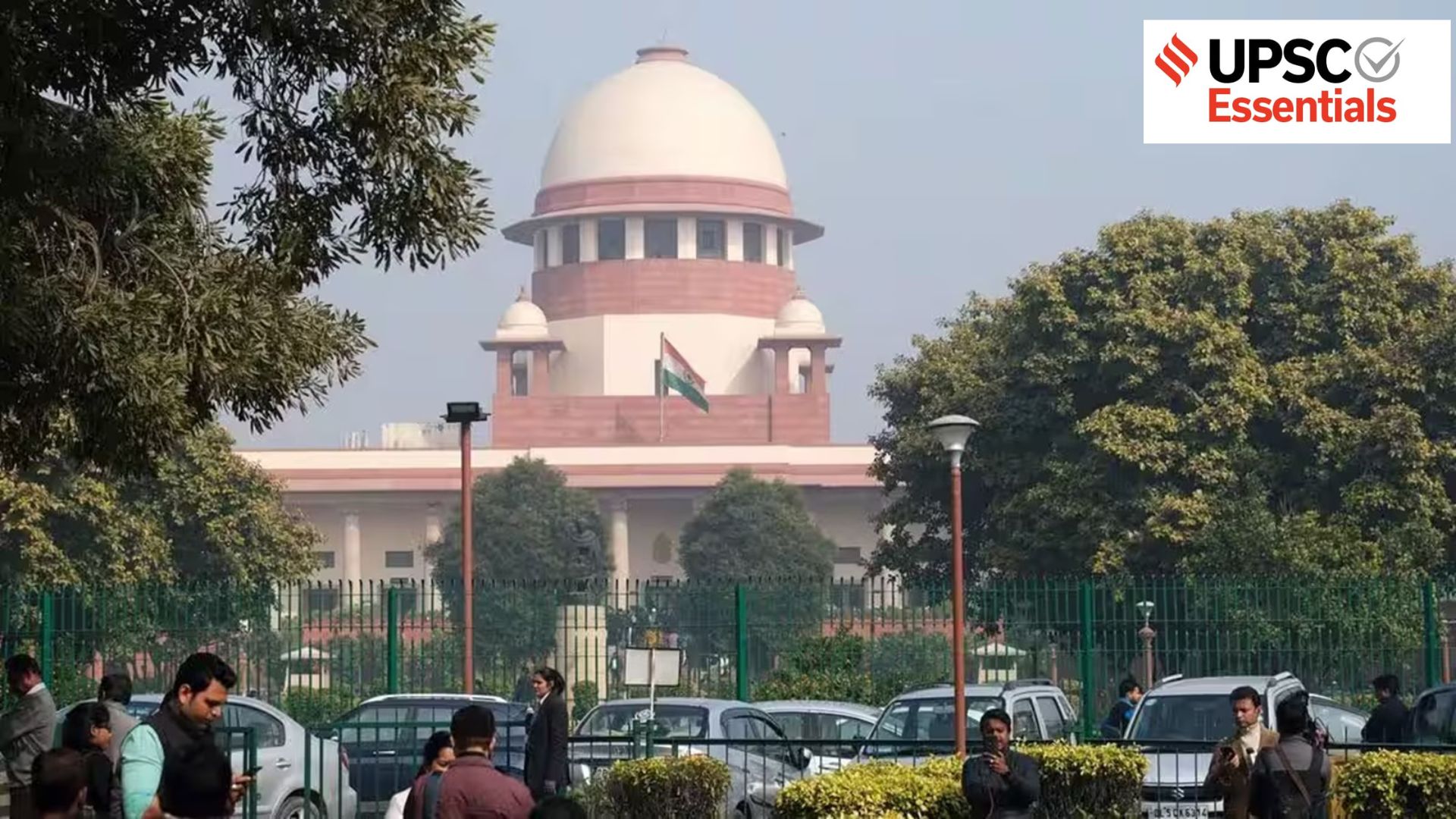
Section 17A of the Prevention of Corruption Act, 1988 (PCA) came under the spotlight after a two-judge bench of the Supreme Court last month delivered a split verdict in a petition challenging its constitutionality.
Justice K V Viswanathan upheld the provision and quoted Sardar Vallabhbhai Patel’s reference to civil servants as the “Steel Frame of India”, underlining that without a basic assurance of protection, “public servants will resort to a play it safe syndrome”. Justice B V Nagarathna, on the other hand, struck it down entirely as unconstitutional.
Section 17A, which was inserted through the Prevention of Corruption (Amendment) Act, 2018, says that “no police officer shall conduct any enquiry or inquiry or investigation into any offence alleged to have been committed by a public servant under this Act, where the alleged offence is relatable to any recommendation made or decision taken by such public servant in discharge of his official functions or duties, without the previous approval” of the centre or state as the case may be.
The divergence in views between Justice Nagarathna and Justice Viswanathan, specifically on whether Section 17A shields the honest public officials from harassment, or enables corrupt public servants to evade accountability. The split verdict, therefore, has largely been seen as reflecting a complex tension between accountability and administrative efficiency in democratic governance. It has also prompted an inquiry into some of the foundational questions, such as:
- Is administrative law fundamentally in tension with the idea of the rule of law?
- In what ways can an ideal anti-corruption law strike and promote maximum accountability of public servants without inducing policy paralysis and decision-making inertia?
Let’s explore and see how renowned scholars like British constitutional theorist A V Dicey and French jurist Maurice Hauriou have addressed such questions.
Shielding corruption or protecting the honest?
Justice Nagarathna struck down Section 17A as unconstitutional and violative of Article 14 of the Constitution. She expressed concern that the requirement of prior sanction would impede timely investigation into corrupt officers and noted the risk of an institutional nexus between corrupt officers and the sanctioning authority.
Story continues below this ad
On the other hand, Justice Viswanathan upheld Section 17A as constitutionally valid, subject to the condition that the power to grant prior sanction should be vested in an independent authority other than the government. He stated that the lack of safeguards for public servants from frivolous complaints would lead to policy paralysis. In contrast, Justice Nagarathna viewed Section 17A as a fetter on the rule of law.
It is often argued that statutory safeguards are necessary to protect honest officers from harassment by means of unwarranted investigations with respect to bona fide errors in the discharge of official duties. The provision seeks to protect genuine officers, promote bona fide decision making, and thereby preserve the morale of public servants.
Conversely, those challenging the section as unconstitutional and mala fide argued that the provision jeopardises the swift investigation into corruption by impeding the collection of sufficient material evidence and pre-investigation efforts. Although the split verdict resulted in referring the matter to a larger bench to be constituted by the Chief Justice of India, the issue triggered some fundamental debates in public administration that extend beyond the immediate legal controversy.
Rule of law and administrative law
The renowned British constitutional theorist A V Dicey in The Law of the Constitution (1885) examined the contrasting relation between the principles of the rule of law and administrative law. His critique of French administrative law (droit administratif), in contrast with the English rule of law, was grounded in the concern that it assumed that government officials enjoyed special rights and privileges vis-à-vis privatecitizens.
Story continues below this ad
According to Dicey, these privileges flowed from the discretionary powers of bureaucrats, which were not supposed to be controlled by ordinary courts. By allowing bureaucrats to act on discretion rather than rigid legal rules, administrative law risked facilitating arbitrariness.
Although the Prevention of Corruption Act does not directly constitute part of administrative law, certain provisions, such as the requirement of prior sanction by the government, tilt it towards the principles governing administrative law. The objection to Section 17A as a fetter on the rule of law arises not merely out of a procedural nature, but from a different context in which the Section brings differential treatment to officers.
Justice Nagarathna said, though “the protection of prior approval is extended to all classes of public servants in substance, it extends only to those public servants who take decisions and make recommendations in the discharge of their official duties”. It prompted scrutiny under Article 14 of the Constitution.
A similar concern was addressed by the Supreme Court in 2014 in Subramanian Swamy v. CBI, where Section 6A of the Delhi Special Police Establishment Act – which granted immunity to high ranking officials – was struck down as violative of Article 14 of the Constitution.
Story continues below this ad
It is often argued that the principle of the rule of law and equality before law under Article 14 of the Indian Constitution cannot be protected if bureaucrats are insulated from legal scrutiny. In contrast, the Union government argued in the court that pre-investigative sanctions are, per se, not anathema to the rule of law, pointing out that similar protections are already enjoyed by the members of the judiciary. However, the safeguard to the judiciary rests on a distinctive constitutional logic intended to ensure its independence rather than shield it from accountability.
Limits of equality before law
The idea of administrative law, when understood properly, is not inherently in tension with the principle of the rule of law. Moreover, certain protective provisions to safeguard public servants are often justified on the premise that responsibilities for wrongs arising from bona fide decision making need to be shared between the individual officer and the government. This idea finds expression in French jurist Maurice Hauriou’s observation:
“There are countries [such, for example, as England or the United States] where every effort is made to shelter the liability of the State behind the personal responsibility of its servant. There are other countries where every effort is made to cover the responsibility of the servant of the State behind the liability of the State itself, to protect him against, and to save him from, the painful consequences of faults committed in the service of the State.”
However, such compromise cannot be treated as a weakness of the rule of law. Not every form of differential treatment is antithetical to equality before law. The critical question is whether the protection of honest officers should be privileged at the cost of weakening anti-corruption mechanisms?
Story continues below this ad
Balancing accountability and administrative efficiency
The Union government defended Section 17A on the ground that it intends to strike a careful balance between administrative efficiency and accountability. A frivolous complaint does not merely affect the morale of a particular officer against whom an investigation is initiated; it may erode institutional trust between the department concerned and public.Hence, the idea of accountability cannot be viewed narrowly as an issue confined to individual officers alone, but has to consider its broader institutional dimension.
Therefore, prioritising administrative efficiency doesn’t amount to choosing corruption over delay in administration. The objective of Section 17A, as argued by the Union government, may be to prevent a climate of decision-making inertia where public servants become risk-averse due to the fear of prosecution for bona fide errors.
The freedom to act fearlessly, without any threat of frivolous complaints, is essential to promote effective administration. An ideal anti-corruption framework may function as a dual remedy by addressing both corruption and policy paralysis and ensuring that honest officers are protected while the corrupt are kept within the reach of law.
Policy paralysis
Bureaucrats in India often exhibit a ‘play it safe’ syndrome, which discourages them from taking decisions involving discretion. Public servants often tend to carefully build and preserve their reputation against the potential threat of their integrity being casually or unfairly questioned. Even honest officials, when unprotected from frivolous complaints, prioritise personal safety and reputation over timely decision-making. Such an environment may foster institutional status quoism, resulting in red tape and administrative delay.
Story continues below this ad
Public servants entrusted with greater responsibilities exercise wider discretionary and policy-making powers, which in turn make them more vulnerable to frivolous or motivated complaints. Given the nature of their functions, such officers may legitimately require proportionately higher procedural safeguards. In order to avoid policy paralysis, a public servant needs to be concretely assured that decisions they take will not be subjected to unwarranted and frivolous complaints. It is not against the spirit of democracy and good governance to allow the bureaucracy to work independently, free from excessive external considerations.
However, independent functioning of civil servants, especially those who exercise discretionary and policy making powers, does not warrant disproportionate safeguard from investigations. Hence, the measures for the protection from the fear of frivolous complaints must be proportionate to the risk they bear in decision-making, without compromising the spirit of the rule of law. An ideal anti-corruption framework needs to strike an ethical balance between accountability, administrative efficiency, and commitment to the rule of law.
Post read questions
The Supreme Court’s split verdict on Section 17A of the Prevention of Corruption Act reflects the tension between accountability and administrative efficiency. Examine this statement in light of constitutional principles and recent judicial reasoning.
Discuss the constitutionality of prior approval requirements for investigating public servants under the Prevention of Corruption Act. How does Article 14 shape the debate?
Story continues below this ad
How does the requirement of prior sanction under Section 17A raise concerns relating to the rule of law and equality before law? Illustrate with judicial precedents.
Fear of accountability can lead to policy paralysis, while excessive protection can enable corruption. Comment in the context of anti-corruption laws and public administration.
(Dileep P Chandran is an Assistant Professor at the Department of Political Science in P M Government College, Chalakudy, Kerala.)
Share your thoughts and ideas on UPSC Special articles withashiya.parveen@indianexpress.com.
Story continues below this ad
Click Hereto read the UPSC Essentials magazine forJanuary 2026.Subscribeto ourUPSC newsletterand stay updated with the news cues from the past week.
Stay updatedwith the latestUPSC articlesby joining ourTelegram channel–IndianExpressUPSC Hub, and follow us onInstagramandX.
