

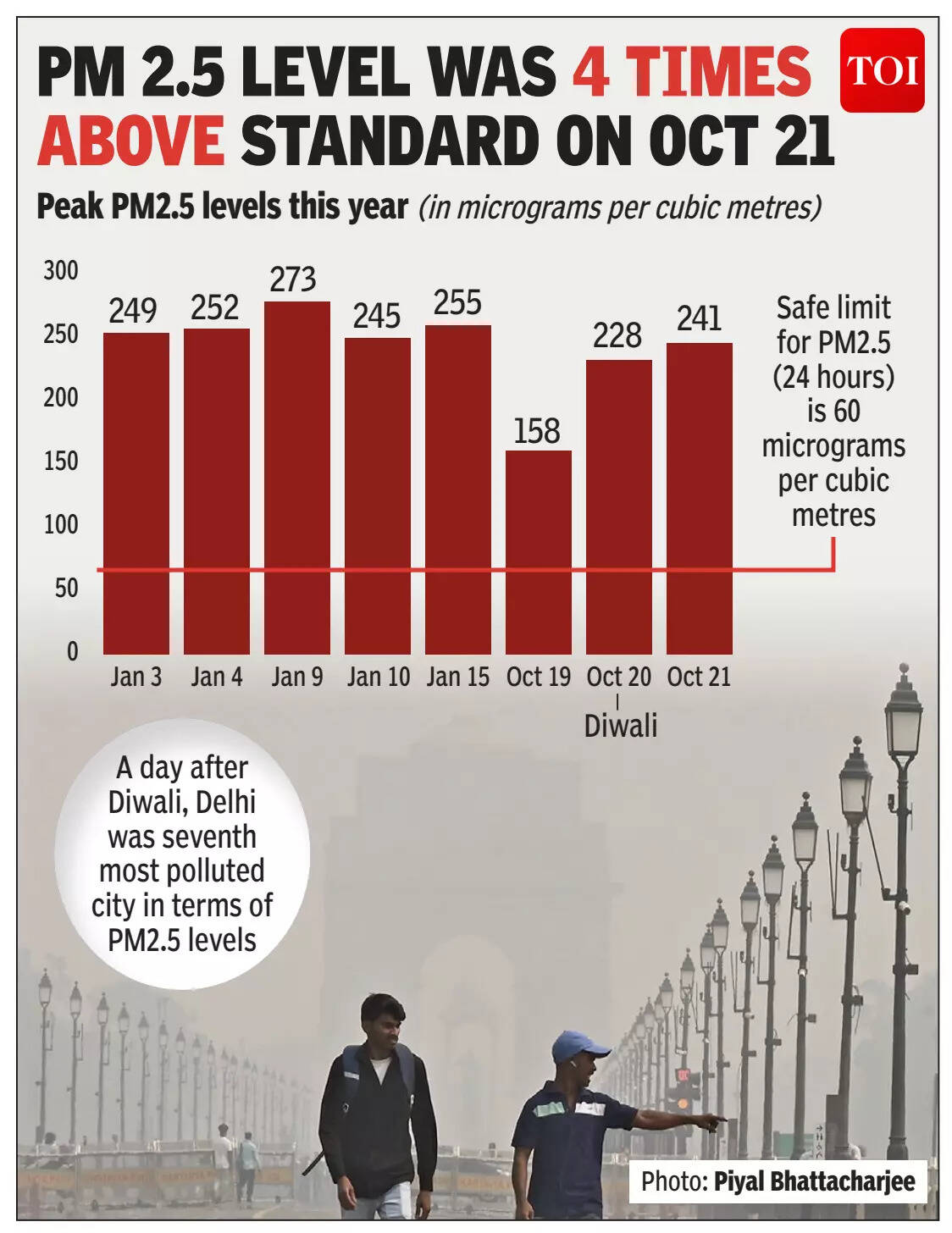
NEW DELHI: Delhi recorded its worst PM2.5 levels of the year on Diwali and the day after, with pollution continuing to blanket the city well into midweek, according to a new analysis by the Centre for Research on Energy and Clean Air (CREA). Despite attempts to control emissions, several neighbourhoods reported hazardous air quality levels, crossing both national and global safety limits by staggering margins.The CREA study found that Delhi’s average PM2.5 concentration stood at 228 micrograms per cubic metre (µg/m³) on Diwali and rose further to 241 µg/m³ the following day — levels seen only four times this year, all in January. The capital ranked as the seventh most polluted city in the country on Tuesday, trailing Haryana’s Jind (412), Dharuhera (298), Gurgaon (290), Narnaul (266), Bahadurgarh (247), and Rajasthan’s Bhiwadi (244). Rohtak (223), Noida (218) and Ghaziabad (207) rounded off the top ten.
In some areas, the pollution levels were off the charts. At Nehru Nagar, hourly PM2.5 concentration skyrocketed from 679 µg/m³ at 9pm on Diwali to an alarming 1,763 µg/m³ at 10pm — 29 times the national ambient air quality standard and 118 times the WHO’s daily safe guideline of 15 µg/m³. Fourteen of the 20 Delhi Pollution Control Committee (DPCC) monitoring stations reported hourly PM2.5 levels above 1,000 on Diwali night, compared to only five the previous year.
“However, the AQI levels appear lower than reality because several CAAQMS stations maxed out or recorded missing values. This reminds us to interpret data cautiously and recognise that pollutant concentrations might have exceeded the instruments’ detection limits. For instance, Anand Vihar reported missing data from 11pm on 20 Oct to 3pm the next day, a window when Diwali pollution typically peaks, suggesting concentrations went beyond the measurable range,” said Manoj Kumar, analyst, CREA.Two days after Diwali, areas such as Anand Vihar continued to record dangerous pollution levels, with hourly PM2.5 at 579 µg/m³ — a slight improvement from 656 µg/m³ a day earlier.Health experts have warned that prolonged exposure to such fine particulate matter can have serious consequences. “These particles (PM2.5) are so small they can easily enter the bloodstream and impact different organs in the body, leading to toxic effects. The tinier the particle, the greater the health risk,” said Anumita Roy Chowdhury, executive director, Centre for Science and Environment (CSE).As the capital struggles under its annual smog blanket, attention has again turned to possible solutions — including the much-debated idea of cloud seeding.
Cloud seeding: What it means and if it can help
Yesterday, Delhi officials said the city was ready for artificial rain. Today, the plan is uncertain again. Amid these flip-flops, experts are questioning whether cloud seeding can really solve the capital’s pollution crisis.
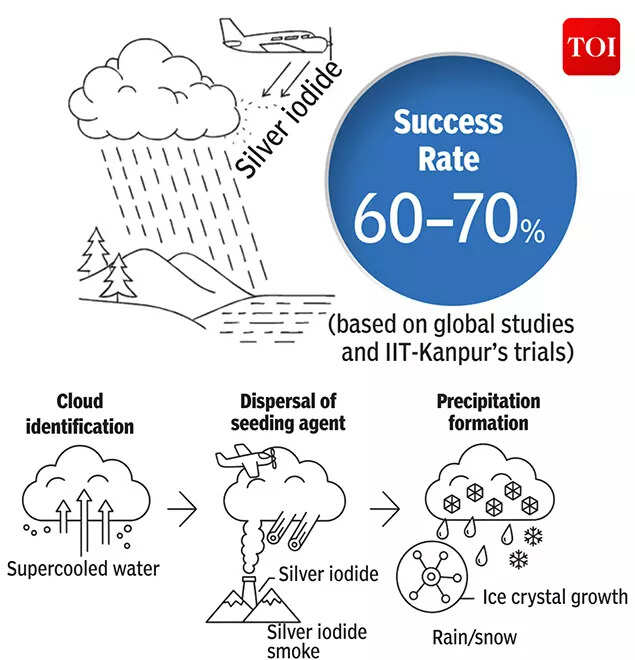
Cloud seeding is a weather modification technique that involves releasing chemicals such as silver iodide (AgI) or salt particles into clouds to induce rainfall. These particles act as nuclei, allowing moisture to condense into ice crystals which can then melt into raindrops. Aircraft usually disperse the seeding material depending on the humidity and temperature levels.
Why the idea is on the table
Artificial rain is being considered as a way to temporarily wash pollutants out of the air during Delhi’s pollution season, driven by:
- Vehicular and industrial emissions
- Open area dust
- Biomass and waste burning
- Stubble burning and stagnant winter air
- By inducing rain, suspended particles could be removed from the atmosphere for a short duration.
- The science and its limitations
While the technique has been used globally — from China and the UAE to Indonesia and Malaysia — experts remain sceptical about its effectiveness in Delhi’s dry winter conditions. Cloud seeding requires moist, dense clouds like nimbostratus, which are rare over north India during this period. The western disturbances that pass over the region often bring high or short-lived clouds, unsuited for seeding, and any rain that does form may evaporate before reaching the ground.
Global experience and history
- 1931 – First experiments using dry ice (CO₂) for cloud seeding in Europe.
- 1946-47 – GE scientists Schaefer & Vonnegut identify silver iodide as an effective ice nucleant.
- Modern usage: Countries like China, UAE, Indonesia and Malaysia use cloud seeding for agriculture, pollution control and event planning.
- 2023 – Pakistan conducts its first artificial rain operation in Lahore with UAE assistance.
Experts advise caution
The India Meteorological Department (IMD), the Commission for Air Quality Management (CAQM), and the Central Pollution Control Board (CPCB) have all warned that the method may have limited impact in Delhi’s climate. They have also raised questions about the chemical and environmental implications of silver iodide dispersal.For now, experts say that while cloud seeding may offer temporary respite, it cannot replace long-term measures to curb emissions — from reducing vehicular and industrial output to controlling crop residue burning.
