

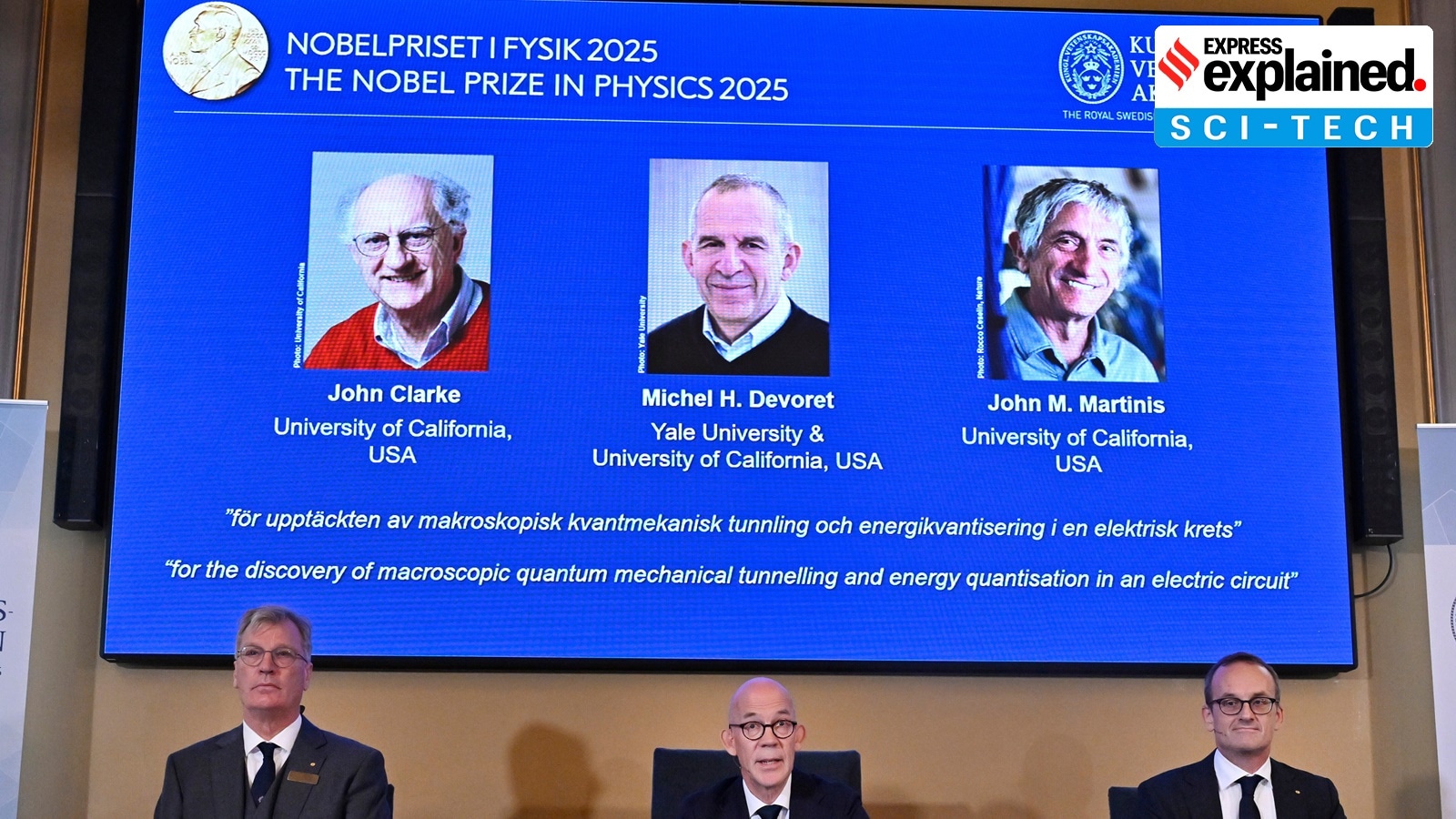
Nobel Prize in Physics 2025: The Nobel Prize in Physics 2025 is out, and the winners are John Clarke, Michel H Devoret, and John M. Martinis, all three working in the USA, “for the discovery of macroscopic quantum mechanical tunnelling and energy quantisation in an electric circuit.”
This is the second time in three years — after 2022 — that the Physics Nobel has been given for work in the field of quantum mechanics.
So, what exactly have these three scientists done, and how does it matter in the wider world? We explain.
Story continues below this ad
First, what are quantum mechanical effects?
What does “the discovery of macroscopic quantum mechanical tunnelling and energy quantisation in an electric circuit” even mean? To understand this, let us first understand what quantum mechanical effects are.
Quantum effects are generally observable in one or very few small particles — atoms, photons — at a time, where these particles don’t follow the classical laws of physics.
For example, a particle can cross a physical barrier (tunneling), exist in different locations at once (superposition), or influence the behaviour of another atom it had once interacted with, even if they are far apart in the moment (entanglement, work on which won the 2022 Physics Nobel).
Quantum mechanics gets its name from another property shown by such particles, which is energy existing in quanta. Basically, if you start increasing an atom’s energy, it may not go from say 5 joules to 6 joules. It will jump to the next band, or quanta, of energy available to it, whatever that may be.
Story continues below this ad
Usually, such properties can be observed only in microscopic particles.
It is this limitation that the Nobel winners’ work crossed. “The laureates used a series of experiments to demonstrate that the bizarre properties of the quantum world can be made concrete in a system big enough to be held in the hand,” the Nobel Prize press release says.
Specifically, their “superconducting electrical system could tunnel from one state to another, as if it were passing straight through a wall. They also showed that the system absorbed and emitted energy in doses of specific sizes, just as predicted by quantum mechanics.”
What was their experiment?
The experiment was conducted in the 1980s, when Clarke was a professor at the University of California, Berkeley, and Devoret and Martinis were in his research group.
Story continues below this ad
What they basically demonstrated was voltage — a difference in electric potential — appearing in a stable electric system without the introduction of any new charge.
“They built an electrical circuit with two superconductors, components that can conduct a current without any electrical resistance. They separated these with a thin layer of material that did not conduct any current at all,” the press release says.
So current is flowing in this system, but has no energy to escape out of it. However, the Nobel winners managed to show that the particles did manage to escape using tunnelling, which was apparent when voltage appeared in the system.
Secondly, the circuit absorbed and emitted energy in discrete amounts, or quanta, rather than a continuous flow. This quantisation, as stated earlier, is a hallmark of quantum systems and was previously thought to be unobservable in macroscopic circuits.
Okay great, but what does this help with?
Story continues below this ad
Quantum computers is something the scientific world is very excited about. India, too, in 2023 set up a Rs 6,000 crore National Mission on Quantum Technologies and Applications.
When fully operational, these computers will be able to solve problems conventional computers struggle with. The Nobel laureates’ work is a big step in taking quantum computers from a great idea to actually helpful devices.
Quantum computers are not just faster than normal computers, they are useful for a whole different kind of complex problems. For example, quantum computers can model molecules at a quantum level, helping scientists design new drugs or materials faster, predict reactions, or optimise molecules for better performance.
Encryption works on using a huge amount of numbers, which conventional computers struggle to get through. Quantum computers can break encryption faster, and thus also create more-difficult-to-break encryption.
Story continues below this ad
The three Nobel winners’ work helps advance these and other critical areas of research and application.
Who are the scientists?
Clarke was born in 1942 in Cambridge, UK. He is a Professor at University of California, Berkeley, USA.
Devoret was born in 1953 in Paris, France. He is a Professor at Yale University, New Haven, and University of California, Santa Barbara, USA.
Martinis was born in 1958. He is Professor at University of California, Santa Barbara, USA.
