

October 25, 2025 11:46 AM IST
First published on: Oct 25, 2025 at 11:46 AM IST
By Shubham Gautam
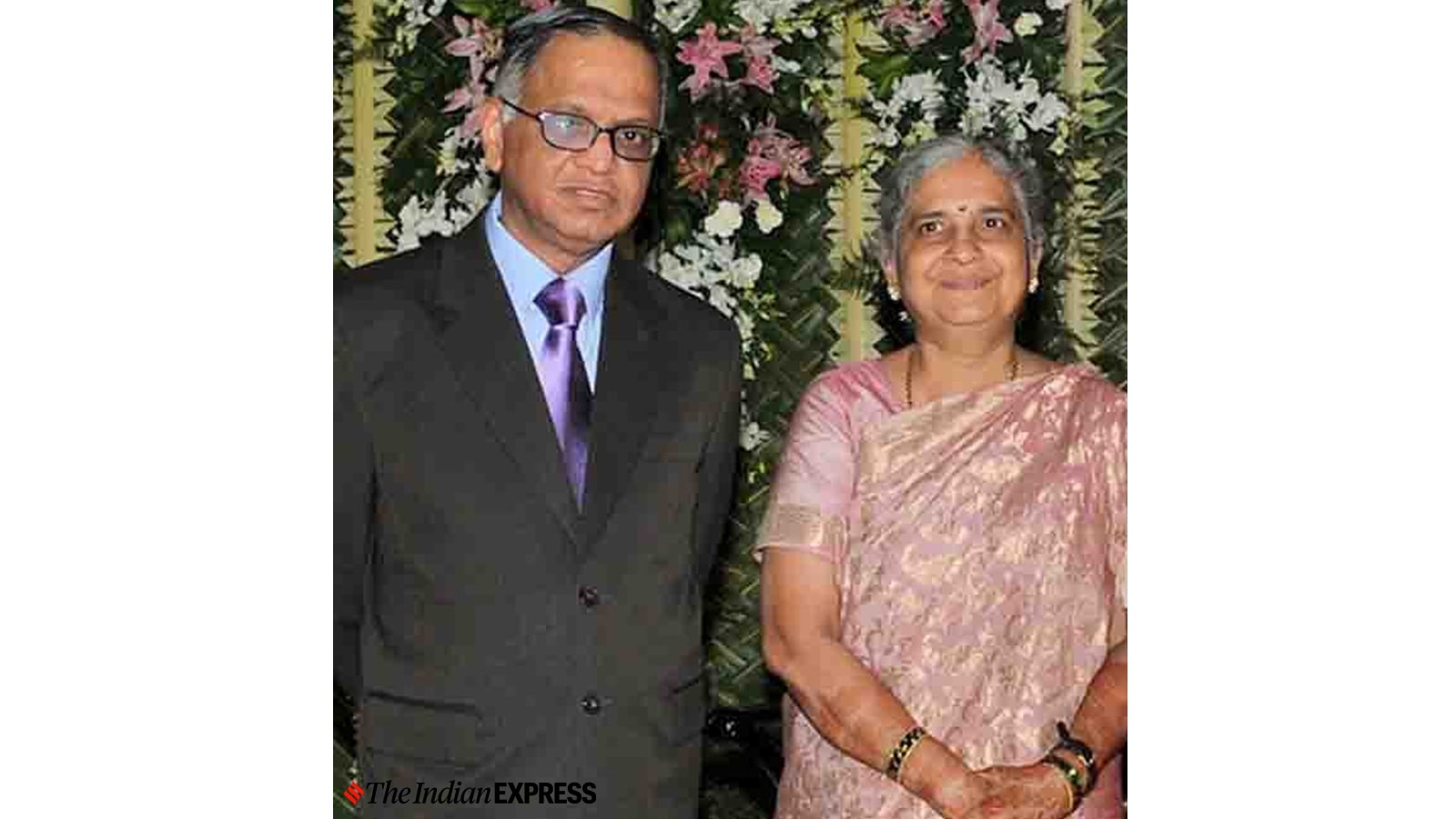
Sudha Murty and her husband industrialist Narayana Murthy’s refusal to participate in Karnataka’s ongoing Social and Educational Survey reveals more than personal dissent. It exposes how the upper caste responds when it comes to acknowledging caste. Denying participation in the survey, she said that as she doesn’t belong to the non-backwards category, it is of no use to her. She also submitted a self-declaration letter opting out of the survey. Her statement was followed by Mohandas Pai, former Infosys CEO, who criticised the state’s caste survey for its focus on “caste appeasement” rather than growth, development, and job creation. Murty and Pai, both economically advanced Brahmins, echo what a significant number of their caste members have been repeating throughout. Responding to the comments, CM Siddaramaiah reiterated the government’s decision to enumerate all the castes, as the survey intends to provide an overall picture of the nature and amount of maldistribution of resources, assets, and opportunities as a result of caste-based stratification in the state. The Karnataka High Court, though, in its interim order has reserved the right of citizens to refuse participating in the survey, the deconstruction of these statements underscores severely flawed but conflicting dominant-caste understanding of not just caste but also the discourse surrounding the socio-economic survey conducted by the state, often dubbed a caste census.

When Murty questions the necessity of counting castes that aren’t “backwards”, the essential argument she makes is that if caste needs to be counted at all, it needs to be done for the welfare of people from the marginalised castes only. Perhaps inadvertently, she draws a correlation between caste identity, enumeration of caste communities and affirmative action. This argument that only the marginalised castes need to be counted perpetuates the presumption of a normative portrait of the average Indian citizen, which is predominantly “General”, while the SCs, STs and the OBCs are the exceptions. According to this position, which echoes the anti-affirmative action discourses across India, “caste” usually means the lower castes, i.e., the SCs, the STs and the OBCs. When a caste census is mooted as a tool to better affirmative action policies in the country, the onus of arguing for the caste census becomes a lower-caste pursuit. Caste effectively becomes a “problem” for the marginal castes alone to solve, while the “General” category can pretend to be caste blind.
Satish Deshpande, in his paper “The Politics of Not Counting Caste”, discusses the self-reinforced “castelessness” of the elite castes in India. As caste is a relational hierarchy and an unequal distributor of privileges and opportunities, caste-based marginality cannot exist without another caste accruing privilege out of the same system. He argues that while the victims of caste (the oppressed castes) are forced to make claims as a caste-marked exception, the beneficiaries of caste (the elite/dominant castes) lay claim to public resources, maintaining their advantage as unmarked citizens on the basis of casteless merit (without actually abandoning caste). Thus, subalterns become the propagandists of caste, while elite castes can claim cosmopolitan identities, cultural heritage, or middle-class status with surprising ease. When the state looks at caste through measures like censuses, surveys and affirmative action, the social identity of being a “marginalised caste” is continually invoked to justify state intervention to “uplift” them. Thus, within the logic of development and social justice, caste becomes more visible for the backward castes, while the privileged castes can wear the cloak of invisibilisation.
The ‘casteness’ of the dominant castes
The denial of participation by Murty also presents a unique case in her home state, Karnataka. Even though the Brahmins sit at the top of the social and material hierarchy across almost all domains in the state, “economically backward” Brahmins have been receiving welfare benefits from the state for quite some time now. The Karnataka government in 2018 instituted a Brahmin development board to “help uplift the Brahmin community in the state” with an interim budget of Rs 25 crores. The benefits include schemes such as providing monetary assistance to brides marrying economically backward Brahmin priests and opening portals to facilitate intra-caste marriages.
Despite no caste census or caste-based socio-economic survey, and consequently no administrative provision of identification of Brahmins in place yet, the state has been issuing Brahmin certificates to provide these benefits. Not only does this totally invert the logic of affirmative action based on social and historical backwardness, but it also demands pertinent questions regarding the discourse of Brahmins around caste and welfare measures. On one hand is Murty’s passionate stance against Brahmins being counted in the survey because they are not backward; on the other hand is a significant chunk of Brahmins already availing “freebies” from the state, much to the ignorance of the likes of Pai. This ambivalence in the way Brahmins view the caste survey, as well as affirmative action, is exacerbated by Brahmin caste associations, who have begrudgingly accepted the inevitability of the caste survey but are protesting the misreporting of the Brahmin population across the state.
Caste is as much a network of distributional relations as it is a complex system of graded inequalities. It significantly informs the material distribution of resources and privileges across the hierarchy and shapes the everyday lives of people. There is an increasing need to understand caste not just in its manifestation in marginalising certain castes but also in enabling the elite and dominant castes to create and perpetuate their elitism within the hierarchy. An exercise in counting caste thus needs to be inclusive of all parts in order to capture its completeness. Caste-based socio-economic surveys are long-awaited pushes in the right direction. Not until we acknowledge the “casteness” of the dominant castes as much as the marginalised ones will we arrive at a collective portrait of society that appears somewhat closer to reality.
The writer is a research scholar, Department of Political Science, Panjab University
