



November 24, 2025 11:50 AM IST
First published on: Nov 24, 2025 at 07:17 AM IST
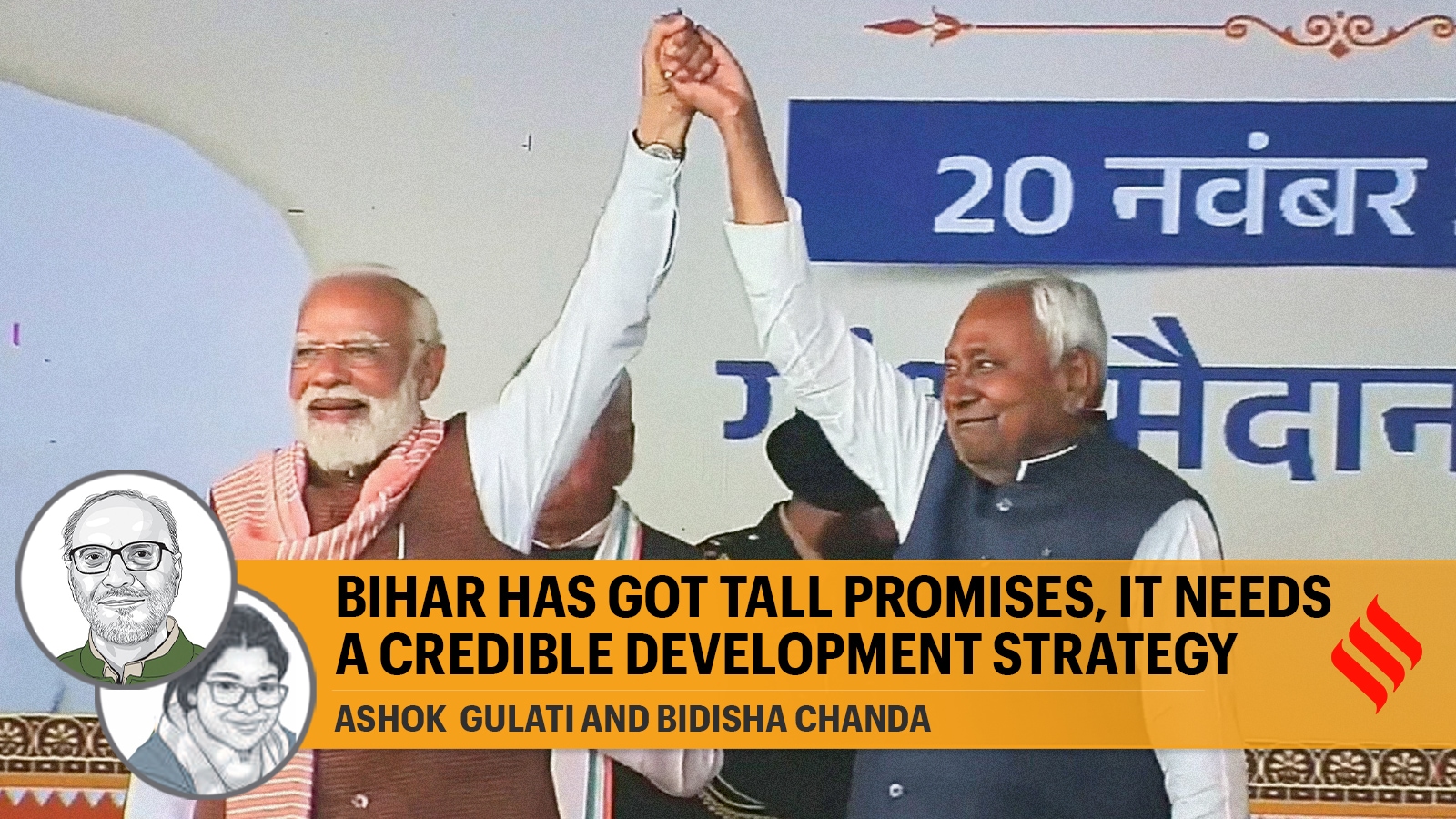
The National Democratic Alliance (NDA) deserves compliments for its landslide victory in Bihar. Being the state’s longest-serving Chief Minister is no mean achievement for Nitish Kumar, given India’s extremely competitive politics. It was also refreshing to see the NDA’s attempt to shift the state’s electoral grammar, from a “M-Y” formulation that denoted a religion-caste coalition to framing “M-Y” as mahila and youth. However, a fundamental question still needs to be asked: How can Bihar move past its bottom, or near-bottom, rank in most social and economic indicators? Last week, while delivering the Ramnath Goenka lecture, Prime Minister Narendra Modi gave a clarion call for progress —“Vikas, vikas, aur sirf vikas”. If this remains the Nitish Kumar government’s focus for the next five years, Bihar can perhaps witness a notable change in its ranking.
There has, of course, been an improvement in Bihar’s baseline social and economic indicators: Electricity has reached homes, highways have stitched districts, and law and order has improved somewhat. Building on that foundation, the NDA has promised MSMEs, industrial parks, expressways, skill centres —all necessary ingredients for the state to move towards a resilient growth story.

The Mukhyamantri Mahila Rojgar Yojana has been credited by many as consolidating the NDA’s women’s vote bank. It began with a simple Rs 10,000 transfer to 75 lakh women in Jeevika SHGs; today that universe stands at 1.5 crore. Translate that into fiscal terms, and the outlay already touches Rs 15,000 crore. The meter is still running with enrolments open till December. More intriguingly, the NDA has promised up to Rs 2 lakh in assistance after an assessment six months later. Whether this is a grant, a soft loan, or a hybrid remains unclear. But one must ask, with some seriousness: What livelihood can a woman make with a one-time transfer of Rs 10,000? Is it not a dole? Such doles cannot substitute for a viable income model.
If Bihar truly wants to turn vikas into something more than an electoral slogan, its youth must be at the focus of its development strategy. Yet the 15-29 age group has a Labour Force Participation Rate (LFPR) of just 34.6 per cent, far below India’s 46.5 per cent (PLFS 2023-24). For such a cohort, the NDA manifesto has promised 1 crore government jobs. Even at a modest salary of Rs 15,000-20,000 a month, the annual bill for this would be Rs 1.8-2.4 lakh crore against the state’s total budget of Rs 3.17 lakh crore. The prospect of fulfilling this promise appears remote.
In 2024, Bihar hosted the Business Connect Summit and attracted Rs 1.81 lakh crore in investment proposals, with players like the Adani Group and Sun Petrochemicals stepping up. That is what a credible development strategy looks like — using incentives to attract private investment rather than expanding an already strained public payroll. Nitish Kumar deserves credit for setting the stage, but investors need sustained confidence, not fiscal overreach. In fact, the Industrial Investment Promotion Package 2025 is a step in the right direction, offering employment-linked incentives such as Rs 5,000 per employee per month for textiles (with up to 300 per cent ESI/EPF support) and Rs 2,000 for other units (with 100 per cent ESI/EPF support). This is essentially the job strategy the state should have been advertising, not fiscally untenable schemes.
While thanking BJP karyakartas for the NDA’s landslide victory, PM Modi said that just as the Ganga flows from Bihar to Bengal, this victory wave will also move in the same direction. West Bengal is supposed to have assembly elections in March 2026, and the BJP is gearing up for a fierce election battle in Bengal to defeat the TMC. Will the BJP follow the same model of Bihar, promising Rs 10,000 or even more to a woman in each family? Will that work? To answer this, one must compare Nitish’s tenure with that of Mamata Banerjee’s since 2011-12.
Between 2011-12 and 2024-25, Bengal’s average annual GDP growth was 4.8 per cent, while Bihar posted a growth of 6.5 per cent. In agriculture, Bengal grew at 2.9 per cent versus Bihar’s 4 per cent. On paper, Bihar looks like a stronger performer. Yet, the development story diverges sharply when viewed through a poverty lens. Bengal’s multidimensional poverty fell from 58 per cent in 2005-06 to 8.6 per cent in 2022-23, a whopping drop by 85 per cent. But Bihar’s poverty moved from 78 per cent to 27 per cent, a drop by 65 per cent. Despite slower growth, Bengal lifted far more people out of deprivation. What explains this divergence?
The answer lies in demographics. Bengal’s population is growing at 0.5 per cent per annum, compared to India’s 0.9 per cent and Bihar’s 1.43 per cent. Bihar’s fertility rate is 3 compared to India’s 2, and Bengal’s 1.6. This explains why even with faster faster-growing GDP, Bihar’s per capita income remained at the bottom.
Another reason is agricultural diversification and intensification. Both states are dominated by small landholdings: Agriculture employs 54 per cent of Bihar’s workforce, and the average agriculture holding is just 0.39 ha. In contrast, Bengal agriculture engages only 38 per cent of the workforce with an average holding size of 0.76 ha (Agriculture Census 2015-16). Further, Bengal’s cropping intensity stands at 193 per cent, the second highest in India, while in Bihar it remains at 148 per cent. Nearly 18 per cent of Bengal’s gross cropped area is under high-value horticulture against
Bihar’s 7 per cent. Fishery also makes Bengal better as it accounts for 15 per cent of the gross value of agri-output, while in Bihar its contribution remains at 8 per cent.
Given all this, can the BJP storm the Bengal fort with doles, or will it come up with a more meaningful development strategy? Only time will tell.
Gulati is Distinguished Professor and Chanda a research assistant at ICRIER. Views are personal

