

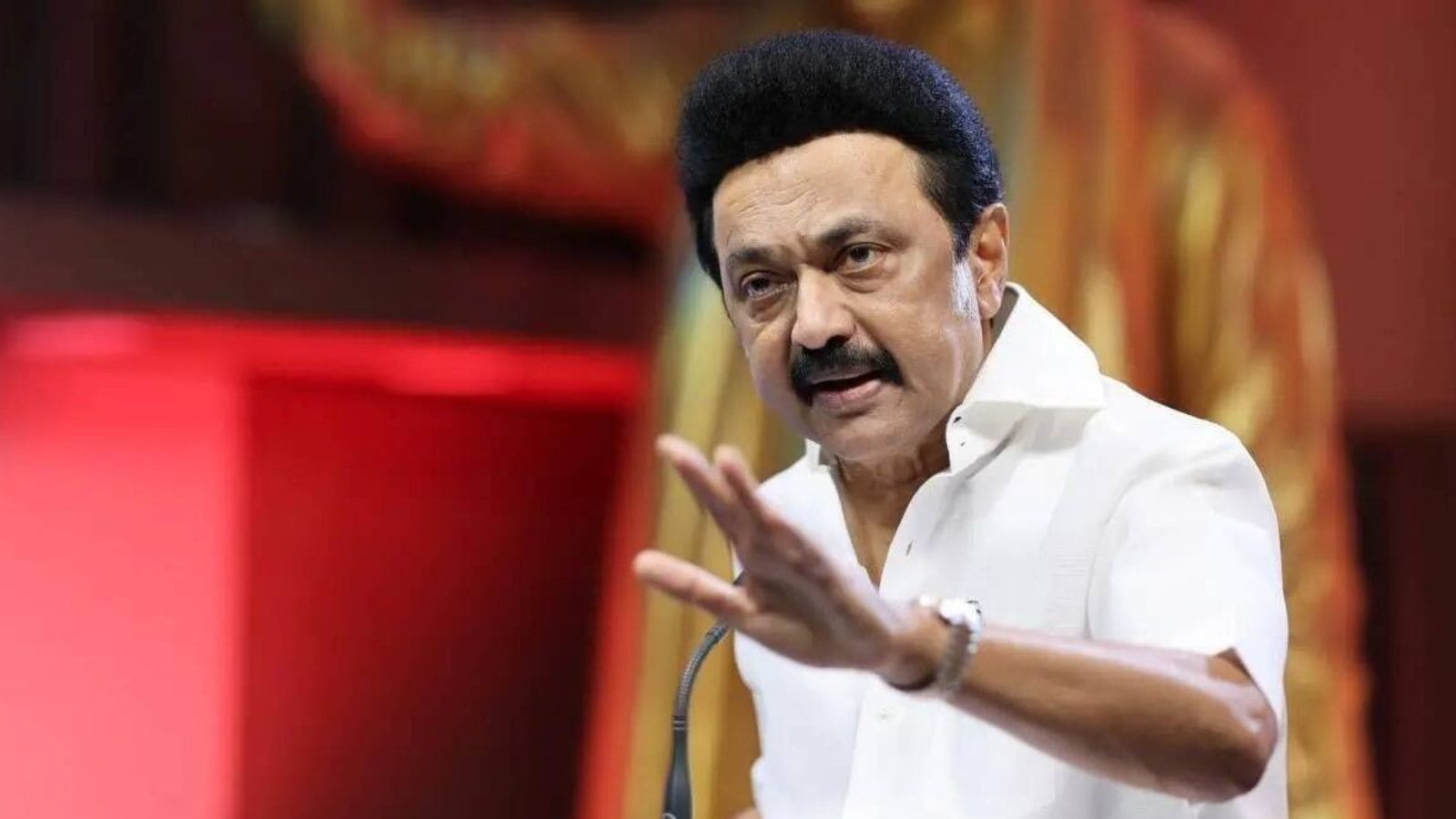
A day after issuing a “final warning” to the Union government over delimitation, Tamil Nadu Chief Minister M K Stalin moved swiftly from rhetoric to mobilisation, convening an urgent meeting of DMK district secretaries on Wednesday and calling for statewide black flag protests on Thursday.
Invoking Tamil Nadu’s history of political assertion, Stalin suggested that if institutional responses failed, public expression would follow. Excerpts from an interview on Wednesday after the DMK’s latest escalation:

You have described delimitation not just as a political issue but as a question of fairness and federal balance. What, in your view, is the principle that should guide India at this moment?
India was not constructed through arithmetic; it was built on trust, restraint, and a shared constitutional vision. The Constitution did not ask states to compete in a demographic race; it asked them to govern responsibly. States that invested in population stabilisation, education, and public health did so in the service of the nation, not to have their voice diminished in the process.
India was not constructed through arithmetic; it was built on trust, restraint, and a shared constitutional vision.
“
Are you saying this is not just about delimitation but more than that?
What we are witnessing today goes beyond delimitation; it is about how power itself is being restructured in one party’s advantage. Is this to strengthen democracy, empower women or recalibrate it for political convenience?
We have seen this approach before. During demonetisation, decisions taken in haste rendered hard-earned currency worthless. Today it is delimitation – to nearly disenfranchise Tamils, muzzle their voices. This is not about numbers alone. It is about voice – and the weight that voice carries. In a parliamentary democracy, every vote matters. Governments, including that of Atal Bihari Vajpayee, have fallen by a single vote. Even a marginal skew can alter national outcomes. A proportional expansion without safeguards will widen the gap between states like Tamil Nadu and Uttar Pradesh.
You referred to Vajpayee and the importance of balance in representation. Why is that precedent relevant now?
That is precisely why Vajpayee froze delimitation – to preserve balance until the country evolved more evenly. Why abandon that wisdom now? Why not continue it until genuine parity is achieved? If representation begins to reward population growth alone, ignoring governance outcomes, we are not correcting the imbalance; we are creating a new injustice. States that upheld national priorities cannot now be politically marginalised. That would strike at the heart of cooperative federalism.
Tamil Nadu’s voice is not incidental; it is distinctive. As our leader and DMK founder Perarignar Anna (C N Annadurai) said, we belong to a Dravidian stock that has something concrete to offer – social justice, rationalism, state autonomy and inclusive governance. That voice must be heard, not muted in Parliament. Federalism is not an administrative arrangement dictated by Delhi; it is a constitutional covenant. If that covenant weakens, the idea of India itself weakens.
You have also raised concerns about linking women’s reservation to delimitation. How do you see this moment shaping both representation and justice in India?
The question is simple: should justice be delivered, or deferred? Women’s reservation is a moral and democratic imperative. It cannot be made conditional on uncertain processes like delimitation or delayed Census timelines. Linking the two risks pushing a long-overdue reform into the indefinite future, despite broad national consensus.
More importantly, it alters the character of the reform. What should have been a decisive step for gender equality is now entangled with a contentious political exercise. It raises a legitimate concern that a social justice measure is being used as a façade for a deeper restructuring of representation.
India has already demonstrated, through local bodies, that women’s reservation can be implemented immediately. In Tamil Nadu, we have ensured 50% representation for women in local bodies. We have 50% women mayors, including in Chennai, Coimbatore and Madurai. The issue is not feasibility; it is political will.
At the same time, fairness cannot be selective. If, while expanding opportunities, we redraw boundaries in a way that weakens certain states – particularly those that have delivered on development goals – then we advance justice with one hand and dilute it with the other.
Let me ask: what prevented the government from implementing 33% reservation within the existing 543 seats in 2024, despite being insisted on by the DMK among the Opposition? Why impose new conditions? Why shift the goalposts? Why are you going back from your own timeline? The haste and bungling of it with delimitation raises more doubts.
A mature democracy must distinguish between what is urgent and what is complex. Women’s rights are urgent – they cannot wait. Delimitation is an altogether different exercise whose dynamics and outcome are different. We must do both, but we must not allow one to delay the other.
You also reminded people of the agitations of the 1950s and 1960s. What did you mean by that?
History is not something we invoke lightly. The movements of the 1950s and 1960s were not against India – they were efforts to shape India into a Union that respects diversity, dignity, and federal balance.
They showed that when institutions fall short and dialogue lacks sincerity, democratic expression does not fade – it deepens and finds strength among the people. In Tamil Nadu, that expression has always been peaceful, principled, and rooted in constitutional values.
I am simply reminding that such a tradition exists – not for confrontation, but for correction. It reflects a society that will engage, question, and stand firm when fairness is at stake. If that reminder unsettles some, they must ask why. This is not a threat; it is a call for course correction. If it is heeded, it will strengthen the Union. If it is ignored, responsibility will lie with those who chose not to listen.
What, in your view, is at stake if this goes ahead as it is?
This is a historic moment – not just for Tamil Nadu, but for the entire southern region. As President of the Dravida Munnetra Kazhagam (DMK) and Chief Minister, I carry a profound responsibility to stand for justice because the consequences of what is being decided today will shape generations to come. At its core, this is about one fundamental question: Where do Tamils stand in the corridors of power in India?
This is a watershed moment for crores of people across South India. It goes far beyond electoral politics. It is about safeguarding the political voice, relevance, and dignity of our people within the Indian Union. Recognising the gravity of this issue, I took the initiative to convene a conference of Chief Ministers from seven states to deliberate on fair delimitation. That effort was not about politics – it was about principle.
If we fail to act now, if we do not assert ourselves at this critical juncture, the imbalance that follows may become permanent. This is not a passing issue; it is a defining moment.
I see this not merely as a political responsibility, but as a historic calling – to ensure that the voice of Tamil Nadu, and of the South, remains strong, respected, and integral to the future of India.
