

A joint Pakistan-China bid to list the Balochistan Liberation Army (BLA) and the Majeed Brigade under the UN 1267 sanctions regime has been blocked by the United States, France and the United Kingdom who cited insufficient evidence to link the two Baloch groups to Al-Qaeda and ISIL to put a six-month “technical hold” on the listing. Here’s all you need to know.
The United Nations Security Council in 1999 unanimously passed Resolution 1267 which designated Osama bin Laden and his associates as terrorists, and established a sanctions regime targeting individuals and entities associated with Al-Qaeda, bin Laden, or the Taliban.

This came after Afghanistan being taken over by the Taliban, whom the resolution accused of “sheltering and training of terrorists and planning of terrorist acts” and providing “safe haven to [Osama] bin Laden”. Less than a year ago, bin Laden had bombed US embassies in Nairobi, Kenya and Dar es Salaam, Tanzania which killed 224 individuals and left as many as 4,000 injured.
Resolution 1267 established a UNSC Committee to designate individuals or entities in the sanctions list and oversee the implementation of the sanctions measures which included an assets freeze, a travel ban, and an arms embargo.
While initially concerned with Al-Qaeda and Taliban, the Committee’s mandate was expanded in 2015 to include the Islamic State in Iraq and the Levant (ISIL) through Resolution 2253. As per its 2024 annual report, “there were 255 individuals and 89 entities on the sanctions list of the Committee”.
Pakistan’s Balochistan problem
Balochistan is the largest province of Pakistan which, with an area of 3.47 lakh sq km, covers roughly 44% of the country’s territory. While its location and abundance of natural resources, especially oil, make the province strategically vital for Pakistan, Balochistan is sparsely populated and its people are impoverished compared to the rest of the country.
Since 1948, when erstwhile Baloch chiefdoms were forced to accede to Pakistan, the province has witnessed a series of bloody insurgencies, brutal state repression, and an enduring Baloch nationalist movement.
Story continues below this ad
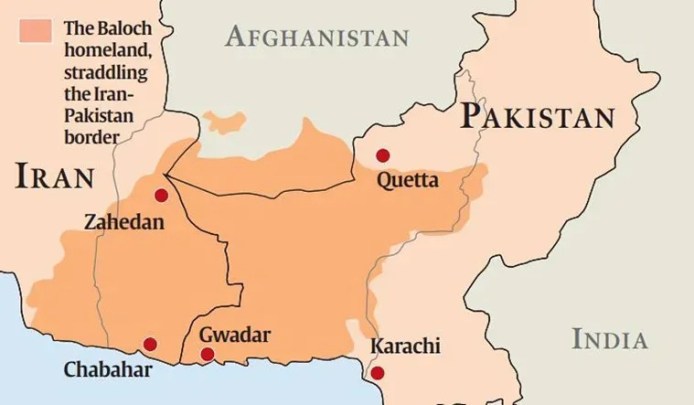 Map showing ethnic Baloch-majority areas in both Iran and Pakistan.
Till date, there have been five Baloch “wars of independence”, fought in 1948, 1958-59, 1962-63, 1973-77, and since 2005-06 onwards. The Pakistani state has brutally dealt with these insurgencies, with numerous reports of abductions, torture, arbitrary arrests and executions levelled at its forces. While it is hard to determine the exact number of casualties, even conservative estimates say tens of thousands of people have been killed by state repression. According to NGO Voice for Baloch Missing Persons, around 5,228 Baloch people went missing just in the period between 2001 and 2017.
That said, the hands of Baloch insurgents are not clean either. They themselves have been accused of atrocities, including the targeted killing of non-Baloch ethnic groups in the province. In recent years, groups such as the BLA have also allegedly fostered ties with the likes of Tehreek-e-Taliban Pakistan (TTP) and ISIL.
At the heart of the persistent conflict in Balochistan are deep economic and ethnic wedges, which the Punjabi-dominated Pakistani state has been unwilling and incapable of bridging. Baloch nationalists have long argued that the Baloch people themselves do not enjoy the fruits of Balochistan’s riches, and such anger has frequently manifested in the form of targeted attacks against state institutions (army check posts, universities, etc.) and non-Baloch people.
BLA & Majeed Brigade
The BLA are a Baloch ethnonationalist group who emerged in the early 2000s with the stated aim of securing independence for Balochistan. The outfit became increasingly militant after 2006 when a military operation ordered by Gen Pervez Musharraf led to the death of Nawab Akbar Khan Bugti, a prominent Baloch leader and more importantly, a moderate who had often sided with the state in the past.
Story continues below this ad
Bugti’s death effectively obliterated any hope for reconciliation between Baloch nationalists and the Pakistani state, turned even moderates towards insurgency, and led to a complete breakdown in the legitimacy of so-called “mainstream” Baloch parties among the populace. As one article in The Diplomat put it: “…by 2006 the new generation had forgotten about past insurgent movements, but Bugti’s killing re-kindled the fire. It permeated towns and cities, extended to districts, and then to divisions.”.
The BLA, led by Balach Marri, son of veteran Baloch nationalist leader Nawab Khair Bakhsh Marri, made a name for itself in this context. Pakistan banned the organisation and got Marri killed in 2006, but the group survived and thrived. This was primarily because the BLA has never been pursuant of a middle ground: it has been, through and through, committed to Balochistan’s complete independence from Pakistan and not more nebulous ideas such as “provincial autonomy”.
Over the years, the BLA’s base has shifted from the Marri tribe to previously moderate educated, middle-class Baloch youth, including erstwhile members of non-violent Baloch Students Organization (BSO).
The Majeed Brigade is the fidayeen unit (suicide squad) of the BLA. The Brigade, named after Majeed Langove who died while attempting to assassinate then Prime Minister Zulfiqar Ali Bhutto in 1974, has been active since 2010 and involved in various high profile attacks, including the 2024 attack on Gwadar port and the Jaffer Express hijacking in March.
Story continues below this ad
Shoe’s on the other foot
Pakistan has long claimed that BLA operates from “across the border” in Afghanistan, and with the aid of UN sanctioned outfits such as ISIS-Khorasan and TTP.
“We have credible evidence of collaboration among these groups through joint training, illicit weapons trade, refuge to terrorists and coordinated attacks,” Ambassador Asim Iftikhar Ahmed, Pakistan’s permanent representative to the UN, told the UNSC on Tuesday when he asked the Council to “swiftly” add the BLA and Majeed Brigade to its sanctions list.
But the US, France and the UK objected, on technical grounds.
According to the Committee’s rules, it “shall make decisions by consensus of its Members”. A Member may, upon presenting a reason, “request more time to consider a proposal by placing a hold on the decision”. Holds can be placed on both technical and substantive grounds.
Story continues below this ad
In this case, the objection is based simply on the fact that the UN 1267 sanctions regime is specifically meant for Al-Qaeda and ISIL, and that there is a lack of evidence linking the BLA and the Majeed Brigade to the aforementioned terrorist entities.
Ironically, such grounds have previously been cited by China to block or delay Indian attempts to list the Pakistan-linked terror groups such as Jaish e Mohammad (JeM) and Lashkar e Taiba (LeT) in the sanctioned entities list. Lashkar was listed in 2005, and JeM in 2001.
The matter will once again come before the Committee six months later.

