

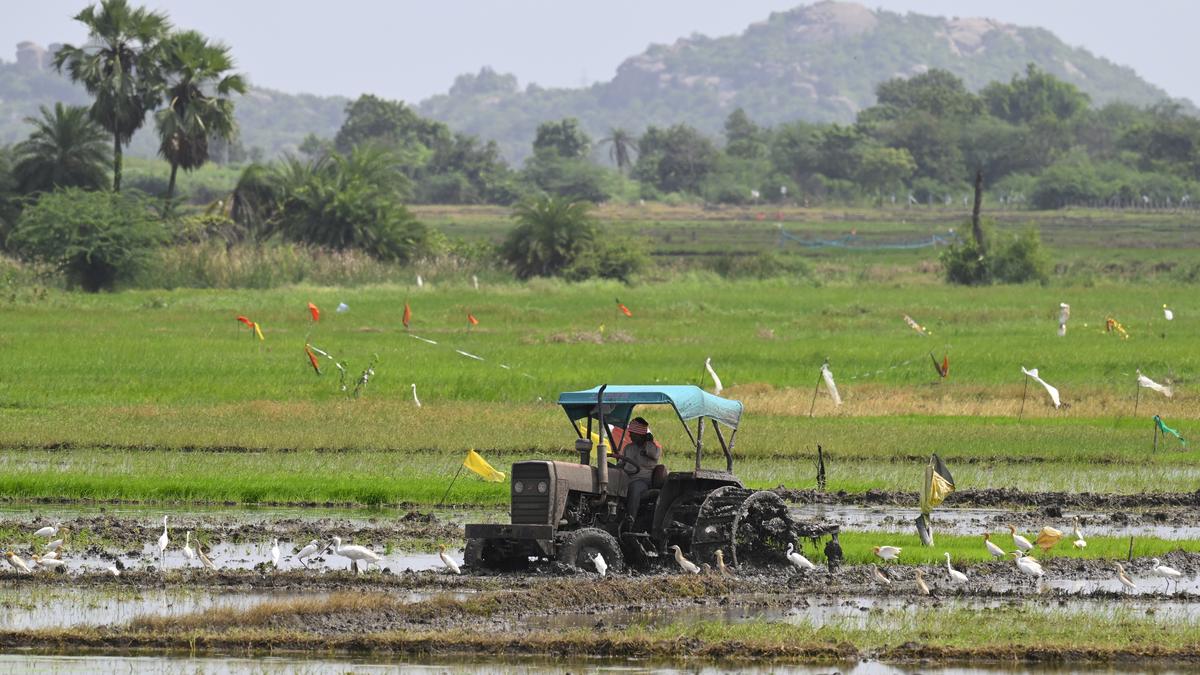
“Tractors are the backbone of Indian agriculture. They are used to plough, sow, harvest, irrigate, transport produce, and manage crop residue. Their versatility across crops and terrains has made them indispensable, reducing drudgery and ensuring timely operations.” File
| Photo Credit: The Hindu
The government’s recent decision to cut the Goods and Services Tax (GST) rate on tractors to 5% is a timely boost for farmers and manufacturers alike. Lower costs are expected to accelerate mechanisation at home, contributing to a stronger domestic manufacturing base to support exports abroad. Yet the global regulatory landscape for such exports is shifting fast, as increasingly stringent emissions standards come into effect in the world’s leading markets. India faces a defining choice: cling to low-cost competitiveness or pivot boldly towards cleaner, higher-value machines that can command global markets.
Regulatory limits for emissions
Tractors are the backbone of Indian agriculture. They are used to plough, sow, harvest, irrigate, transport produce, and manage crop residue. Their versatility across crops and terrains has made them indispensable, reducing drudgery and ensuring timely operations. This robust domestic base has propelled India to become a leading global supplier, with tractor exports totaling $1.15 billion and reaching 162 countries in 2024–25. But with growing volumes come growing externalities: an analysis by the International Council on Clean Transportation (ICCT) found that emissions from tractors and other non-road equipment in India are projected to surpass those from road vehicles by 2030. Policy has already begun to shift this trajectory. As discussed in a previous ICCT analysis, India’s leap to Bharat Stage (TREM) IV standards for agricultural tractors in 2023 slashed the regulatory limit for particulate emissions by up to 94%, nearly closing the gap with the norms of the United States and European Union. By April 2026, Bharat Stage (TREM) V standards will bring most Indian tractors in line with U.S. Tier 4f and EU Stage V requirements.
These reforms aren’t just environmental milestones; they are trade strategies. Regulatory alignment means Indian manufacturers can sell the same tractors in domestic and foreign markets, avoiding compliance costs and supporting economies of scale in production. A recent ICCT working paper on India’s tractor exports found that such alignment may already be paying dividends. While overall tractor exports to the U.S. fell by 40% in 2023-24 and 10% in 2024-25, exports in the large segment (75–130 kW), where Indian and U.S. norms align, surged. Meanwhile, in Europe, exports to Belgium surged after the rollout of TREM IV led to a closer alignment of regulatory frameworks: medium-range tractors (37–75 kW) exported in 2023–24 were nearly 200 times the 2022–23 levels, while large tractor exports jumped from virtually zero to $28 million in 2024-25.
When Brazil introduced emission standards for tractors in 2017, the models that Indian manufacturers were selling domestically were already compliant, thanks to standards in effect in India since 2010. That head start gave Indian manufacturers an advantage. After Brazil’s MAR-I standards came into effect (in 2017 and 2019), Indian tractor exports to Brazil climbed from $4.5 million in 2017-18 to $88 million in 2024-25 — a staggering CAGR of 65% — further highlighting how regulatory alignment can help enable demand for agricultural machinery.
An opportunity
To be clear, many factors influence global trade, and no causal link has been established between emission standards and tractor exports. Indeed, Indian tractor exports have also grown in markets without emission norms, such as Bangladesh, South Africa, and Thailand, where they are valued for reliability and affordability. Still, data from India’s top seven tractor export destinations indicate that such exports increased with greater alignment of emission standards, either by enforcement of more stringent norms in India or by the importing country. Faced with rising tariffs in the U.S., Indian manufacturers have an opportunity to reposition themselves not merely as cost-competitive producers, but as higher-value, cleaner-technology suppliers. Cleaner machines often deliver lower lifetime costs, better efficiency, and resilience against future regulatory changes. TREM V’s implementation will only strengthen India’s standing, enabling smoother entry into Europe and the U.S. while extending leadership in emerging markets.
The lesson is clear: emission standards are not a burden but a passport to stronger trade. As tariffs rise and protectionism spreads, India must reposition itself not just as a low-cost producer but as a leader in clean agricultural machinery. Policy enablers, such as the GST cut and targeted incentives for electric tractors, can reinforce this shift. If India plays its cards right, tractors can do more than transform our farms; they can power our exports. Low-emission, high performance machines will not just meet global demand but set new benchmarks, turning India’s tractor industry into a force that drives both rural growth and global trade.
Published – October 15, 2025 02:09 am IST

