

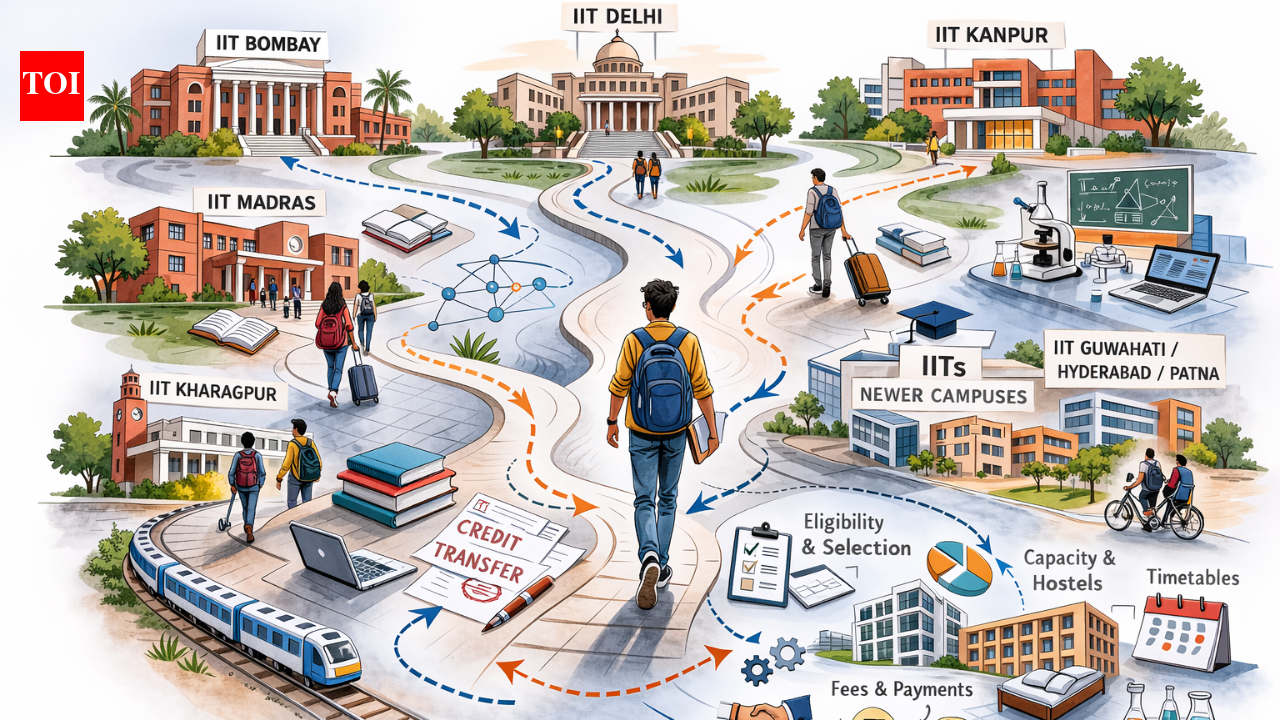
An IIT student’s trajectory is defined by a system that is precise, high-stakes, and largely non-negotiable. A JEE rank doesn’t just decide a branch. It decides a campus, the professors they learn from, the labs they can access and even the peer ecosystem that they will be part of. Once an IIT is allotted, the academic universe largely stays within that boundary.Now, the Indian Institutes of Technology have approved cross-campus mobility for undergraduate students. Under the new framework, students will be able to take courses, and in some cases, spend a semester at another IIT. Their credits will be transferred back to their parent institute. In plain terms, the new initiative is trying to make the IITs work more like one connected academic network by expanding choice.IIT Madras introduces flexible BS programme in Management and Data Science with open access admissions
From locked campuses to a connected IIT network: What actually changes
If the plan plays out as intended, it could make IIT academics a bit less campus-bound. Today, a student’s course options are largely shaped by what their own IIT offers in a given semester — who is teaching, what electives are running, which labs are available, and what the timetable allows. Cross-campus mobility changes that in a practical way: A student may be able to take a course at another IIT, or in some cases spend a semester there, and have those credits counted at the home institute. For students, the immediate benefit is a wider menu of courses and exposure beyond one campus.At the same time, the programme is expected to start in a limited manner. Only a small proportion of undergraduates, around 5 per cent, may be able to do a full semester exchange initially. The operating rules will also vary by institute, because each IIT Senate will decide the details: Eligibility, selection, the number of students it can send and receive, and what the host campus can accommodate in terms of seats, lab capacity, and housing.This is where the implementation questions begin. When only a limited number of students can participate, the way they are selected becomes important. If CGPA is the main basis, then students with higher grades are more likely to get the opportunity. If the decision is made by departments or programme coordinators, the rules should be clearly written down and shared in advance, with fixed timelines. Students need to know how the selection works and what is expected of them.One rank, many campuses: IIT Madras welcomes cross-campus study programme allowing students to take courses at other IITs and earn credits
The hierarchy question IITs must confront
Not all IITs are perceived equally. The legacy campuses — Bombay, Delhi, Madras, Kanpur, Kharagpur — occupy a different symbolic and placement space compared to newer entrants to the system. In such a landscape, mobility may not flow evenly.Will older IITs attract disproportionately high demand from students at newer campuses? If seats are limited, will competition intensify around particular destinations? And, crucially, will some IITs become net exporters of high-performing students while others become net importers?This is a low-key risk for sure, but it’s worth watching. If mobility ends up being used mostly in one direction — for example, more students moving from some IITs to a smaller set of highly preferred campuses — it could mirror existing differences within the IIT network.To keep the programme balanced, IITs need to track patterns over time: Which campuses are sending students, which are receiving them, and how many students participate across branches and years. Sharing this data periodically would help everyone see how the system is working in practice and whether any course-corrections are needed.
Logistics: Where reform often falters
Policy announcements travel faster than administrative preparedness. Credit transfer systems look elegant on slides. Their success depends on painstaking coordination.Curriculum mapping across 23 institutes is no trivial task. Course equivalence must be precise. Academic calendars must align. Assessment structures must communicate seamlessly across campuses. A core course at one IIT cannot become an elective afterthought at another without academic friction.The practical layer is just as important. Hostel space is limited. Popular electives can fill up quickly. Even small timetable clashes can make cross-campus registration difficult. There are also administrative details to settle — whether fees are paid to the home IIT or the host, how mess and accommodation charges are adjusted, and how mid-semester academic changes are handled. These operational aspects may appear routine, but they will shape how workable the mobility framework is in everyday terms.
The placement subtext
Officially, mobility is about learning. Unofficially, placement optics linger in the background. Will a semester spent at a legacy IIT influence internship perception? Will recruiters differentiate between degree origin and cross-campus exposure? Or will the parent IIT continue to dominate signalling value in the labour market?There is no immediate evidence that mobility will recalibrate hiring dynamics. Yet, in an ecosystem where brand matters, students will inevitably assess mobility partly through a career lens. Managing expectations will therefore be crucial.
Governance in a networked system
Perhaps the most significant shift is institutional, not academic. Cross-campus mobility will push IITs to act like a distributed university system, but they still have their own set of rules.While autonomy is there and will continue to exist, coordination must not be overlooked. The success and credibility of this initiative will depend on Senate approvals, eligibility standards put out transparently, ways to handle complaints, and clear deadlines. In a system that promises fair entrance ranking, future academic opportunities must also be fair. If mobility is still optional and rare, it could be seen as a symbolic reform—progressive in name but limited in effect.
A reform worth strengthening
There is no question that the intention behind cross-campus mobility is apt. Contemporary higher education values interdisciplinarity, flexibility, and academic networks over rigid silos. So, there is no denying that the IIT system, which has long been admired for its academic strength, needs to evolve structurally.But the evolution must be paired with administrative clarity and equity safeguards. Mobility should not become an elite privilege within an elite system. Nor should it strain campuses unequipped for sudden inflows. The IITs have opened the gates. The real test lies in ensuring that what passes through them is genuine academic mobility grounded in fairness, preparedness and institutional balance.
