

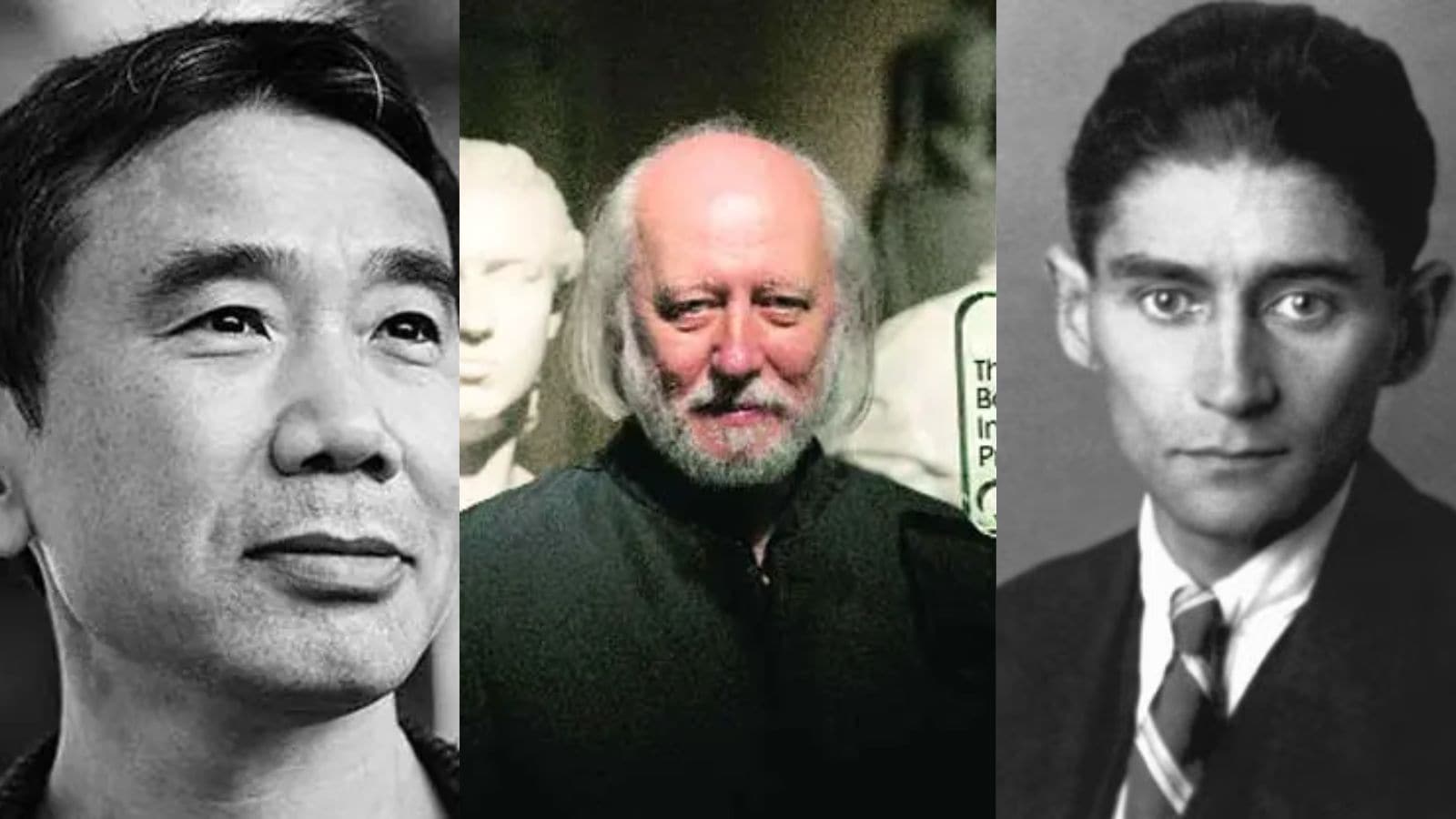
When Hungarian writer László Krasznahorkai won the Nobel Prize for Literature this year, it was a reminder of how much Franz Kafka — the original chronicler of estrangement — occupies the modern imagination. That lineage of alienation perhaps finds its most haunting echo a century later in Haruki Murakami’s Samsa in Love (2013), a deliberate homage to The Metamorphosis (1915).
Kafka’s Gregor Samsa wakes one morning to find himself transformed into an insect. Casual cruelty follows from the world. His family recoils, his employer retreats in disgust, and Gregor watches his humanity dissolve before his eyes. Kafka’s world offered no solace, only the slow suffocation of an ordinary man crushed by the indifference of those he served. It became the perfect archetype of 20th-century alienation — when man becomes unrecognisable to society, and finally, to himself.

Murakami’s Samsa in Love, written nearly a 100 years later, turns that story inside out. Here, Samsa wakes not as an insect but as a man; naked, weak, and terrified. He doesn’t understand this strange, new body that offers no shell, no armour, no protection like his previous form. Every gesture is tentative: Walking, dressing, opening a door. The world around him is hollow, an empty house in a city unknown to him. Into this emptiness walks a hunchbacked girl who has come to fix something broken in his abandoned abode. In their brief, fumbling encounter, Samsa feels a tremor of something human, perhaps love or something like it, for the first time.
Where Kafka stripped a man of his humanity, Murakami returns it to him — not as restoration but revelation. The tables have turned: The insect has become a man, yet the struggle to belong remains. The metamorphosis that once marked damnation becomes, in Murakami’s retelling, an opportunity for rediscovery. To become human again is to feel confusion, shame, and longing — to awaken to the full ache of consciousness.
The hunchbacked girl is the story’s pivot. She is what Gregor might have become in The Metamorphosis had he lived — marked by cruelty from the world, aware of how others perceive her, yet moving with matter-of-fact dignity. But Murakami’s Gregor is not repelled by her deformity, unlike in Kafka’s world, where outward “beauty” or the lack thereof drew sharp denouncement. For the first time since waking, he sees beyond the body — hers and his. In that recognition of an emotion, Murakami reveals what it means to be human: Not beautiful, not certain, but capable of tenderness despite everything.
Murakami’s Prague is not Kafka’s claustrophobic city of bureaucracy and guilt but a post-war, post-modern landscape where tenderness feels like rebellion. Murakami writes in an age where alienation has turned inward. His characters live in abundance yet drift through emotional vacancy. Their loneliness is not imposed but ambient, woven into the quiet routines of a hyper-modern, emotionally sterile society.
Kafka’s Curse, Murakami’s Mercy
The two writers meet at the same question from opposite ends: What does it mean to be human in a world that no longer recognises us, or when we no longer recognise ourselves? Kafka’s answer is silence, a body withering in a closed room. Murakami’s is hesitantly hopeful. His Gregor may not understand love, but he is drawn to it unknowingly, regardless.
In Murakami’s universe, the oppressions of Kafka’s world — money, family, duty — have morphed into subtler alienations of identity and detachment. Murakami suggests the rot remains, only now it has also crept within us. His Samsa’s bewildered affection for the girl becomes the faint pulse of something redemptive, proof that the human heart, however bruised, still stirs.
For Murakami, love is not salvation but an experiment in vulnerability. It is awkward, unfinished, and unnameable. Yet through this bewildered emotion, Samsa begins to feel alive. The insect, in Kafka’s time, was a grotesque symbol of otherness; the human, in Murakami’s, is the alien, unable to comprehend his own emotions.
 The Metamorphosis by Franz Kafka.
But what does it mean to be human?
In Krasznahorkai’s fiction, that search becomes a torrent of language, a desperate act of seeing before the world collapses. In Kafka and Murakami, it takes quieter forms — the stillness of a room, a glance between strangers, the absurdity of waking up one day and finding yourself utterly changed. All three writers, in their own idioms, insist that alienation is not the end of being human but the very terrain where humanity must be reimagined.
When Murakami reverses Kafka’s metamorphosis, he is not mocking it; he is completing it. The man who once lost his humanity now bears the unbearable weight of regaining it. The shell is gone, but the world remains cold and strange.
Between the two Samsas, one crushed under guilt and the other trembling with love, lies the full arc of modern consciousness. Kafka’s insect could not return to the world. Murakami’s man can barely enter it.
Both writers arrive at the same bleak tenderness: To be human is not to be whole; it is to be out of place, yet to keep reaching for meaning anyway.
stela.dey@indianexpress.com

