

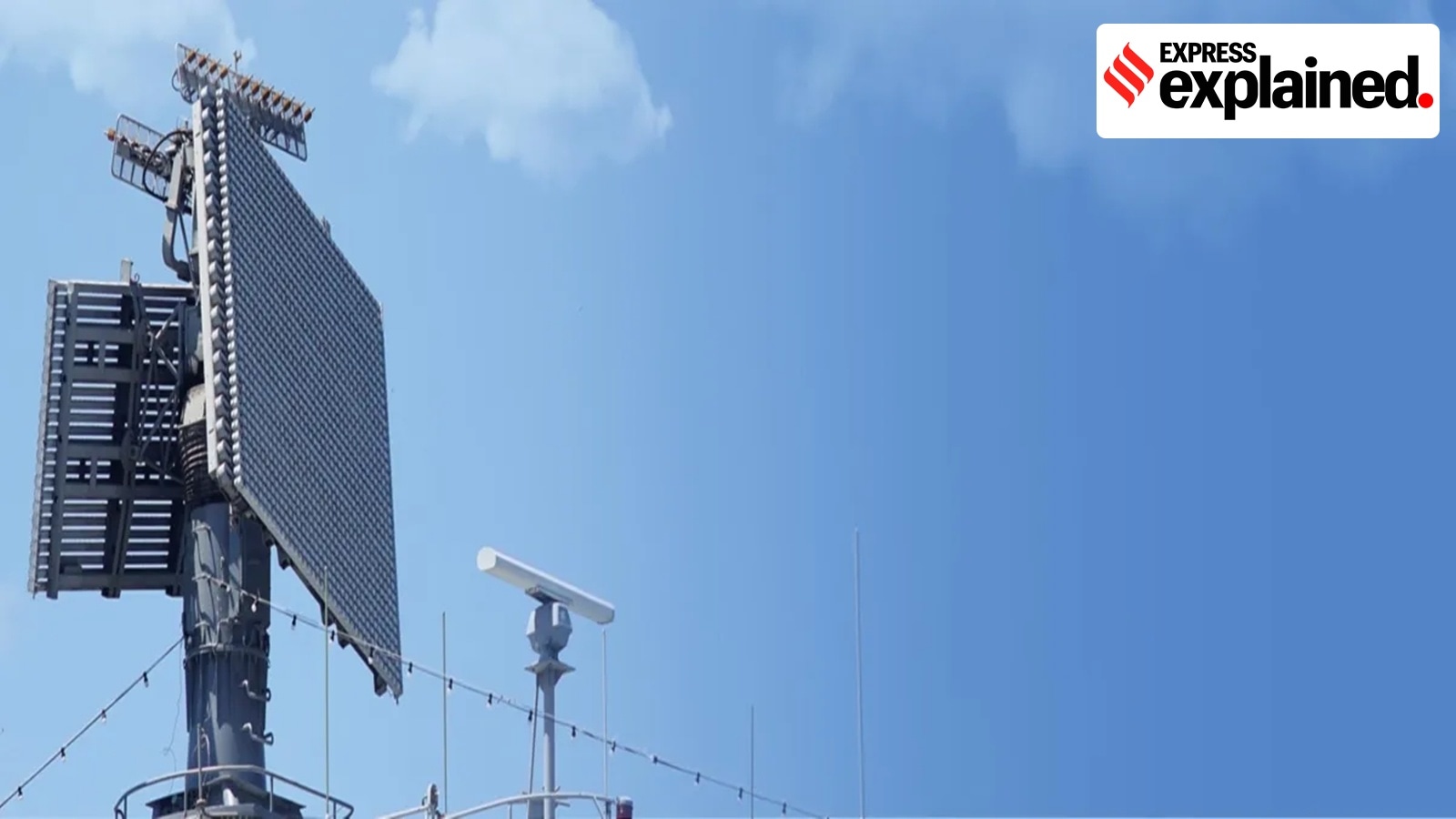
With the procurement of a range of advanced air defence (AD) radars, the Indian Army has begun the process of plugging gaps in its air defence network along the northern and western borders.

The Army has sought to procure up to 45 Low Level Light Weight Radars (Enhanced), up to 48 Air Defence Fire Control Radar-Drone Detectors (ADFCR-DD), and 10 Low Level Light Weight Radars (Improved).
These AD radars can detect, track, and engage aerial objects with small radar cross-sections (RCS), like the Pakistani drones which infiltrated Indian airspace in May.
How radars work
Radar is the acronym for RAdio Detection And Ranging. It is a specialised electronic system that uses radio waves to determine the direction, distance, and velocity of target objects. AD radars are used by the military to search, detect, identify, and help destroy aerial threats.
In simple terms, a radar comprises two basic components: a transmitter which sends out radio signals, and a receiver which collects any reflected signals from a target. The angular direction of a target is determined based on the direction from which the reflected signals are received; the measurement of the location of a target at successive moments helps calculate its trajectory.
Radars were developed in the 1930s and 1940s, primarily for military use. Amid the increasing importance of airpower in warfare, radars became essential defensive (and later offensive) systems for militaries.
Story continues below this ad
There are primarily two kinds of AD radars: surveillance radars and fire control radars.
The former constantly surveill the skies to detect aerial objects. These detections are then analysed by an operator (increasingly with the help of computers) to identify the objects spotted. Surveillance radars are not directly connected to any anti-aircraft weapon system unlike fire control radars, which help surface-to-air guns or missiles target aerial threats.
Currently with forces
Both the Army and the Indian Air Force (IAF) have both surveillance and fire control radars.
The IAF controls most of the high and medium power radars (HPRs and MPRs) which have ranges of up to several hundred kilometres and can track aerial threats at higher altitudes. These are used to tackle larger threats such as fighter jets, enemy transport aircraft, or Airborne Warning and Control System (AWACS).
Story continues below this ad
Both the IAF and the Army also have some Low Level Light Weight Radars (LLLRs). These have lower ranges and are meant to track aerial objects, often smaller, flying at lower altitudes.
For fire control radars, the IAF has a range of radars in place, such as the 3D central acquisition radar and the Rajendra radar. The Army, on the other hand, primarily uses Flycatchers, which are indigenously upgraded Super Fledermaus (USFM) radars, and the AD tactical control radar.
Upgrades long needed
There has long been a need to upgrade the Army’s aging radars. India’s three-day long conflagration with Pakistan in May further made this case.
During Op Sindoor, hundreds of low-cost enemy drones were used to camouflage a few surveillance and attack drones. These entered Indian airspace from across multiple locations along the border, before they were shot down.
Story continues below this ad
A senior Army officer said that the procurement of LLLWRs and ADFCR-DDs stems from the need to tackle future threats from such smaller, low-flying aerial objects, such as drones, which can overwhelm older AD systems or even blindside them.
Such objects, the officer explained, are frequently being used in new-age conflicts globally, including during Op Sindoor and by Hamas against Israel. There is thus a need to increase the number of LLLRs and other fire control radars, which cannot only detect threats with low RCS but also identify friend from foe in a cluttered air space.
RCS, or radar signature, is a measure of how detectable an object is by radar, usually represented in square metres; larger the RCS, greater the detectability. The RCS is not only the function of the size of an aerial object but also its specific design features: the basic thrust of modern stealth technology is to reduce an aircraft’s RCS.
The new radars being procured will be capable of scanning the airspace, detecting and tracking targets, and prioritising them based on the threat they pose.
Story continues below this ad
An enhanced LLLR, for instance, would be able to pick up signals from low-RCS drones, including swarms, and transmit target data to weapon systems up to 10 km away.
The ADFCR-DD — which are modern fire control radars — will be capable of detecting, identifying, classifying, and controlling weapon systems to target even the smallest surveillance and attack drones, making destruction of such threats far more effective.
India’s AD infra
India’s AD infrastructure comprises AD guns and surface-to-air missiles like the Russian S-400s and the indigenous Akash missile system. Despite some breaches, this system performed remarkably during Operation Sindoor, and prevented Pakistan from inflicting any significant damage during its aerial forays into India.
The Army has the Akashteer system in place. This provides a common, real-time air picture to the control room, radars and AD guns, enabling coordinated AD operations by integrating various radar systems, sensors and communication technologies into a single operational framework.
Story continues below this ad
Similarly, the IAF has the Integrated Air Command and Control System (IACCS), which is an automated command and control system that integrates data from all air defence assets to detect, identify, intercept, and destroy hostile intruders, while simultaneously controlling offensive packages deep inside enemy territory.
At the moment, the defence establishment is focussing its energies in setting up a comprehensive air defence shield as a part of Mission Sudarshan Chakra. Towards this, the Defence Research and Development Organisation (DRDO) last month successfully conducted maiden flight tests of an Integrated Air Defence Weapon System (IADWS).
