

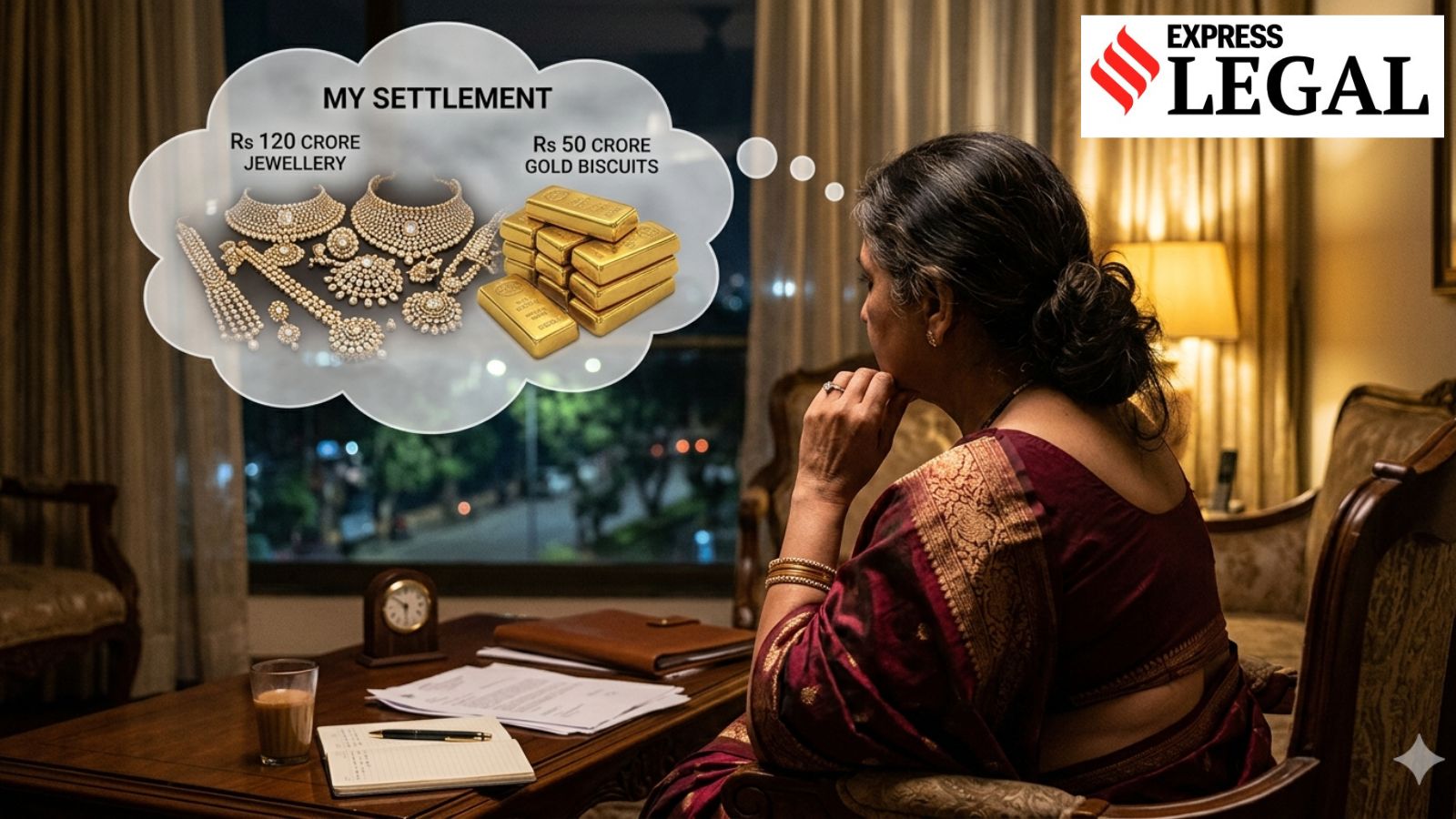
Supreme Court: Rejecting a claim of Rs 170 crore gold of a woman from her estranged husband and his family, the Supreme Court Monday quashed a domestic violence case filed by her against the man and his family observing that domestic violence case without specific allegations “shall be nipped in the bud”.
A bench of JusticesRajesh Bindal and Vijay Bishnoi was hearing a criminal appeal filed by the man challenging a Delhi High Court order that allowed a domestic violence case to proceed despite a prior settlement and rejected the woman’s claim that she was promised of Rs 120 crore gold jewelry and Rs 50 crore gold biscuits by the man as “settlement”.

“A criminal complaint regarding domestic violence, with mere reference to the names of the family members or the husband without any specific allegation that points towards their active involvement in commission of such an act of violence, shall be nipped in the bud,” the court said on April 13.
Calling the case of domestic violence against the man and his family an “afterthought”, the top court said, “While we are conscious of the fact that the parties to a long standing marital dispute are often fuelled by emotions, we cannot allow such emotions to take a drastic turn in as much as allowing the bursts of emotions to form the basis of criminal prosecution. Such criminal prosecution, if allowed, would lead to an abuse of law and cause harassment.”
 The Supreme Court found no evidence of such circumstances and held that the wife’s withdrawal from the settlement was unjustified. (Image enhanced using AI)
Rs 170 crore gold claim fails judicial test
A dramatic element of the case was the wife’s claim that she had agreed to the settlement only after being assured that jewellery worth Rs 120 crore and gold biscuits worth Rs 50 crore, collectively Rs 170 crore would be returned to her before the second motion of divorce.
The Supreme Court, however, found this claim to be wholly unsubstantiated. It noted that the alleged Rs 170 crore promise was not recorded in the settlement agreement.
It did not appear in contemporaneous communications, including a list of items shared by the wife herself, said the Supreme Court. The claim surfaced only later in the domestic violence complaint.
Story continues below this ad
The court was particularly critical of the explanation that such terms were excluded from the written agreement to avoid tax scrutiny, describing the argument as “egregious” and reflective of disregard for legal norms.
The Supreme Court observed that a party, especially one assisted by legal counsel, could not later rely on unwritten and unverified assurances of such magnitude to justify backing out of a formal, court-recognised settlement.
Domestic violence complaint termed ‘afterthought’
Examining the domestic violence complaint, the court found it lacking in material particulars. There were no specific allegations detailing acts of violence by the husband or his family, and the claims appeared to be general and unsubstantiated.
The bench also took note of the timing of the complaint, pointing out that no allegations of domestic violence had been raised during the couple’s long marriage.
Story continues below this ad
The complaint was filed only after the settlement had been partially executed. There was a significant delay in raising serious accusations.
This led the Supreme Court to conclude that the proceedings were “premeditated” and filed as an afterthought, primarily to sustain litigation after the wife withdrew from the settlement.
It further noted that most of the allegations appeared to be “trivial disagreements exaggerated” to justify invoking criminal law.
What Must a Domestic Violence Complaint Contain? SC Sets the Standard
“A criminal complaint regarding domestic violence, with mere reference to the names of the family members or the husband without any specific allegation that points towards their active involvement in commission of such an act of violence, shall be nipped in the bud.” — Supreme Court of India | Justices Rajesh Bindal & Vijay Bishnoi | April 13, 2025
WHAT SUSTAINS A DV COMPLAINT vs WHAT GETS IT QUASHED
Specific acts of violence — not vague or general claims; each act must be described with particulars
Active involvement of each named person — cannot simply list family members without showing their role
Contemporaneous evidence or consistent pattern — allegations must not surface only after a dispute over money or settlement
DV law is protective legislation — courts will not allow it to become a tool of harassment
No allegations during marriage — complaint filed only after settlement partially executed signals afterthought
Trivial disagreements exaggerated — routine marital discord dressed up as criminal violence won’t pass judicial scrutiny
Timing is suspicious — complaint filed after withdrawal from settlement = “premeditated” use of criminal law to sustain litigation
SC: Emotions cannot drive criminal prosecution · Rs 170 crore gold claim rejected as unsubstantiated
In this case: Wife filed DV complaint against husband and mother-in-law on Oct 16, 2025 — only after withdrawing from a court-recognised settlement under which Rs 75 lakh, a car and jewellery had already been exchanged. SC called it an “afterthought” designed to sustain litigation.
VERDICT DV case quashed. Rs 170 crore gold claim rejected as not in settlement, not in any communication, surfaced only in DV complaint. Divorce granted under Article 142 — all civil and criminal proceedings closed.
Marriage, settlement, breakdown
The case arose out of a long marriage solemnised on February 19, 2000, which later ran into serious discord, leading the couple to start living separately around 2022-23. The husband approached the family court in January 2023 seeking divorce on grounds of cruelty and adultery.
Story continues below this ad
The dispute was referred to mediation, culminating in a comprehensive settlement agreement dated May 16, 2024, under which both parties agreed to dissolve the marriage by mutual consent. The agreement provided for a full and final financial settlement of Rs 1.5 crore, along with transfer of assets, jewellery, and other financial arrangements between the parties.
Pursuant to the settlement, the family court allowed the first motion for divorce on August 14, 2024, and substantial portions of the agreement were implemented. The husband paid Rs 75 lakh as the first instalment, Rs 14 lakh for the purchase of a car, and returned jewellery items, while the wife transferred over Rs 2.52 crore to the husband in terms of agreed financial adjustments.
However, the dispute took a sharp turn when the wife refused to proceed with the second motion for divorce, effectively withdrawing her consent. Shortly thereafter, on October 16, 2025, she initiated domestic violence proceedings against the husband and his mother.
Strong words against misuse of criminal law
In a clear articulation of legal principle, the Supreme Court emphasised that matrimonial disputes, however emotionally charged, cannot be allowed to morph into criminal proceedings without a solid factual foundation.
Story continues below this ad
It cautioned that allowing such complaints to proceed would result in harassment and abuse of the legal process, undermining the purpose of protective legislation.
Settlement agreements can’t be taken lightly
The Supreme Court judgment also reinforces the binding nature of mediated settlements. The court held that once parties voluntarily enter into a settlement and act upon it, they cannot unilaterally resile from its terms without valid grounds such as fraud, coercion, or non-compliance by the other side.
In the present case, the court found no evidence of such circumstances and held that the wife’s withdrawal from the settlement was unjustified.
Divorce granted under Article 142
Taking note of the prolonged separation, multiple litigations, and complete breakdown of the relationship, the Supreme Court invoked its powers under Article 142 of the Constitution to dissolve the marriage.
Story continues below this ad
It observed that the relationship had become “emotionally dead” with no possibility of reconciliation, noting that the “sacrosanct thread” of marriage had long snapped.
Directions to bring closure
To ensure finality, the Supreme Court issued detailed directions including that the husband must pay the remaining Rs 70.22 lakh as per the settlement within two weeks.
Property transfers and related formalities must be completed within a fixed timeline.
The Rs 89 lakh deposited by the wife before the high court is to be returned with accrued interest.
All pending civil and criminal proceedings between the parties stand closed, said the Supreme Court.
